MSU Extension zoning program earns national recognition for strengthening local decision-making
 Print
Print Email
EmailNational award highlights the Zoning Administrator Certificate Program’s enduring impact for local leaders and communities in Michigan.
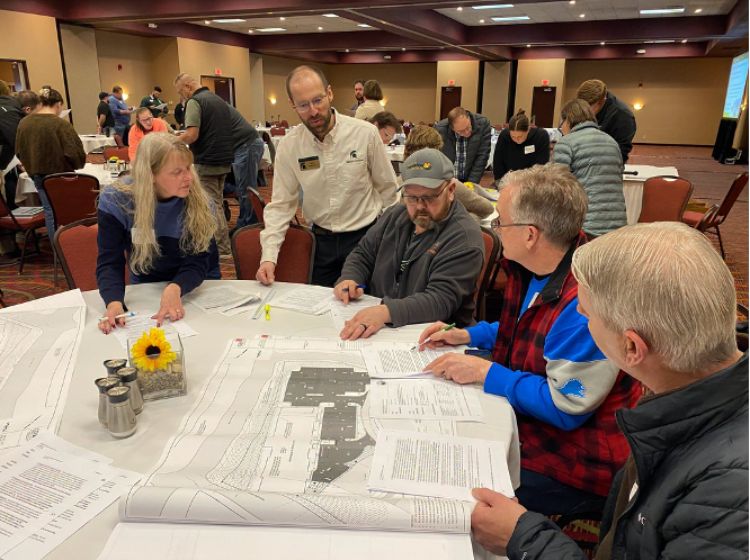
Across Michigan, zoning administrators help guide local land-use decisions, review development proposals, and enforce ordinances that shape how communities grow. Despite the importance of these positions, many enter the role with little formal training.
For nearly two decades, Michigan State University Extension’s Zoning Administrator Certificate (ZAC) Program has filled this statewide need by providing training grounded in Michigan law, zoning administration, and local government best practices.
The program recently received the 2026 Excellence in Community Development Award from the National Association of Community Development Extension Professionals (NACDEP) during their annual summer convening. The NACDEP award recognized findings from a long-term evaluation examining how the ZAC Program influenced past participants and their communities over time.
Building on years of participant feedback, the evaluation compared former participants with local government officials who had not completed the program. When compared, participants reported stronger knowledge and confidence across nearly all areas of zoning administration while describing benefits that extended into the communities they serve.
Meeting a statewide need
Zoning administrators are required by state law for more than 1,000 units of government in Michigan and are typically responsible for reviewing development proposals, preparing reports for local boards, enforcing ordinance requirements, and ensuring all decisions are consistent with local regulations. From the start, the ZAC Program was designed to prepare these professionals for their unique roles often at the intersection of development pressure, public scrutiny, and legal responsibility.
After launching in 2009 as a collaboration between faculty and MSU Extension educators affiliated with the MSU Land Policy Institute, the program fully transitioned to MSU Extension in 2019. Today, the ZAC Program blends live webinars and self-paced online modules with an in-person training portion. After completing the full breadth of the program and successfully passing an exam participants receive a certificate of completion.
Building confidence and strengthening decision-making
Michelle Parkkonen, AICP, managing director of technical assistance programs with the Michigan Economic Development Corporation (MEDC), said the ZAC Program strengthened her understanding of land-use regulations and helped her navigate increasingly complex development issues.
Her experience reflected broader findings from the evaluation, with many participants reporting an increase in job satisfaction, expanded leadership responsibilities, and new career opportunities after completing the program.
Notably, she also recognized benefits from the program extending beyond her personal professional development, influencing the way she helps communities approach future opportunity.
“ZAC delivers results that matter for economic growth,” Parkkonen continued. “Communities with predictable zoning and strong customer service, core outcomes of ZAC training, are consistently more competitive in attracting community-driven development.”
Reducing risk for local governments
Douglas Kuhlman, a recently retired zoning administrator and code compliance officer who served southwest Michigan for nearly 20 years, said training proved especially valuable when legal challenges arose. Throughout his career, Kuhlman encountered disputes that reached district and circuit courts, the state boundary commission, and other legal venues.
“A small error made on behalf of a municipality can prove to be very costly,” Kuhlman reflected. “I am happy to say that I believe it was because of my training and our expert legal teams that the municipalities came out on top in these cases.”
Many alumni echoed Kuhlman’s experience, indicating the program also helped them reduce legal risks for the communities they served. Participants reported taking steps to improve documentation, proactively keep ordinances current, and ensure decision-making was based on established community standards.
Enduring impacts, stronger communities
The long-term evaluation explored how participants applied what they learned from the ZAC Program once returning to their communities. Many respondents noted updating their local plans, ordinances or policies, along with improving their application and review processes for potential development. Others described taking action to streamline collaboration with partner agencies and strengthen public engagement efforts.
Katie Gruenberg, AICP, planning director for Manistee County, completed the ZAC Program when she began her career in the department. Under her leadership, all newly hired planners and code enforcement officers participate in the training.
“The program helps ensure our staff are prepared to serve as professional, knowledgeable, and confident zoning administrators for the communities that have entrusted us with that responsibility,” Gruenberg explained.
She also shared that she frequently recommends the ZAC Program to other communities beyond her jurisdiction when they hire new zoning administrators.
“I believe it is one of the most valuable professional development opportunities available in Michigan for zoning administration and local land use regulation,” she said.
The evaluation results also highlighted a continued need for programs like it in Michigan, with many of the nonparticipant local government officials surveyed indicating interest in attending in the future.
Looking ahead
As Michigan communities continue to navigate increasingly complex land-use issues, demand for zoning education remains strong. In 2027, the ZAC Program will expand to offer two learning cohort options for participants, with in-person sessions held in Bay City and at Crystal Mountain Resort in Thompsonville.
Learn more about MSU Extension’s Zoning Administrator Certificate Program by visiting canr.msu.edu/ZAC.