Mycotoxins in feed Part 2: Key mycotoxins that matter in swine
 Print
Print Email
EmailInspired by a very wet Michigan spring, this series provides a refresher on mycotoxins, their effects and mitigation in pig production.
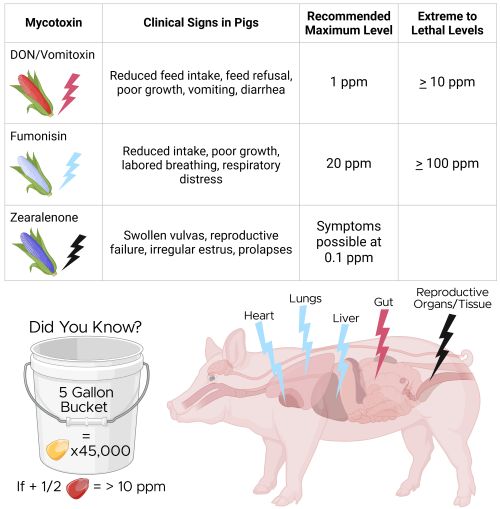
In part 1 of our series, we introduced the three most prevalent mycotoxins in feed affecting pigs: deoxynivalenol (DON), also commonly called vomitoxin, fumonisin and zearalenone. This article will dig a little deeper into what you should know about these mycotoxins as a producer. It’s important to be familiar with the symptoms of mycotoxicosis because it is not always obvious that feed is contaminated — it takes very little to affect pigs. It can be an invisible threat to pig health.
Vomitoxin (deoxynivalenol, DON)
What you see in the barn
Your pigs are suddenly eating less than normal and may even refuse to eat. In feeder pigs, there is very little weight gain or possibly weight loss, and pregnant sows may have significant weight loss and abort. In severe cases, pigs may have diarrhea or vomiting and die suddenly.
Vomitoxin/DON in feed
Vomitoxin primarily targets epithelial cells in the gastrointestinal tract and affects the immune system. For this reason, nursery pigs, with their immature gut and immune systems, are the most sensitive to vomitoxin. It is recommended that the feed contain less than 1 ppm (1 mg/kg). As concentration increases, so do the effects. When vomitoxin reaches 5 ppm, you will likely see feed refusal; at 10 ppm, you will see more extreme symptoms such as vomiting, and at very high concentrations, death is possible.
Fumonisin
What you see in the barn
Your pigs are eating less but not refusing feed. A few days later, some pigs seem lethargic and seem to be breathing hard with an open mouth, nearly panting. All pigs are growing more slowly than normal. In severe cases, pigs experience respiratory distress with mucous membranes of the mouth and nose appearing bluish from the lack of oxygen. Pregnant sows may abort, and some pigs may die suddenly.
Fumonisin in feed
It is recommended that the feed contains no more than 20 ppm. With increasing concentration, we see an increase in symptoms. Once the feed exceeds 100 ppm, pigs will exhibit extreme symptoms such as Porcine Pulmonary Edema (PPE), and it can be fatal.
Zearalenone
What you see in the barn
You notice your sow herd is not performing as usual. There seem to be more abortions, more stillbirths and mummies, and litters seem smaller than typical. Among piglets, gilt piglets have swollen, noticeably red vulvas (vulvovaginitis). Breeding females waiting to be bred seem to be in heat when they shouldn’t be while others have a delayed heat cycle. If you own boars, you may notice what appears to be mammary development and, in extreme cases, a complete loss of libido. In weaned pigs and finishing hogs you may notice prolapses (rectal and vaginal) are more frequent.
Zearalenone in feed
Zearalenone is non-steroidal and mimics estrogen by binding to estrogen receptors making the body think there is more estrogen than there is. Estrogenic symptoms can occur at concentrations as low as 0.1 ppm, and severe symptoms such as prolapse and reproductive dysfunction can occur at 1 ppm. Boars are generally more resistant, with impacts on libido and testicular health rarely occurring unless extreme levels exceeding 40 ppm are fed.
One mycotoxin is rarely the whole story
If a feed test comes back positive for one mycotoxin, assume others are present too. In Michigan testing, 93% of feed samples in 2017 — and every single sample in 2018 — were contaminated with vomitoxin, and every sample contained at least four different mycotoxin types according to Fusilier et al., 2022.
This matters because mycotoxins can make each other more dangerous. Most safe-level guidelines are based on studies of a single mycotoxin at a time, but research shows that combinations can be toxic even when each individual mycotoxin is under its recommended limit according to Holanda & Kim, 2021. In other words, a “safe” level of vomitoxin plus a “safe” level of fumonisin or zearalenone in the same feed may not be safe at all.
The takeaway: don’t stop at a single-toxin test. Ask your feed supplier or nutritionist for a full multi-mycotoxin panel — it’s the only way to know what your pigs are actually eating.
Recent research of interest
Since our last articles on vomitoxin and zearalenone in 2019, research has continued to reveal impacts on pig health and production.
|
Vomitoxin (deoxynivalenol, DON)
|
Even at low doses, vomitoxin ramps up inflammation and damages gut health — this shows up in blood markers and gut tissue, not just in growth numbers (Zhang et al., 2025) Vomitoxin can quietly cancel out your PRRS vaccine. In one study, piglets fed a high-vomitoxin diet responded to PRRS infection almost the same whether or not they’d been vaccinated (Pierron et al., 2023) Sows on contaminated feed pass vomitoxin to piglets through colostrum — meaning a contaminated sow diet is also a contaminated piglet diet, from day one (Trevisi et al., 2020) |
|
Fumonisin |
The more fumonisin in the feed, the more growth you lose, and losses accelerate sharply once feed exceeds about 33 ppm (Rao et al., 2020) Even when you don’t see a growth hit, 30 ppm is enough to disrupt gut bacteria in weaned pigs — meaning a “normal-looking” pig can still be compromised (Zeebone et al., 2023) |
|
Zearalenone |
Zearalenone doesn’t stay in the gut — it crosses into the brain and can alter hormone signaling there, which may help explain the wide range of reproductive symptoms seen in the barn (Gajecka et al., 2026; Yuan et al., 2026) The reproductive damage can outlast the exposure. Microscopic changes to reproductive tissue have been shown to keep affecting fertility even after zearalenone is removed from the diet (Soffa et al., 2022) |
Important points
- There’s no tell-tale sign of mycotoxicosis with frequently observed symptoms overlapping with other illnesses, so your first call should always be to your veterinarian.
- Mycotoxins can interact with each other, causing individual mycotoxins to become more toxic and lowering the threshold for what is considered safe
- It takes very little contamination to cause a lot of harm; consult with your feed supplier about testing and mitigation if you have concerns.
Articles in this series
Mycotoxins in feed Part 1: A quick guide for pig producers
Mycotoxins in feed Part 2: Key mycotoxins that matter in swine