PFAS in dairy farming
 Print
Print Email
EmailMSU Extension is here to help producers impacted by PFAS contamination.
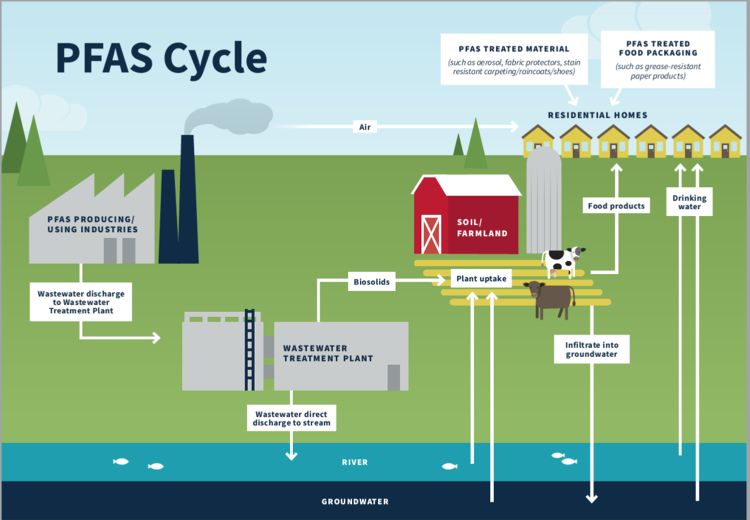
Per- and polyfluoroalkyl substances otherwise known as PFAS or “forever chemicals” are a large class of manmade chemicals that are commonly used for their water, oil and stain-resistant properties. These chemicals can be found in a wide range of products like firefighting foam, cosmetics, food packaging, non-stick cookware, carpeting, textiles and more.
PFAS are still in use today and don’t break down significantly in the environment, but they can move, particularly through the water cycle. Some PFAS can build up in our bodies, which can lead to health risks. Therefore, breathing, drinking or eating food contaminated with PFAS is a concern. Although more research is needed, some human health studies have shown that high exposures to certain PFAS may:
- Increase the chance of thyroid disease
- Increase cholesterol levels
- Change the body’s immune response
- Increase the chance of cancer, especially kidney and testicular cancers
- Lower a woman’s chance of getting pregnant
- Increase the chance of high blood pressure in pregnant women
How do PFAS get onto farmland?
PFAS have entered farmland through several different pathways including land application of materials containing high levels of PFAS, such as biosolids, paper sludge and tannery waste. Other pathways include irrigating with contaminated water and potentially though the application of pesticides, herbicides, septage and precipitation, although more research is needed to understand the extent of soil contamination resulting from these pathways. Since 2021, Michigan has implemented a PFAS interim strategy to limit the land application of biosolids with high levels of PFAS. Prior to 2021, some biosolids may have contained high levels of PFAS and have been applied to some farmland across the state.
PFAS in dairy products
Most food screening levels focus on PFOS concentrations in milk, beef and eggs because PFOS is one of the more toxic chemicals and that is where the most research has been conducted. Long chain PFAS, such as PFOS, accumulate in cattle because they are re-circulated through the enterohepatic cycle, not largely excreted through urine like other PFAS. Milk is a major excretion route of PFOS in contaminated cattle because it is rich in proteins and PFOS like to move with proteins. In most cases, animals switched to clean feed and water have reduced PFOS secretion enough to again produce saleable products, although this may take up to a few months for the accumulated PFOS to clear from blood.
In 2024, Consumer Reports investigated grocery store milk in five states known to have groundwater contamination of PFAS, Michigan being one of them. While they don’t report exact detection numbers for all the samples, Consumer Reports stated there were detections of PFOS and PFOA in six milk samples, with the highest being 84 ppt PFOA and 60 ppt PFOS. It is important to understand that while we don’t want to have any PFAS in our food, this result is hardly surprising as PFAS can be detected in soils across the globe, even in Antarctica where no one has manufactured or disposed of these chemicals.
Currently, there are no federal or Michigan food safety standards for PFAS, however, some states and countries do have regulations or guidelines in place. In Maine, the Center for Disease Control has an action level of PFOS in beef (3.4 ppb) and milk (210 ppt). These action levels guide the decision to allow a farm’s products to be sold in the commercial market. For comparison, in the Europe Union (EU), the regulatory threshold for beef is 0.30 ppb PFOS and there is an indicative level of 20 ppt PFOS in milk. The large difference between the thresholds in the EU and Maine is due to different toxicity values (a toxicity value is a measure of a substance's harmful potential) used in the calculations. Expect these thresholds to decrease as more research is conducted and new toxicity values are adopted.
What can be done about PFAS contamination?
PFAS in the water can be filtered out but is probably not feasible for medium to large scale farms due to high volume and flow rates. A more realistic option is to find a clean water source, possibly by putting in a new well utilizing a different aquifer.
While there are not yet practical options for removing or destroying PFAS from the soil, there are management strategies available to help deal with PFAS contaminated land. For example, some plants, such as grasses, readily uptake PFAS while others do not. Corn grain has repeatedly shown very little PFAS accumulation, however, the leaves do accumulate PFAS. If you have some contaminated fields, it would be better to grow corn grain on the land with higher levels of contamination and use the less contaminated land for harvesting corn silage, haylage or grazing animals.
Because the nature of PFAS could lead to uptake and bioaccumulation in plants and animals, even low levels of PFAS in the soils or water could result in elevated concentrations within crops and/or animals. PFAS may build up over time in animal tissues and could be present in their meat, milk and eggs. Animals that are grazing grass on contaminated land are of particular concern because of increased soil ingestion when grazing and a relatively high transfer factor of PFAS from soil to the leaves of grass species.
MSU Extension is here to help producers impacted by PFAS contamination. MSU Extension can have confidential conversations on determining risk and strategies to mitigate PFAS contamination, and sample agricultural water and soils at no cost to the farm. Visit our website at https://www.canr.msu.edu/pfas/ or contact Faith Cullens-Nobis at 517-388-1078 or cullensf@msu.edu for more information.