Rolling the Dice: Exploring Advocacy Campaigns through Policy Quest
 Print
Print Email
EmailPolicy Quest brought together food policy council members to play out advocacy actions in an interactive activity. This event was presented by the Equitable Community Food Assessment Cohort, hosted through the Michigan Local Food Council Network.
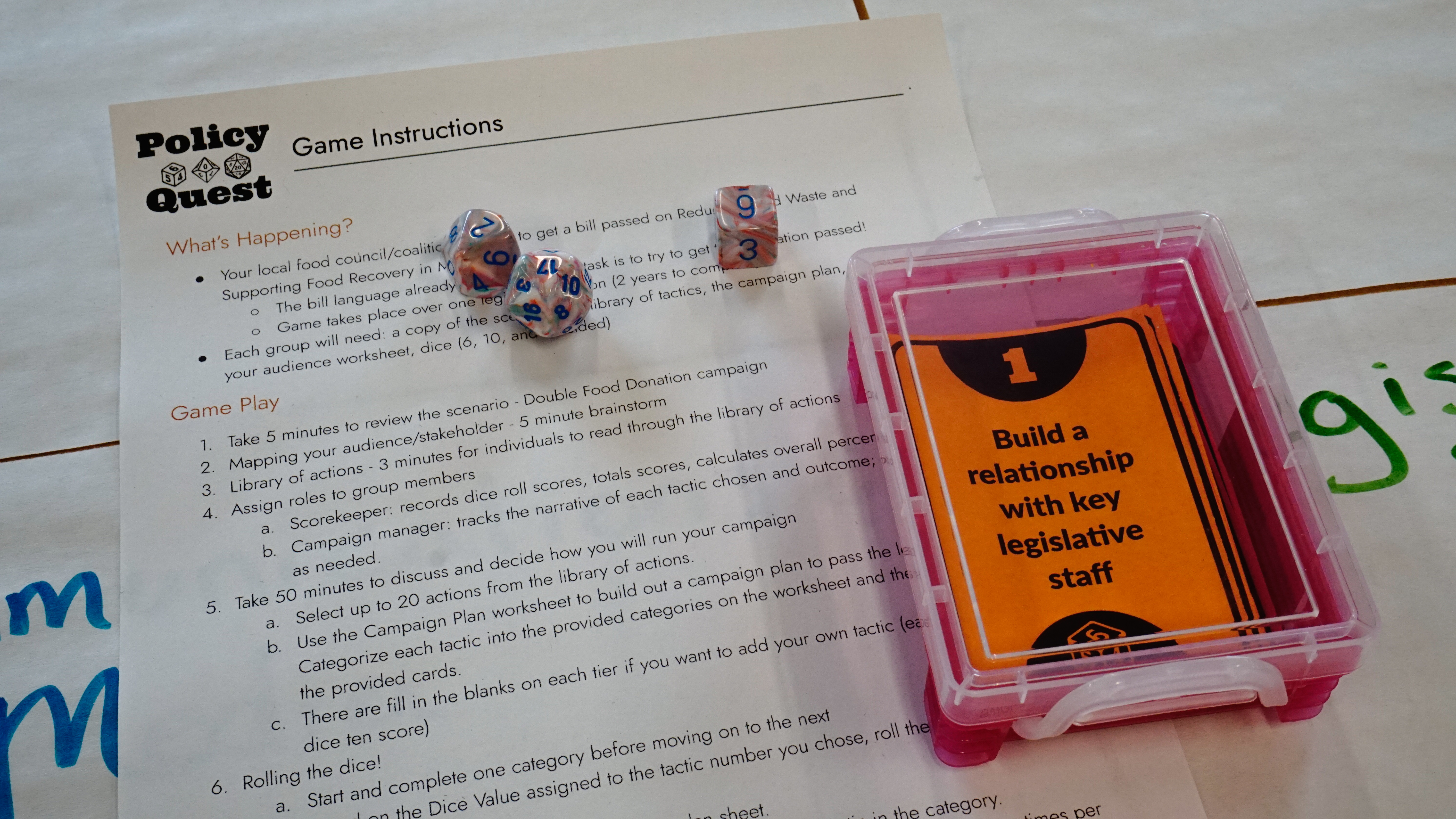
On June 26, 2026, over 20 participants gathered at Michigan State University to participate in an interactive Policy Quest. This event brought together people from across the state, including those involved in local food policy councils and the Michigan Farm to School and Early Care Network, to learn more about how to effectively advocate for community driven state-level policy change.
“Policy change can feel complicated, so our goal is to make the process feel more approachable,” Lindsey Scalera, Director of Policy and Leadership Education, Assistant Director of Policy of Michigan State University Center for Regional Food Systems, said. “Although information about advocacy is widely available, many people still struggle to decide what actions will have the greatest impact, or where to start.”
Modeled after role-playing games like Dungeons & Dragons, Policy Quest created a way for participants to experiment with different advocacy strategies and develop connections with each other. To begin the Quest, attendees broke up into small groups and, using a pre-drafted bill as an example, mapped out their audiences and the political landscape to help guide their campaigns. Individuals would then select an advocacy action, such as collecting impact stories, organizing a day of action, or finding a legislative sponsor, and then roll a die to determine how risky or time-consuming an action would be based on values pre-assigned to each action. Different types of dice – six-, ten-, or twenty-sided – were used depending on the “weight” of the action, and the total number of points at the end determined how successful a group’s campaign was in advancing their policy. Groups whose efforts were over a certain threshold succeeded in turning their bill into a signed law. Participants saw in real time learn how a combination of small steps and bigger risks can help build momentum toward policy change.
“I loved the game as a way for a group to work through policy goals and options for taking action,” one of the attendees shared through the evaluation form.
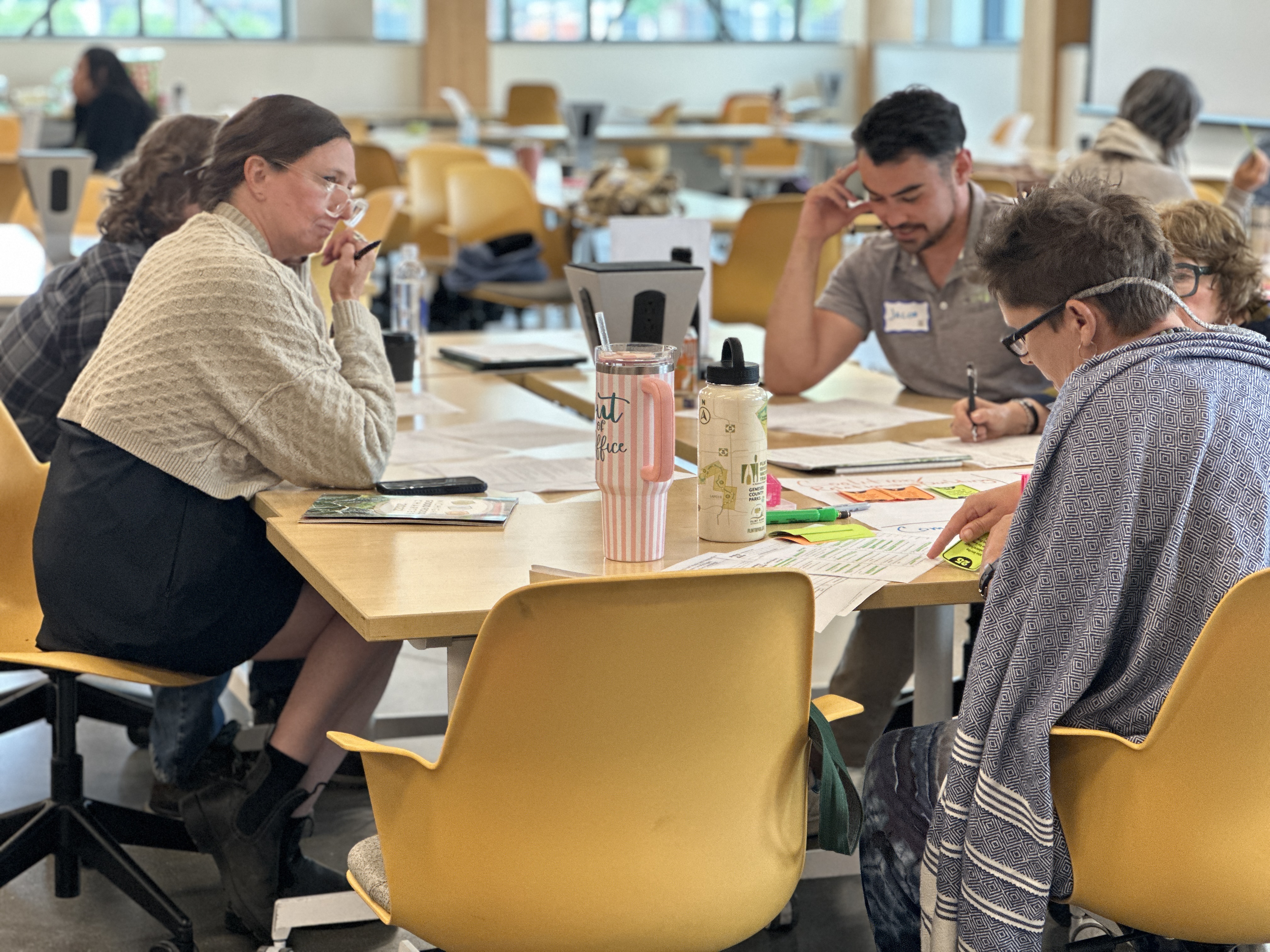
The morning session primed participants for this activity; food council representatives discussed their experiences with current advocacy issues in their communities. For example, the Allegan Food Alliance sought advice on how to connect with individuals beyond a community survey. Ideas uplifted by other council members included listening sessions, meeting with governing boards, and even performance pieces to build authentic connections and relationships. This facilitated conversation encouraged knowledge sharing from other participants to provide ideas towards possible solutions.
This day-long event was organized as part of the Equitable Community Food Assessment (ECFA) Cohort, hosted through the Michigan Local Food Council Network. The ECFA Cohort was designed to help food policy councils and community groups who have been doing the work outlined in the ECFA toolkit. This event was part of the learning process to develop advocacy skills to make that action plan a reality.
“We learned a lot about how to run this and plan to do work on several more iterations with different groups this fall!” Scalera said. “If you missed this opportunity, keep your dice warmed up!”
Interested in learning more? Check out the Michigan Local Food Council Network Monthly meetings, on the third Thursday of each month. From there, get involved with your own local council to be a voice in your community!
About the Michigan Local Food Council Network
The Michigan Local Food Council Network (MLFCN) brings together food councils to build their individual and collective capacities to work on food and food policy issues, operate effectively, and engage their communities, through peer-to-peer learning. Learn more at foodsystems.msu.edu/mlfcn