Soil Health Advancement for Agricultural Resilience Enhancement (SHARE) project aims to assess resilience of Michigan’s regenerative agriculture
 Print
Print Email
EmailLearn more about regenerative agriculture and the ways it has emerged as a key solution to navigating climatic extremes.
The challenge: Michigan’s changing climate
Future climate projections for Michigan indicate rising temperatures and variable precipitation that often lead to extended droughts, floods and erratic seasonal extremes that disrupt field activities, severely affecting crop yields and producer profitability. Michigan’s agriculture is exceptionally diverse, ranging from row crops to specialty crops such as fruits, vegetables, seed corn, and livestock. Because of this diversity, climate impacts vary by sector, requiring specific, targeted solutions.
The role of regenerative agriculture
To navigate climatic extremes, regenerative agriculture has emerged as a key solution. Regenerative agriculture begins with soil conservation to actively rebuild soil health and support vital ecosystem services and aims to improve the environmental, social, and economic outcomes of sustainable food production.
Core practices include no-till, cover cropping, diverse crop rotations, organic amendments, inclusion of perennials, agroforestry, crop-livestock integration, and managed grazing. Agricultural soil can act as either a source or a sink of greenhouse gas emissions depending on how we manage it.
Thus, regenerative agriculture focuses on improving soil health by increasing soil organic matter content, decreasing carbon dioxide and nitrous oxide emissions, enhancing nutrient cycling, and improving water availability for crops.
Previous research also showed that regenerative agriculture increases biodiversity and improves ecosystem functions in local watersheds, resulting in a net-positive environmental benefit. For instance, one of our previous studies here at Michigan State University (MSU) found that no-till can enhance groundwater recharge relative to conventional tillage, thereby improving aquifer storage and supporting groundwater-dependent ecosystems such as wetlands.
The SHARE project to address this challenge
Many Michigan producers are already adopting one or more regenerative agriculture practices to help address extreme weather events. While past studies suggest these practices are most effective when implemented together, it remains unclear how they interact and how soil health can be managed to enhance soil moisture and nutrient cycling under extreme events.
The Institute of Water Research (IWR) at MSU is leading an interdisciplinary effort to address this gap through the Soil Health Advancement for Agricultural Resilience Enhancement (SHARE) project. Funded by the Agricultural Resiliency Program from AgBioResearch and MSU Extension, in partnership with the Michigan Department of Agriculture and Rural Development (MDARD), the SHARE project aims to quantify and predict how regenerative agriculture can enhance soil health and hydrological functions to mitigate the risks of climate extremes.
Since Fall 2025, the project has collaborated with about 20 producers across Michigan who grow row crops and specialty crops under a wide range of regenerative management practices. To evaluate performance, the research team is comparing two fields with contrasting management for each producer.
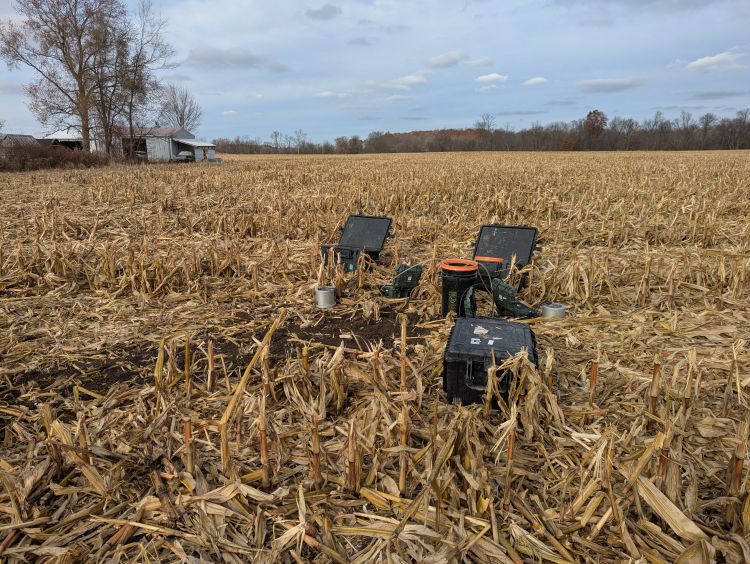
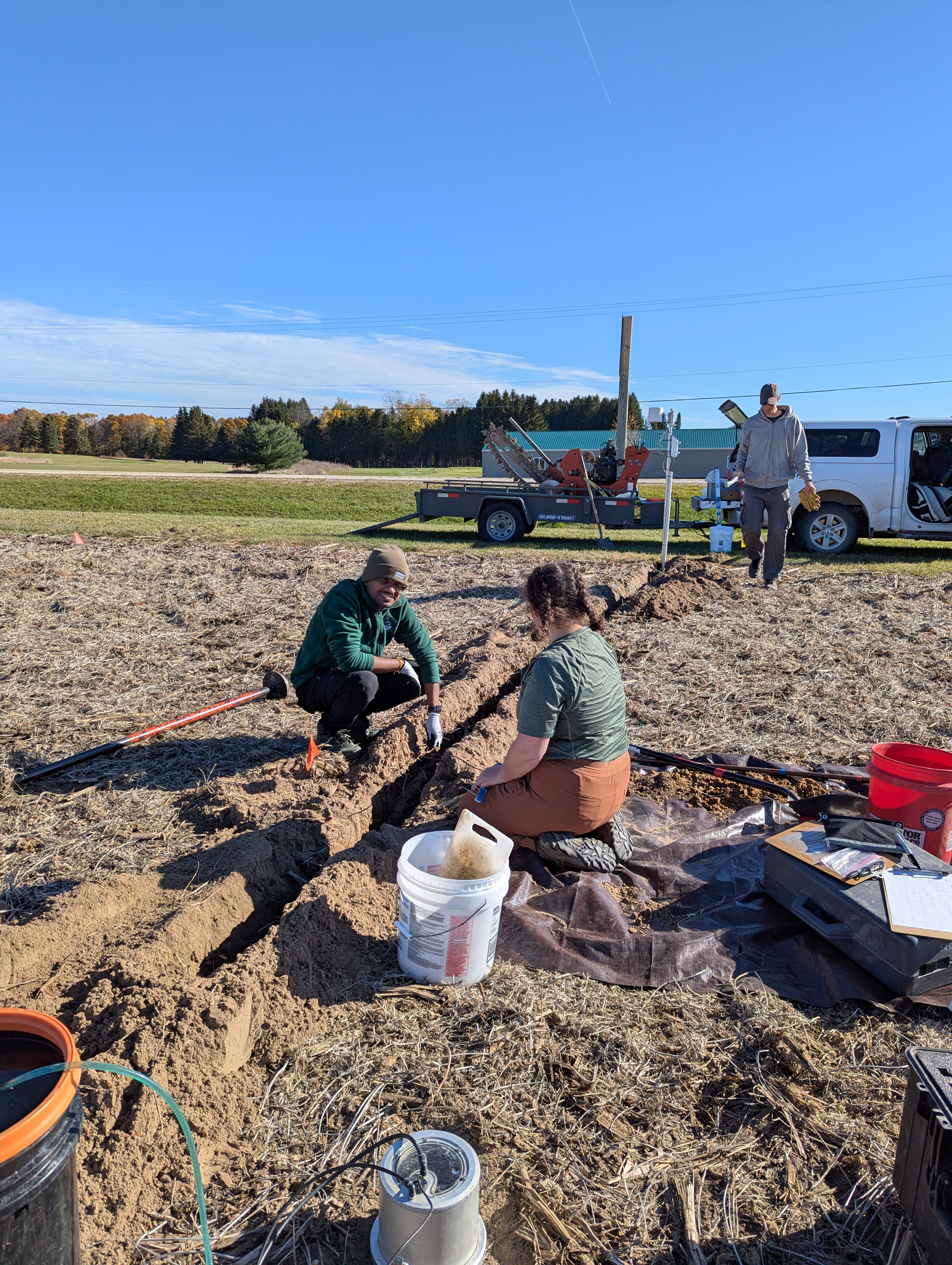
Each field is equipped with soil moisture sensors at four different depths, and the team collects and analyzes soil samples to quantify soil health and hydrological properties. Weather data is gathered from in-field rain gauges and from nearby MSU Enviroweather and National Oceanic and Atmospheric Administration (NOAA) stations. Additionally, producers provide crop management and yield data through structured questionnaires. The research team is evaluating the relationships between soil health and agronomic performance across different soils, climates, crops, and management practices.
To understand how these practices will perform under future climate conditions, the research team will scale up field observations using validated process-based crop models. Crop models are benchmarked using long-term data from the Kellogg Biological Station-Long Term Ecological Research (KBS-LTER) Main Cropping System Experiment. These models, combined with producer-specific soil and crop management information, will help assess the long-term resilience of regenerative agriculture practices.
The project team also includes social scientists studying how on-farm research influences producers’ trust in predictive modeling. Through qualitative interviews, the team will examine how involvement in this participatory modeling process affects producers’ valuation and use of model-based recommendations.
Expected impacts
This work will provide peer-to-peer learning opportunities, real-time soil moisture data, and decision-support tools to producers. Over time, increased adoption of regenerative agriculture can improve soil water-holding capacity, reduce runoff, sediment transport and nutrient losses, enhance groundwater recharge and stream baseflows, reduce irrigation demand and pumping costs, and improve crop resilience and yields under climate stress.
The project will also build stakeholder confidence in model-based decision-support tools through transparent producer involvement and evaluation. The dataset and modeling approach can inform future strategies for improving agricultural resilience, supporting both state agencies and researchers.
Finally, the project will establish a foundation for expanded research, partnerships, and funding opportunities across Michigan and beyond, including applications related to soil water conservation, groundwater management, aquatic habitat protection, and climate-smart agriculture.
Acknowledgement
This work is supported by the Agricultural Resiliency Program, project award number #AG25-019, from AgBioResearch and MSU Extension at Michigan State University, in partnership with the Michigan Department of Agriculture and Rural Development.