Summer patch and necrotic ring spot damaging lawns
 Print
Print Email
EmailSummer patch and necrotic ring spot attack Kentucky bluegrass lawns and can occur under similar weather conditions in Michigan.
Summer patch, caused by Magnaporthiopsis poae, and necrotic ring spot, caused by Ophiosphaerella korrae, are major root diseases of Kentucky bluegrass lawns in Michigan. Because they develop under similar weather conditions and cause similar symptoms, summer patch and necrotic ring spot were known as the Fusarium blight disease complex before the 1980s, and they still can be very difficult to distinguish from one another.
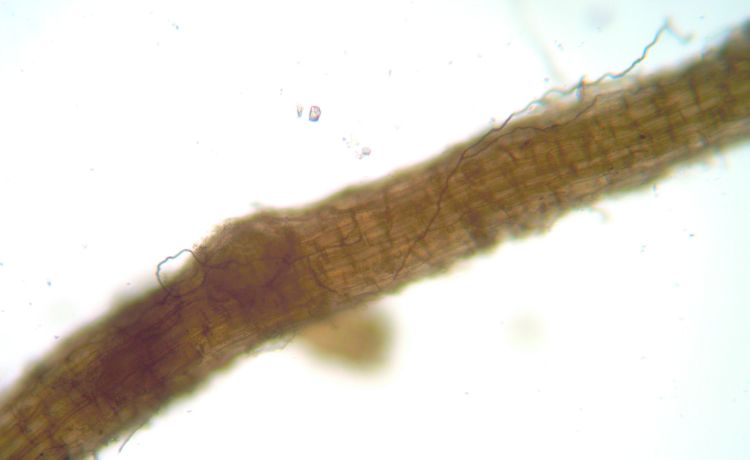
In general, both diseases first appear as small, circular, straw-colored patches or rings. As the disease epidemic continues to develop, infection proceeds outward in a circle or ring, grass in the center of the ring becomes completely necrotic and dies, leaving a sunken depression, and could eventually recover (during mild disease epidemics) or be invaded by less susceptible grasses or weeds. Both diseases can be diagnosed microscopically by the presence of dark, runner hyphae along the roots (Photo 1), which is a characteristic of all ectotrophic root-infecting fungal pathogens of cool-season turfgrasses, including summer patch, necrotic ring spot, and take-all patch. Infected roots, crowns and stolons appear dark and necrotic.
Molecular tools are required to accurately distinguish among those root pathogens. Experienced turfgrass disease diagnosticians can often identify these diseases using multiple pieces of information, including weather conditions, host grass species and cultivars, microscopic fungal structures, and stand symptoms. However, summer patch and necrotic ring spot have very similar symptoms and signs, both macroscopic and microscopic, can occur under the same weather conditions and affect the same hosts, making them very difficult to differentiate. The good news is that the management practices and chemical control options for these two diseases are very similar.
Table 1 describes similarities and minor differences between summer patch and necrotic ring spot. Necrotic ring spot can occur throughout the growing season, and although disease development typically slows or stops during hot summer weather, symptoms can still be visible as straw-colored patches, whereas summer patch symptoms usually appear during the summer months. According to “Compendium of Turfgrass Diseases” by Tredway et al. (2023), necrotic ring spot is often observed in the northern and mountainous regions of the U.S., while summer patch can be found in temperate, transition zones, or subtropical climates.
In Michigan, both diseases have been observed. Plants infected with either disease can display a spectrum of visual field symptoms from wilt to yellow, bronze or straw-colored foliage, depending on the stage and severity of the infection. Symptoms of summer patch appear suddenly after several days to several weeks of hot weather, whereas necrotic ring spot damage develops more gradually. Summer patch is likely to have a higher optimal temperature for disease development based on optimal growth temperature in culture in the laboratory (Table 1).
Necrotic ring spot usually appears as rings that are less than 1 foot in diameter but can be as large as 2-3 feet. Summer patch also typically produces patches less than 1 foot in diameter that may coalesce into large, irregularly shaped areas of dead turf resembling drought stress.
It is important to note that although most severe symptoms of both diseases may be observed during hot, stressful weather when plants with damaged roots begin to decline, the fungi actually infect the roots during cooler, moist weather when field symptoms may not be as obvious or visible at all.
Table 1. Similarities between summer patch and necrotic ring spot in Kentucky bluegrass.
|
Disease |
Symptom development |
Symptoms |
Soil temperature for infection |
Optimal growth in culture |
|
Summer patch |
Summer |
Circular, straw-colored turf, frog-eye patch or ring, or developing into large irregular areas of blighted turf. No leaf lesions. |
65 F to 75 F |
77 F to 86 F |
|
Necrotic ring spot |
Late spring; late summer to early fall |
Circular, ring-like patches of straw-colored turf, frog-eye appearance. No leaf lesions. |
55 F to 70 F |
68 F to 82 F |
Summer patch can sometimes be confused with Ascochyta leaf blight because symptoms of straw-colored turf can show up rapidly. One of the major differences between summer patch and Ascochyta leaf blight is that for summer patch, the entire tillers die and crown tissue becomes dark and decayed, whereas Ascochyta leaf blight is associated with straw-colored foliage, but crowns are still green and unaffected.
Root-infecting pathogens can severely damage roots and reduce their ability to take up water and nutrients, making turfgrass more susceptible to drought and heat stress. Cultural practices should focus on reducing plant stress and improving root health. Avoid traffic to alleviate soil compaction. When roots are compromised, avoid over-fertilizing, instead using slow-release and organic amendments to provide small amounts of nutrients to turfgrass over time. Control thatch buildup and reduce compaction by implementing aerification, which may encourage recovery.
Irrigation is critical for managing root diseases. Use light, frequent irrigation to help alleviate drought and heat stresses. Read more about irrigation and fertilization research conducted at Michigan State University on necrotic ring spot.
Root diseases are among the most difficult turfgrass diseases to control with chemicals because curative applications can provide temporary relief and prevent the disease from spreading. But dead turf may not recover, and re-seeding or sodding is often needed. Additionally, it is challenging to get fungicide active ingredients to the targeted roots and crowns.
For areas with a history of root disease, preventive fungicide applications, if warranted, are usually recommended in the spring when soil temperatures at the 2-inch depth are around 55-65 degrees Fahrenheit for necrotic ring spot and above 65 F for summer patch for five consecutive days. These applications should be watered in to avoid drying on the foliage and to help reach the roots and crowns of the plants. Repeating the fungicide application 30 days after the first application is typically warranted as per fungicide labels. Few efficacious options are available for home lawns, and the most reliable management of root diseases comes with combined cultural strategies. DMI fungicides that are labeled for lawn use would be among the best options.
.jpg?language_id=1)
For areas with severe summer patch damage, re-seeding with perennial ryegrass would be a good option. Perennial ryegrass is not affected by summer patch (Photo 2) because perennial ryegrass is a non-host for this disease. Some Kentucky bluegrass cultivars are more resistant to summer patch than others. Commercially available cultivars with improved resistance include, but are not limited to, Barserati, Bombay, After Midnight, Starr and Midnight.
For additional information on summer patch resistance among Kentucky bluegrass cultivars, refer to the National Turfgrass Evaluation Program.
Reference to commercial products or trade names does not imply endorsement by Michigan State University Extension or bias against those not mentioned.
This work is supported by the Crop Protection and Pest Management Program (grant no 2024-70006-43569) from the USDA National Institute of Food and Agriculture. Any opinions, findings, conclusions, or recommendations expressed in this publication are those of the author(s) and do not necessarily reflect the view of the U.S. Department of Agriculture.