


Systems approach to early soybean planting in Michigan
 Print
Print Email
EmailStrategies for enhancing rewards and reducing risk associated with early planted soybean.
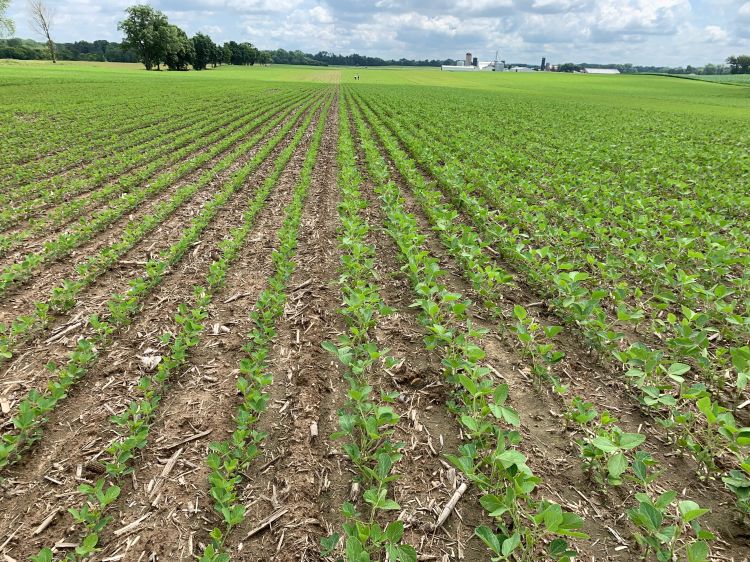
Soybean planting date has been shown to have a large impact on crops’ yield potential in Michigan. The length of the growing season is a limiting factor in Michigan and other northern states. Hence, early soybean planting (starting late April in south-central Michigan) is an important strategy to maximize yield and extend the planting window. While planting early helps maximize yield by forming canopy quicker to improve light interception, retain soil moisture and help control weeds, managing risk that comes with it is crucial to achieve these rewards.
Early planting increases the risk of planting into cold and wet soils, along with a higher likelihood of cold rain events. If a cold rain occurs within the critical first 24 hours after planting, some seeds might not emerge due to chilling injury. Cold and damp soils can also slow root development, seedling emergence, and make soybean susceptible to various insect and seedlings diseases.
These issues indicate that early planting might not be the silver bullet in itself, and a systems approach is warranted to maximize benefits of early soybean planting. This approach focuses on managing the entire production system, including genetics (variety), environment and management practices (i.e., G x E x M interactions) in order to mitigate risks associated with early planting while maximizing yields and minimizing production costs.
There are several management factors to think about under early planting, including field and variety selection, seeding rate and row spacing. Other important considerations include seed treatment, tillage, fertility, pest management and harvest decisions. While these decisions are not unique to early planting, they are especially important as early planted soybeans carry both higher reward and greater risk. Research is ongoing on designing ideal systems for early soybean planting but the following are considerations and management recommendations based on data from trials conducted over the last decade by the Cropping Systems Agronomy lab at Michigan State University.
Variety maturity
Our research has shown that the benefits of early soybean planting can be improved by using varieties that are half to full maturity group longer than what you would typically plant for the area. These longer varieties under early plantings increased the amount of growing degree day accumulation during vegetative as well as reproductive stages and resulted in a greater number of seeds per unit area without reducing seed weight, leading to yield increase. Please see these articles showing data on variety maturity selection under early planting and practical implications for soybean farmers.
Seeding rate
For early planted soybeans, using the same or a slightly lower seeding rate than needed under typical planting is recommended. Early planted soybeans have high yield potential and can better utilize the space between plants to produce more branches, nodes and pods. Additionally, there is also a longer duration for dry matter accumulation compared to those planted later. Based on our data from two different studies conducted over six years, growers might be able to lower seeding rate (about 8-10%) for early planted soybeans or at minimum stay with the seeding rate used at typical planting. It is typically not beneficial to increase seeding rate under early planting if the goal is to maximize profit. Growers can instead use a seed treatment as insurance against non-ideal field conditions. Also, see this article on recommendations for replanting versus repair-planting.
Row spacing and seeding rate adjustment
Our data from a three-year study showed that narrow (15-inch) row spacing can increase yield (by around 10%) over 30-inch rows. There was no planting date by row spacing interaction, meaning yield increase with narrow over wider rows was consistent regardless of the planting date. We also evaluated seeding rates in both row spacings, and although rates did not differ between row spacings at typical planting, early planted soybean maximized yield by increasing seeding rates around 20% in narrow compared to wider rows. Narrow rows have more space between seeds compared to wide rows at same seeding rate, so increasing seeding rate particularly in fields prone to crusting (tilled, low residue etc.) brings seedlings closer and helps push through the crust.
Seed treatment
Our data showed no improvement in yield using a complete seed treatment (consisting of insecticide, fungicide and nematicide) with early planting. Seed treatments protect seeds and seedlings from pests, pathogens and diseases. They also can improve emergence, plant stand and seedling vigor. In one of our trial locations, we observed improvement in plant stand with seed treatment despite no improvement in yield. Nonetheless, we recommend using seed treatment under early planting where cool and wet soil conditions increase the risk of disease and result in reduced seedling vigor and stand loss. For maximizing profits while keeping some insurance against low stands, use either seed treatment or a higher seeding rate under early planting, but not both.
Planting method
Data from eight site-years has shown minimum yield losses while using less-precise planting equipment (e.g., drilled or broadcast incorporated), probably due to soybean plant’s ability to compensate for uneven and lower plant stands (unlike corn). Consequently, precise seed placement is more critical in corn than soybean. Using equipment with less precise seed placement (or faster planting speed) can help with early soybean planting if your other system is busy with corn planting. Considering the yield advantages associated with early soybean planting, growers should emphasize timely planting over precise seed placement, with latter still useful if possible.
Other considerations
Choose varieties with proven high yields in your location and with high warm and cold germ test, early-season vigor and tolerance to sudden death syndrome. Avoid planting in wet soil to limit long-term compaction and do not plant if forecast of cold rain in 24 hours. If possible, avoid using fields that were planted to cover crops as residues can make soil colder and wetter and increase slug population. Ensure a comprehensive fertility program, particularly sulfur application, as reduced atmospheric deposition and limited mineralization under early planting can make sulfur supply insufficient to meet soybean requirements.
Implement a robust weed control strategy, including PRE followed by POST herbicides. This is especially important in non-ideal plant stands. Consider adjusting combine settings as early planted soybean plants might pod close to ground and with thick stems. Also, check crop insurance replanting dates for your area as they have been moved earlier in recent times.
Key takeaways
- Planting soybeans early in the season improves yield or at minimum extends the planting window and reduces yield penalty associated with delayed planting.
- Wet and cold soils can affect stand establishment and yield, therefore consider using fields that are well drained and can warm faster for successful early soybean planting.
- Using equipment that can help plant soybeans early, even with reduced precision in seed placement, is preferable to delaying planting.
- Using narrow row spacings can increase yield benefits even under early planting and can also help with weed control. However, fields with history of white mold might not benefit from narrow rows.
- Using typical or slightly lower seeding rates when planting earlier in the season might not provide maximum yield but can reduce input costs and maximize net income.
- Using seed treatment instead of increasing seeding rate might maximize return on investment under early planting conditions.
- If the goal is to maximize soybean yield, select varieties with half to full unit longer maturity group under early planting. If your goal is to plant wheat or cover crops after soybeans, use your typical or half unit shorter maturity.