The future of farming may be shaded
 Print
Print Email
EmailResearchers find solar panels can reduce crop stress while maintaining yields in commercial vegetable systems.
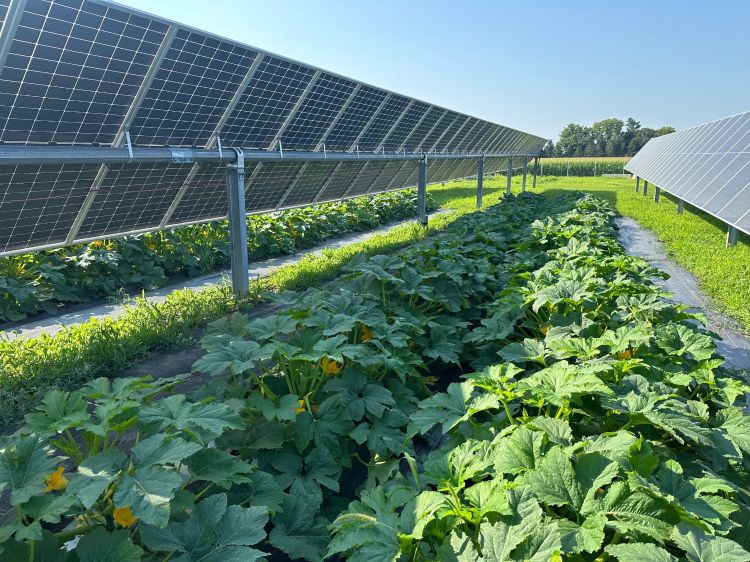
Growing vegetables inside a utility-scale solar farm may sound unconventional, but new research from Iowa State University suggests it is both feasible and commercially realistic.
During Michigan State University Extension’s MI Ag Ideas virtual session “Where Veggies Meet Volts: Commercial Vegetable Production in a Solar Project,” Iowa State University horticulture professor Ajay Nair shared results from a multi-year agrivoltaics study examining whether vegetables can be grown profitably within an operating solar installation without disrupting energy production.
“Agrivoltaics is basically two words combined together,” Nair said. “Agriculture and solar energy production. So how can we grow vegetables and fruits and other crops within a solar farm? That’s basically what we are testing here.”
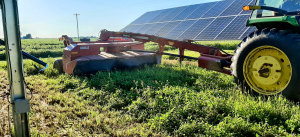
The project, funded by the U.S. Department of Energy, is located on a 10‑acre, 1.3‑megawatt solar farm operated by Alliant Energy on Iowa State University land. Over two growing seasons, researchers produced broccoli, bell peppers, summer squash, strawberries, raspberries and pollinator plantings using standard commercial equipment.
“It was important for us that we are able to farm on a commercial scale,” Nair said. “Not as a small hobby farm, but more as a commercial production system.”
Despite concerns that solar panels may reduce crop yields, the research showed otherwise. While broccoli yields were slightly lower under panels in one season, squash consistently performed better, and peppers showed no significant yield loss. “We are not compromising yield when we grow in this agrivoltaic system,” Nair said. “That’s a big thing to take home.”
Vegetable growth under the panels was often more vigorous. Drone imagery showed taller plants and greater plant volume for broccoli, squash, and peppers grown within solar arrays. According to Nair, partial shade likely reduced heat stress during peak summer conditions.
“What we are finding here is the temperatures in the open field are higher,” he said. “Actually, the temperatures in that solar agrivoltaic system are lower. So it’s a buffering temperature.”
Microclimate data supported this conclusion, showing air and soil temperatures 1 to 2 degrees cooler beneath panels during summer months. This moderated environment also reduced stress-related damage such as sunscald on peppers.
Beyond crop production, the project addressed economics, labor and land use concerns. Researchers tracked labor inputs and material costs and found that labor declined by 28% in the second year as operations became more efficient.
Nair emphasized that agrivoltaics is not intended to replace solar’s primary purpose. “The main moneymaker is energy,” he said. “In my colleague Matt O’Neals words: If you think of agrivoltaic like a burger, the meat is the electricity. Fruits and vegetables are the sesame on the bun.”
Still, he stressed that coexistence matters, particularly for farmers facing solar development pressure. “Many farmers are saying, ‘I’m interested in solar, but I don’t want to lose agriculture,’” Nair said. “When they see this site, the biggest takeaway is that yes, it is possible without compromising scale.”
As agrivoltaics expand, Nair believes research like this can help inform landowners, farmers, utilities and communities searching for practical, dual‑use solutions.
If you have questions about agrivoltaic opportunities, please contact Charles Gould, Michigan State University Extension bioenergy educator, at (616) 834-2812 or gouldm@msu.edu. The MSU Extension Agricultural Bioenergy and Energy Conservation website has additional information on renewable energy.