The loss of Michigan's farmland
 Print
 Email
How housing, renewable energy and data centers are reshaping Michigan’s landscape at time when farmland value is on the rise.
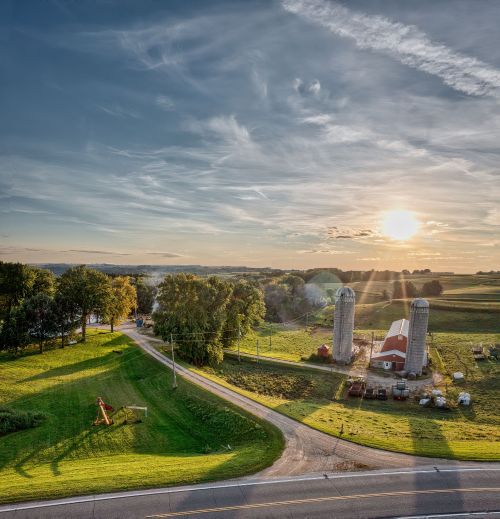
American farmers produce 85-90% of the food and beverages purchased in the United States. Most of the grains, meat, eggs and milk that we buy are produced by our own farmers, and most processed foods use mainly ingredients grown in this country.
Farming is also very important to Michigan. Over 800,000 Michigan jobs are supported by food and agriculture, and the industry contributes $125.8 billion annually to our state economy.
Despite the need for stable farming production in the state, Michigan farmland shrunk by 670,000 acres between 2002 and 2022. This represents a loss of about 6% of Michigan land used for farming. The rate of reduction in farmland acres also does not appear to be slowing, as another 100,000 acres across Michigan were lost in 2024. Similar to a loss of acres, there is also a trend for fewer farms in Michigan. Between 2017-2022, Michigan lost 4.3% of its farms, which was a loss of 2,060 farms.
The USDA’s National Agricultural Statistics Service (NASS) 2022 census reports that cropland acres were down across Michigan by the following amounts:
- Corn acres down by 84,336 acres (3.4% decline)
- Wheat acres down 26,328 acres (5.4% decline)
- Soybean acres down 137,594 acres (5.5% decline)
- Dry bean acres down by 16,237 (7.2% decline)
- Sugarbeets grown on 2,647 less acres than previous years (1.8% decline)
Contributing Factors
There are several reasons that we have less agricultural acres in Michigan.
Some farmers are leaving farming, citing ongoing stress and financial loss as the main causes. Farmers in this same study also reported feeling a gap between themselves and those who do not farm. As food is so easily available at the grocery store and online, there appears to be less connection to the source of food and to the people who produce it, leaving farmers feeling underappreciated and alone. These are also some of the reasons that children of farmers choose not to go into farming. This means, the heirs of farmers are selling land that will not be used for housing or personal needs.
During the current housing shortage in Michigan, land developers may be the highest bidders when farms are for sale. Farm acreage is often seen as a blank canvas for new suburbs and apartment complexes. Of farmland lost in the state between 2011-2021, 86% was converted to housing.
Solar and wind farms have increased across Michigan as well. Companies lease farmland for two to three times as much as a farmer can make from crops like corn or soybeans, with less risk and work. These leases provide steadier income, as these payments are not impacted by drought or storms. Some farmers also see additional benefits to leasing their land because the soil is not damaged beyond repair and can be farmed in the future.
Data centers also need a large amount of land to build on, and developers see farmland as a great resource for these projects. In Illinois, during just the first six months of 2026, 26% of farm managers reported they had been approached about selling farmland for data center projects.
The first hyperscale data center in Michigan is coming to Saline Township, and is being built on what was previously 250 acres of land used for farming.
Farmland values have increased a lot over the last two decades, as lower availability raises the cost. In Michigan, the average value of farm acres increased by 7.8% between 2025 and 2026, rising faster than the national average, which grew by 4.3%.
Higher land values can make farmland ownership unaffordable for many farmers, with beginning and younger farmers particularly likely to be priced out of the market. Overall, it can be more profitable for retiring farmers or family members inheriting acres to sell the land, rather than continue farming. In addition to competition from housing, energy and data center companies, farmers compete with investment firms, which own a million acres of farmland across the United States.
As farmers retire or leave farming, farmland is often transferred, sold or repurposed as part of broader family, estate, retirement or long-term care planning decisions. In some cases, farmland is converted to other uses, and once converted, it is uncommon for the land to return to agricultural production.
Opportunities to Connect
The Farm Management team at Michigan State University Extension offers support and education to help families navigate farming, providing services for those who are just beginning their career to those who are nearing retirement and planning for succession. They can help families make decisions that will save acres of Michigan farmland.
Michigan State University Extension also offers a variety of programming and resources to support yourself or loved ones undergoing mental health distress. If you are a farmer coping with stress or feeling underappreciated and alone, the Managing Farm Stress website at Michigan State University Extension offers resources like referrals to no cost teletherapy and education about recognizing signs of stress. MSU Extension offers programs such as Mental Health First Aid, which can teach you how to support someone who is experiencing a mental health challenge or crisis. The MSU Extension Virtual Health Programs calendar offers a variety of programming to support your emotional and physical health needs.