Tropilaelaps mite information for beekeepers
 Print
Print Email
EmailResources for learning about Tropilaelaps spp., mites that can parasitize various species of honey bees, including Apis mellifera.
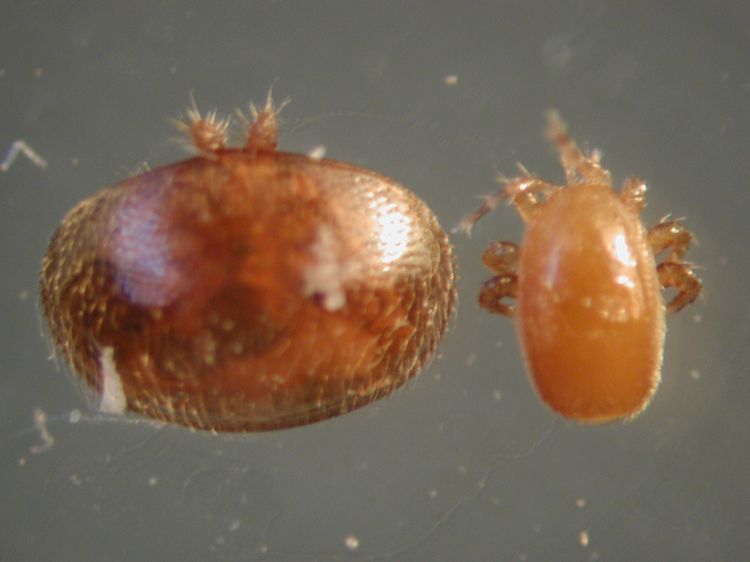
Tropilaelaps mites, which are sometimes referred to as “tropi mites,” can parasitize various species of honey bees, including Apis mellifera, the Western honey bee. Apis mellifera is currently the only species of honey bee found and managed in the United States. Tropilaelaps mites originate from Asia; according to the Tropilaelaps Mites 2024 United States Primer, they have been reported in China, Georgia (the country, not the U.S. state), India, Indonesia (except Sulawesi), Myanmar, Nepal, Papua New Guinea, Philippines (Palawan only) Russia (Krasnodar and Krai only), South Korea, Thailand, Uzbekistan and Vietnam. As of October 2024, Tropilaelaps mites are not known to be in North America. Tropilaelaps mites harm honey bees by feeding on developing bees, which can lead to shorter bee lifespans, and vectoring viruses, including deformed wing virus.
Many apiary inspectors, researchers, Extension educators and honey bee organizations are investing time and effort in learning about Tropilaelaps mites and sharing educational resources. The Apiary Inspectors of America maintain the website Tropilaelaps – Honey Bee Pests with resources and updates. The Apiary Inspectors of America, Auburn University, Honey Bee Health Coalition, Pollinator Partnership, Project Apis m., U.S. Department of Agriculture (USDA) Animal and Plant Health Inspection Service and USDA Agricultural Research Service released a Tropilaelaps fact sheet that describes the mite’s life cycle, what the mite looks like, and what to do if you suspect the mite in your honey bee colonies. The Tropilaelpas Mites 2024 United States Primer from Apiary Inspectors of America, Auburn University, Honey Bee Health Coalition, Pollinator Partnership, Project Apis m., USDA covers Tropilaelaps mite information in greater detail. The Tropilaelaps Training 2024 Documentary Series from Project Apis m. has videos on what beekeepers should know about Tropilaelaps mites and information from Thailand, where the mite is found in honey bee colonies.
Michigan State University Extension coordinates the Managed Pollinator Protection Working Group, which hosted webinars on Tropilaelaps mites and posted their recordings: Tropilaelaps Beekeeper Preparedness with Natasha Garcia-Andersen and Tropilealaps Mite Monitoring, Diagnosis, and Management with Jenna Crowder and James Fulton.
Visit the Tropilaelaps website from the Apiary Inspectors of America
Download Tropilaelaps, A Growing Threat to Honey Bees Fact Sheets
Download Tropilaelaps Mites 2024 United States Primer
Resources and additional information on Tropilaelaps mites
- Tropilaelaps Mites – Honey Bee Pests from Apiary Inspectors of America
- Tropilaelaps fact sheet – Apiary Inspectors of America, Auburn University, Honey Bee Health Coalition, Pollinator Partnership, Project Apis m., U.S. Department of Agriculture Animal and Plant Health Inspection Service and U.S. Department of Agriculture Agricultural Research Service
- Tropilaelpas Mites 2024 United States Primer – Apiary Inspectors of America, Auburn University, Honey Bee Health Coalition, Pollinator Partnership, Project Apis m., USDA
- Tropilaelaps Training 2024 Documentary Series and 2024 Tropilaelaps Training in Thailand Trailer– Project Apis m.
- Tropi STOP webpage – Pollinator Partnership and partners
- Tropilaelaps Beekeeper Preparedness Webinar Recording with Natasha Garcia-Andersen – hosted by Michigan State University Extension
- Tropilealaps Mite Monitoring, Diagnosis, and Management Webinar Recording with Jenna Crowder and James Fulton – hosted by Michigan State University Extension
- Navigating the Mite Spectrum in Honey Bee Colonies: From Harmful Tropilaelaps to Harmless Counterparts – Washington State University Extension
- Found in Translation: Tropilaelaps and Co. by Jay Evans – Bee Culture
- The Auburn Series: How the Auburn University Bee Center is Thinking About Tropilaelaps vs. Varroa Mites by Dan Aurell – Bee Culture
- Expert Talks on Tropilaelaps Mites webinar recording – Apimondia Federation and partners
- Episode 188: Tropilaelaps – podcast episode by Two Bees in a Podcast
- Tropilaelaps: What Beekeepers Need to Know – webinar recording with Samuel Ramsey
- Tropilaelaps the WORST mite of HONEY BEES – video with Humberto Boncristiani from Inside the Hive TV
- Tropilaelaps Infestation of Honey Bees – case definition publication by U.S. Department of Agriculture
- Featured Creatures Tropilaelaps mite – publication from University of Florida
- Varroa mite and Tropilaelaps mite – slide from U.S. Department of Agriculture’s Animal and Plant Health Inspection Service
- First report of established mite populations, Tropilaelaps mercedesae, in Europe – publication from Journal of Apicultural Research
Acknowledgements
This article was published in collaboration with the Managed Pollinator Protection Working Group.
This work is supported by the USDA National Institute of Food and Agriculture, Crop Protection and Pest Management Program through the North Central IPM Center (2022-70006-38001).