Turning Agricultural Data Into Decisions is Goal of MSU Researcher
 Print
Print Email
EmailAnjin Chang, Ph.D., joins the Department of Biosystems and Agricultural Engineering to bring data together from drones, sensors, and satellites to create decision tool for producers.
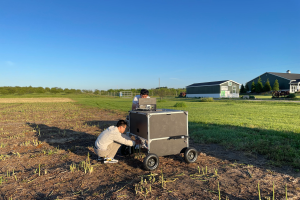
Modern agriculture generates more data than ever before from various sources such as drones, satellites, weather stations, and sensors. Much of this information remains disconnected, underutilized, or too complex to  inform real-time decisions. Producers often struggle to turn these multiple and complex datasets into practical tools that improve crop performance and sustainability. As part of Michigan State University's goal to provide leading technologies and solutions, Anjin Chang, Ph.D., joins the Department of Biosystems and Agricultural Engineering. He is addressing this challenge by developing data-driven smart agriculture systems that integrate diverse data sources and transform them into intuitive decision-making support tools.
Chang is a geospatial engineer whose work combines engineering, data science, and agriculture. With a background in geomatics, remote sensing, and data science, Chang began his research career focusing on the agricultural applications of geospatial and image processing technologies, including crop modeling, yield prediction, and disease and insect damage monitoring for advanced precision agriculture and sustainable practices. Today, his work focuses on transforming large, complex agricultural datasets into actionable insights for producers and researchers.
Over the past decade, Chang has specialized in high-quality imaging technologies, leveraging data collected from drones, satellites, and image sensing systems. By monitoring crops throughout the growing season, his research applies artificial intelligence and advanced modeling techniques to analyze plant health, predict outcomes, and support timely management decisions.
“For data-driven agricultural applications and practices, advanced analytics and artificial intelligence are only as powerful as the data behind them.” said Chang “If data are noisy, inconsistent, or poorly collected, even the most sophisticated models can produce misleading results. My research emphasizes collecting high-quality data and establishing standardized data-processing frameworks for smart agriculture, because reliable data are the foundation for trustworthy decision-making tools that producers can confidently use in real-world agricultural systems.”
As an interdisciplinary scholar in the Department of Biosystems and Agricultural Engineering, Chang collaborates closely with faculty across crop science, entomology, and environmental sciences. His work brings engineering and the agricultural sciences together, demonstrating how cutting-edge technologies can be integrated to solve real-world challenges in food production.
“One of the most exciting aspects of joining Michigan State University is the opportunity to collaborate across disciplines and colleges.” said Chang. “By working with faculty in crop science, environmental science, engineering, and computer science, we can address agricultural challenges that truly require multidisciplinary teams. MSU provides an ideal environment to develop, integrate, and deploy data-driven and AI-assisted technologies that advance smart agriculture at scale.”
Chang’s long-term research focuses on developing a digital agriculture platform that integrates complex datasets, including drone and satellite imagery, weather and soil sensors, and genomic information, as well as implementing AI-assisted tools. His goal is to increase productivity and efficiency by providing intuitive, accessible decision-making support tools for producers. The data portals allow users to upload, share, and visualize their own data, while Chang’s team provides training and guidance to ensure a user-friendly and straightforward experience.