West central Michigan tree fruit update – June 23, 2026
 Print
Print Email
EmailSweet and tart cherries are turning red across the region, and early sweet cherry varieties are ready for harvest this week.
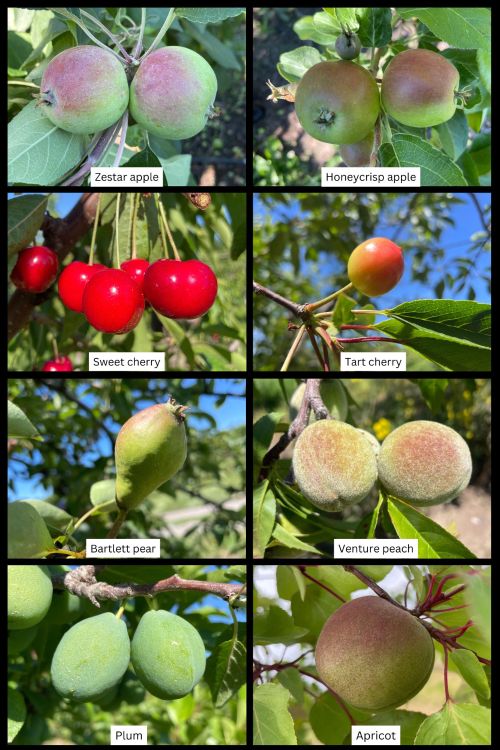
Weather update
Weather has been cooler again this week, and scattered showers are in the forecast for the west central and Grand Rapids, Michigan regions on Wednesday, June 24. Fruitlets continue to grow rapidly for tree fruit crops such as cherry, peach and apple (Figure 1). Based on the Hart Envirodweather station for June 23, current degree-day (DD) accumulation is 1,259 DD42 and 721 DD50. At the Sparta Enviroweather station, current DD accumulation is 1,433 DD42 and 854 DD50.
Temperatures will remain moderate the rest of the week with highs in the 70s and lows in the 60s. Temperatures will increase going into this weekend and early next week with highs in the 80s and lows in the mid- to upper 70s.
Listen to the weather update from Jeff Andresen, MSU climatologist, at the Fruit & Nuts Weather page from MSU Extension.
Weather data was gathered from MSU Enviroweather.
More information and reports on normal weather conditions and departures from normal can be found on the NOAA Climate Prediction Center website, NOAA U.S. Climate Normals website, NOAA Climate Normals Quick Access Page.
Crop update
Apple varieties in Oceana County range from 31-50 millimeters (mm) fruitlet growth stages depending on the location in the county. In Hart, average fruitlet size on June 15 was 43 mm for Zestar and 38.8 mm for Idared. Average fruitlet size for later varieties was 32.8 mm for Gala and 35.8 mm for Honeycrisp. Scout block by block to assess fruit set to determine potential crop load and hand thinning needs.
As a reminder, summer sprays of NAA can be applied to enhance return bloom, especially for varieties that tend to be biennial. Summer NAA applications are recommended at five, seven and nine weeks after bloom for varieties with a heavy crop load or that tend to have poor return bloom. At this timing, fruitlets are about 1 inch in diameter and are no longer sensitive to NAA as a chemical thinner like smaller fruitlets are.
Flower bud initiation has already begun for most varieties such as Honeycrisp and Minneiska, but summer NAA treatments (three applications) of 5 ppm during the next 30 days have been shown to enhance return bloom of varieties like Golden Delicious, Jonagold, Fuji and Empire. Find more information about return bloom sprays.
More information about general apple thinning recommendations and decision-making tools for apple can be found in Honeycrisp crop management - Apples (msu.edu).
Apple scab pressure for primary scab is coming to a close for Hart. For the rain event on June 19-20, zero spores were counted, but because this rain was overnight, it’s possible that the last of the spores were not released at this time. This is because apple scab primary spores typically do not release overnight. Enviroweather is predicting 100% of the spores will be mature and released by June 29. I will count spores again tomorrow after the rain to monitor for the end of primary scab season with two consecutive rain events with spore counts of zero .
Management of summer diseases such as fly speck and sooty blotch is important going forward. A scheduled fungicide program from mid-June through August will be effective against these diseases.
Tart and sweet cherry fruitlets are growing rapidly in Hart and are turning red. For early sweet cherry varieties such as Ebony pearl, average fruitlet size was 28.3 mm this week. Harvest of early sweet cherry varieties will begin this week for some growers.
For tart cherry, average fruitlet size was 20.64 mm. Tart cherries are also starting to turn red. With lighter crops this season, cherries may mature faster.
Spotted wind drosophila (SWD) are being trapped in Oceana County in low numbers, only two per trap. Now that fruit are turning red, they are becoming susceptible to SWD. According to the MSU Enviroweather model for SWD, fruit coloring occurs at 954 to 1,170 growing degree days after bloom (at base 39.2 F). During this period, there is medium risk predicted. High risk of infestation is predicted once fruit are ripe.
For example, if bloom time was on May 4, high infestation risk is predicted to begin on June 28. Higher temperatures also advance pest development and generation time; however, high temperatures in the 90s may slow insect development.
Focus on managing adults with excellent coverage, full covers and tightening spray intervals if populations build. A minimum of seven-day spray intervals under dry conditions is recommended with tighter intervals following a rain or other wetting event if needed. Be sure to rotate chemistries to manage for resistance of SWD. Remember that trap counts are not necessarily an indicator of fruit infestation. It is important to sample fruit to monitor if larvae are present in fruit. Find more information about SWD management.
As tart cherry harvest gets closer, consider when to apply ethephon to loosen cherries for mechanical harvest this year. Find more information and considerations for ethephon applications on tart cherry.
Peaches are growing quickly. Venture peaches at the West Central Michigan Research and Extension Center are almost at the pit hardening stage, with average fruit size at 36.3 mm. Rusty spot (powdery mildew) and bacterial spot management are needed in peaches, particularly if disease pressure was high in 2025.
Growers are starting to hand thin peaches in the region. A general rule of thumb is to leave an average of 6 to 8 inches between fruit (the larger spacing for earlier or hard-to-size varieties). Two or three peaches can be left clustered if there is enough additional limb space and leaves to support their growth. Remove small fruit and leave larger fruit, even if they are clustered.
Plum fruitlets are growing rapidly in west central Michigan. Average fruitlet size for Castleton plums is 29.2 mm. June drop is occurring in plum. Some varieties have heavy fruit set and will need to be hand thinned. If needed, management for black knot is recommended. Bacterial spot symptoms were also observed this week resulting in a shothole appearance in the leaves, which is caused by Xanthomonas arboricola pv. pruni. Varieties differ in their response to infection, and symptoms can include necrotic leaf spots, yellow halos and yellow leaf tips, necrotic spots on fruitlets, or only slight skin-flecking.
Apricot average fruit size is 44.2 mm. Fruit set was very light this year, likely due to cold damage and poor pollination weather during bloom. Protect trees against bacterial spot and canker during this time of the season.
Pear fruitlet size of Bartlett pear at the West Central Michigan Research and Extension Center averaged 27.9 mm. Similar to last week, applications to manage pear scab are needed to cover new green tissue similar to apple scab. Pear scab symptoms and pear psylla adults have been observed in the region. Some damage from freeze injury is also showing up as scaring on the fruit surface.
Additional pest and disease information
Codling moth and oriental fruit moth counts were low or none this week, depending on the site. Obliquebanded leafroller adults were trapped in Oceana County this week with two adults per trap.
American plum borer, lesser peachtree borer and greater peachtree borer had no catches this week at the West Central Michigan Research and Extension Center. Dogwood borer was trapped at an average of nine adults per trap.
Other pests to scout for this week include rose chafer, green peach aphid, European red mites and white apple leafhopper.
European red mite is active in warm and dry conditions which are favorable for egg hatch and larvae activity. Scout for European red mites in apple and pear.
Green apple aphid nymphs and adults were observed feeding on the underside of leaves this week. Scout to determine if management is needed. Many aphid predicators such as lady beetles and lacewings can help keep aphid populations in check. In general, established orchards can sustain thresholds of an average of three to four infested leaves on terminals before fruit damage occurs.
Green peach aphid may be present in orchards this week. Adults and nymphs cause leaf curling and yellowing from feeding on the undersides of leaves. Monitor orchard blocks to determine if treatment is needed.
Scout for rose chafer adults on leaves and fruit where rose chafer typically feed. Damage can be more severe in sandy locations near the orchard edge and grassy areas.
Rosy apple aphid and woolly apple aphid are common pests in our region. Scout for colonies of rosy apple aphid nymphs in fruit clusters. Woolly apple aphids have been observed in orchards this week.
Twospotted spider mites are active in hot and dry weather like have right now. Scout for two spotted spider mites in addition to European red mites. Check for necrosis or bronzing of leaves and webbing on the underside of the leaf. Twospotted spider mites can impact leaf health in combination with European red mite and plum rust mite if feeding is heavy. “Firing” in tart cherry has been associated with this mite complex and can cause branch die back in hot and dry conditions.
For more information about regional reports, please visit the Michigan State University Extension website.
This work is supported by the Crop Protection and Pest Management Program (grant no 2024-70006-43569) from the USDA National Institute of Food and Agriculture. Any opinions, findings, conclusions, or recommendations expressed in this publication are those of the author(s) and do not necessarily reflect the view of the U.S. Department of Agriculture.