New World Screwworm, Cochliomyia hominivorax
June 10, 2026 - MSU Extension Animal Agriculture Educators
 Print
Print Email
EmailWhat is NWS and how do you identify it?
New World Screwworm (NWS) is a pest that infests warm-blooded animals, including livestock, pets, wildlife and, less commonly, people and birds.
NWS flies may travel 6 to 15 miles to find a host and tend to travel along water. The ideal environment for survival and activity of NWS is between 77 and 86 degrees Fahrenheit, with a relative humidity of 30 to 70%. Temperatures consistently below 46 F typically kill the pupae (intermediate stage between larvae and adult fly).
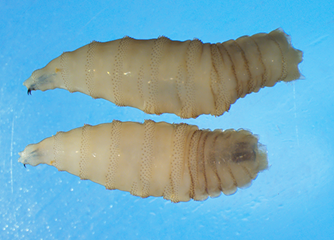
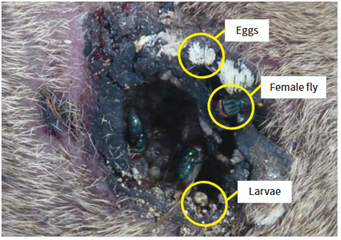
Adult female NWS flies are attracted to and lay their eggs around or in open wounds (as small as a mosquito or tick bite) or mucous membranes (i.e., ears, nose, eyes, mouth or genitals). As these NWS eggs hatch 12 to 24 hours later, they can lead to a deadly condition if not treated, called myiasis (also known as flystrike). Myiasis is the parasitic infestation of fly larvae (maggots) that hatch from these NWS eggs and burrow into and feed on the living tissue of its host.
NWS larvae are difficult to see until three days after hatching and are typically seen by slight motion within the wound. After the NWS larvae feed through two molts (5 to 7 days), the larvae leave the wound and fall to the ground to pupate. Adult NWS flies emerge and feed on vegetation such as flowers or wounds of decomposing tissue.
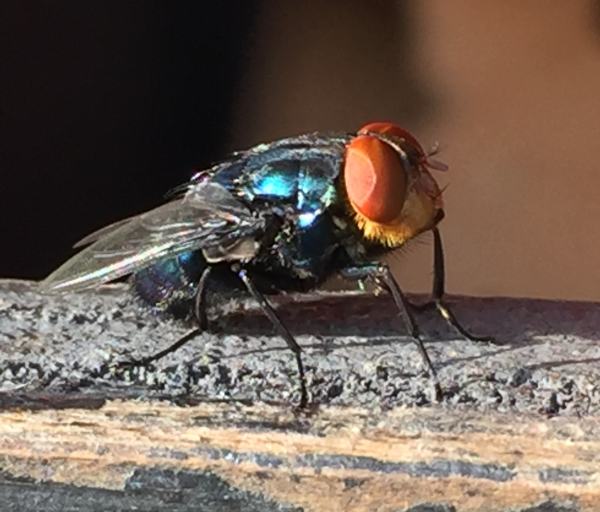
Adult NWS flies have orange eyes, a metallic blue/green body and three dark strips along their back. Male NWS flies may begin mating within 24 hours, while females mate within 3 to 5 days after emerging. Female NWS flies typically mate once and lay one to two batches of eggs. Adult NWS flies live up to 14 days for males and 10 days most commonly for females but may live longer up to 30 days.
Current Status of New World Screwworm (June 2026)
New World Screwworm was eradicated from the United States in 1966. A local outbreak of NWS occurred in the Florida Keys through the fall of 2016 and into the spring of 2017 before being declared eradicated once again. However, since 2022, NWS has migrated North of Panama and reached Mexico in 2024.
The anticipated arrival of NWS into the U.S. finally took place on June 3, 2026. At the time of this writing, multiple NWS cases have been confirmed in the Southern U.S. by the U.S. Department of Agriculture’s (USDA) Animal and Plant Health Inspection Service (APHIS).
- 3-week old calf with larvae identified in its umbilical area (Zavala County, Texas)
- 1-month old calf (Zavala County, Texas) – 5.6 mi away from first case
- Calf (La Salle County, Texas)
- Dog (Lea County, New Mexico) – dog recently traveled to Mexico
- Goat (Gillespie County, Texas)
- Calf (La Salle County, Texas)
USDA APHIS and state officials in Texas and New Mexico are taking immediate action to implement the strategic actions outlined in the NWS Response Playbook to combat NWS. These actions include:
- Forming a unified incident command team to affected areas.
- Establishing a 20 km infested zone around each detection site and implementing quarantines, movement controls, and surveillance.
- Additional sterile male NWS flies are being released on the ground, in addition to the sterile flies being released aerially in and around the affected areas.
- Increased trapping for NWS.
- Surveillance of NWS in wildlife.
- Targeted outreach about NWS in the local areas.
The USDA has activated the NWS sterile fly dispersal facility at Moore Air Base in Edinburg, Texas. Sterile pupae arrived on June 5, 2026, with aerial dispersals beginning on June 9. Previous sterile NWS fly production has relied on a facility located in Panama. The sterile insect technique being used to effectively control NWS takes advantage of the fact that female NWS flies typically only mate once in their lifetime. Mating between a female NWS fly and a sterile NWS fly effectively controls the reproduction and spread of NWS. Sterile NWS flies can be identified by a fluorescent green or orange dye that glows under UV light that has been applied prior to dispersal for monitoring purposes when evaluating traps.
USDA Food Safety and Inspection Service (FSIS) ensures that the nation’s commercial supply of meat, poultry, and egg products is safe, as NWS does not infest meat, fruits, vegetables or other food sources.
USDA is encouraging producers and residents to monitor their livestock and pets for signs of NWS. Look for draining or enlarging wounds and signs of discomfort. Also look for screwworm larvae (maggots) and eggs in or around body openings, such as the nose, ears, and genitalia or the navel of newborn animals. If you suspect your animal is infected with screwworm, contact your state animal health official immediately.
Additionally, U.S. Food and Drug Administration (FDA) has issued emergency use authorization for several treatments of NWS for different species (listed below).
Can New World Screwworm infestations be prevented and treated?
Yes, an NWS infestation can be prevented and treated. If NWS is detected in the U.S., animal owners of affected areas are recommended to implement strategies to prevent infestation, such as:
- Frequently inspect animals for signs of NWS infestation and wounds.
- Treat wounds with approved insecticides immediately upon discovery.
- Check for sharp objects or pieces in pens and equipment used around animals to avoid skin injuries.
- Apply approved insecticides to the umbilical cord of newborns immediately after birth.
- Implement measures to control external parasites. For more information, check out this article on controlling external parasites in cattle.
Additionally, the FDA has a list of approved products for both prevention and treatment.
- Dectomax-CA1 (doramectin): injectable solution for prevention and treatment in cattle.
- Exzolt Cattle-CA1 (fluralaner): topical solution for prevention and treatment in cattle.
- Ivomec (ivermectin): injectable solution for prevention in cattle.
- F10 Antiseptic Wound Spray with Insecticide (benzalkonium chloride, polyhexanide, and cypermethrin): topical solution for prevention and treatment in cattle, horses, sheep, goats, deer, raptors and other wild birds, pet bird and captive wild, exotic and zoo mammals.
Before using any of these products, review their information on the FDA website or consult with your veterinarian. Always follow your veterinarian’s recommendations when treating an animal infested with NWS.
How to report:
If you identify any suspicious wounds, maggots, or infestations, contact the State Veterinarian at the Michigan Department of Agriculture and Rural Development at 1-800-292-3939, or for after-hours emergencies, call 517-373-0440 or 412-847-2255.
If you believe that you may have screwworm, contact your primary health care provider.
Where can I get more information:
More information for producers, veterinarians, and health care professionals can be found by visiting the United States Department of Agriculture Stop Screwworm: Unified Government Response to Protect the United States website.