Statewide Ballot Proposal 26-2: Michiganders for Money Out of Politics
DOWNLOADSeptember 15, 2026 - Eric Walcott, Michigan State University Extension
 Print
Print Email
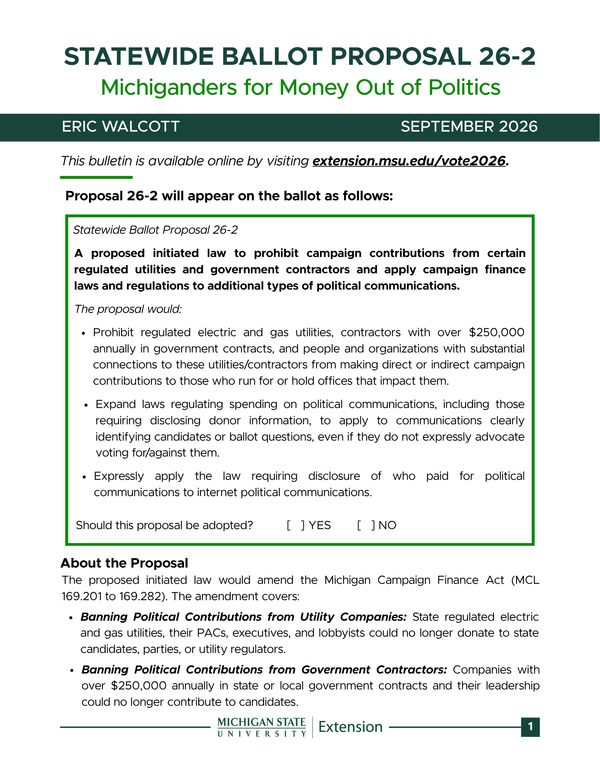
EmailProposal 26-2 will appear on the ballot as follows:
Statewide Ballot Proposal 26-2
A proposed initiated law to prohibit campaign contributions from certain regulated utilities and government contractors and apply campaign finance laws and regulations to additional types of political communications.
The proposal would:
- Prohibit regulated electric and gas utilities, contractors with over $250,000 annually in government contracts, and people and organizations with substantial connections to these utilities/contractors from making direct or indirect campaign contributions to those who run for or hold offices that impact them.
- Expand laws regulating spending on political communications, including those requiring disclosing donor information, to apply to communications clearly identifying candidates or ballot questions, even if they do not expressly advocate voting for/against them.
- Expressly apply the law requiring disclosure of who paid for political communications to internet political communications.
Should this proposal be adopted? [ ] YES [ ] NO
About the Proposal
The proposed initiated law would amend the Michigan Campaign Finance Act (MCL 169.201 to 169.282). The amendment covers:
- Banning Political Contributions from Utility Companies: State regulated electric and gas utilities, their PACs, executives, and lobbyists could no longer donate to state candidates, parties, or utility regulators.
- Banning Political Contributions from Government Contractors: Companies with over $250,000 annually in state or local government contracts and their leadership could no longer contribute to candidates.
- Defining “Electioneering Communication”: Creates a formal definition covering ads that reference candidates and ballot proposals within 100 days of a general election, even without “vote for” language
- Expanding Digital Advertising Oversight: Requires “paid for by” disclaimers on online political ads.
- Increasing “Issue Ad” Disclosure Requirements: Groups spending $5,000+ on candidate or ballot-question related ads must disclose donors over $100.
- Artificial Intelligence (AI) Disclosures: AI-generated phone messages must disclose use of AI for advocacy related to clearly identifiable candidates or proposals.
Summary of Current Law and Proposed Changes
| Topic | Current Michigan Law | Proposed Changes |
| Utility Contributions | Michigan already prohibits corporations and utilities from giving money directly to candidates from their business accounts. However, they can set up a Political Action Committee (PAC), a separate political fund, that collects voluntary donations from employees and executives to give to campaigns. | Covers regulated electric/gas utilities and their PACs, principals, affiliated entities, board members, key executives, lobbyists, and immediate family members. None of these could make contributions to state executive officers, legislators, party committees, candidate committees, or Public Service Commission members (Sec 30a). |
| Government Contractors | Contractors and their affiliated individuals follow standard individual/corporate contribution limits. | Covers government contractors with over $250,000 in annual public contracts, and their key executives, board members, lobbyists, and family members. None of these could contribute to candidates, candidate committees, or candidate affiliated entities. |
| Electioneering Communications Window | Does not separately define "electioneering communications" from general political activity. | Establishes a formal definition for targeted political messages referencing a candidate within 100 days of a general election or 30 days of a special election, regardless of express advocacy. |
| Internet & Digital Media Rules | Lacks explicit statutory definitions for "internet communications" in campaign finance law. | Defines "internet communication" as paid public messages placed or promoted on third-party websites, digital devices, applications, or platforms (Sec 9(5)). |
| "Expenditure" Definition | Applies primarily to spending for messages containing express advocacy (e.g., "vote for" / "vote against"). | Expands "expenditure" to include public messaging that promotes, supports, attacks, or opposes a candidate or ballot question—even without express advocacy terms (Sec 6). |
| Disclaimer & Disclosure Requirements | Standard "paid for by" disclaimers are required on traditional media, but internet disclaimers are not explicitly codified. | Expressly mandates "paid for by" disclaimers on all qualifying internet communications (Sec 47). |
| AI Disclosure Robocalls | Mandates a specific disclaimer, “This message was generated in whole or substantially by artificial intelligence," on prerecorded AI phone messages (Sec 47(7)). | Expands requirements to include advocacy in which the candidate or ballot question is clearly identifiable, even if not named specifically. |
| Issue Ad Donor Transparency | Non-profit groups running issue-focused ads without express advocacy are not required to disclose donors. | Expands disclosure rules to issue ad groups targeting candidates or ballot questions. Once they reach $5,000 spent, they would be required to report spending and disclose donors giving over $100. |
Background
This proposal was placed on the ballot through Michigan’s initiated legislation process, which gives Michigan voters the ability to propose legislation for the ballot through collection of signatures in support of a petition. Initiated legislation petitions require signatures equal to eight percent of the total votes cast for governor in the last election, meaning petitions for this election needed 356,958 valid signatures.
The Michigan Board of Canvassers approved this petition as having sufficient signatures at its July 24, 2026, meeting. Based on the Michigan Constitution, the state legislature had 40 days after that date to adopt or reject the proposal. Since the legislature did not adopt the proposal within the 40 days, it now goes to the ballot for approval or rejection by voters at the November 3 general election.
One potential impact of this proposed legislation would be to limit the ability of regulated electric and gas utility companies and of state and local government contractors to make campaign contributions to candidates for state elected office. The legislation would prohibit these entities from making political contributions and block some individuals associated with them from making contributions.
Not all individuals associated with these companies would be prohibited from making campaign contributions. The proposal specifically lists board members, majority or substantial owners, presidents, CEOs, treasurers or officers who hold similar responsibilities, as well as agents and lobbyists and their immediate family members.
Michigan law currently prohibits corporations from making direct campaign contributions, but political action committees (PACs) acting on their behalf are not prohibited from contributions. This proposal would prohibit contributions to state-level candidates from these PACs.
Another change would impact requirements for disclosure of donors. Currently, groups that run “issue ads” which focus messaging on political topics without telling people how to vote, are not required to disclose their donor information.
In contrast, political action groups campaigning for or against candidates directly using phrases like “Vote for…”, must disclose all donors who contribute over $100 in an election cycle. This proposal would require groups that spend over $5,000 on ads that promote, support, attack, or oppose a candidate or ballot question, even if there is no specific advocacy, to disclose those contributors as well.
Campaign Finance in Other States
In 2010, the U.S. Supreme Court’s Citizens United decision ruled that corporations have a right to spend unlimited money on political speech that is independent of a candidate’s campaign. However, that ruling did not extend the same protection to direct contributions to a candidate.
Since that time, several states have attempted to place restrictions on corporate contributions. State governments have generally been given more freedom to regulate direct contributions to candidates, and some states have placed narrow restrictions on political spending by government contractors (National Conference of State Legislatures, 2016).
For the most part, the changes proposed in this initiative are in line with campaign finance requirements in numerous other states, especially as it relates to contributions from contractors, disclosure requirements, defining electioneering communication, and regulating online communication and adapting to the emergence of AI technologies.
Donor Transparency
According to the National Conference of State Legislatures, fourteen states currently require some level of donor transparency for issue advertisements and electioneering communications paid for by PACs or non-profits.
These disclosure laws generally require organizations to publicly report donor details once a donor’s total contributions reach a threshold as low as $50 in some states (Idaho and Alaska), to $1,000 or more in others (Colorado, New York, West Virginia).
This proposed law would require disclosure of any donor contributing over $100, the same as is required for political advocacy (National Conference of State Legislatures, 2022b).
Corporate Contribution Restrictions
Michigan is one of 21 states that prohibit corporate contributions to campaigns, but corporations can still contribute through Political Action Committees. These PACs are funded through voluntary donations from eligible employees, executives, corporate officers, and families, but not directly from corporate funds or business accounts (Coffey, 2022).
Since 2023, legislation has been introduced in 22 states to prohibit regulated utilities from using customer funds to support political activities (Green, 2025). These do not directly prohibit political spending, but many of these bills specifically prohibit utilities from charging customers for their lobbying expenses and similar political activity.
This proposed legislation would go a step further in prohibiting political contributions from these entities to candidates for state level offices. The proposed ban would apply to Michigan’s publicly regulated utilities, each of which are listed on the MPSC website (Electric Utilities; Natural Gas and Propane Providers).
Contractor Contribution Restrictions
Around 20 other states, including Midwestern neighbors Illinois, Indiana, and Ohio, restrict political contributions from companies that do business with state and local governments in some way. Federal law also prohibits contractors from making contributions to officeholders or candidates for U.S. House, Senate, or President (Norton et al., 2019).
This proposal would specifically prohibit owners of government contractors, as well as board members, executive employees and their families, or agents and lobbyists from making campaign contributions to candidates for state level office. A list of active contracts managed by state agencies is available on the Michigan Department of Technology, Management, and Budget website.
Disclosure Requirements
As of 2022, Michigan is one of 12 states that do not specifically require disclosure of payers of political advertisements and electioneering communication (“Paid for by…”) to appear directly on internet communications (Coalition for Integrity, 2022). States have been increasingly addressing online political activity through legislation, with at least five states enacting new laws in recent years (National Conference of State Legislatures, 2022a).
This proposal would add a specific definition of internet communication to Michigan law and require such disclosure for all online advertisements and electioneering communication.
Electioneering Communication
Michigan is one of 23 states that do not separately define “electioneering communication” from other political communication. Common characteristics of definitions in states that do regulate electioneering communication include identification of a candidate or ballot question, and communications within a specific timeframe close to an election, often 30-60 days, though some include up to 120 days. Most state definitions specify that electioneering communications do not require express advocacy (“vote for”, “vote against”).
Key Debates
Political Influence Concerns
One could ask why the proposal focuses on contributions from electric and gas utilities and government contractors, and not other groups and industries. Proponents argue that contributions from utilities regulated by the state and subject to state oversight may influence elected officials tasked with that oversight in favor of the utility companies.
The state oversees electric and gas utilities separately through the Michigan Public Service Commission (MPSC) because of the natural monopolies they hold. The MPSC exists to protect consumers and promote fairness, transparency, and trust in Michigan’s utility sectors.
Members of the MPSC are appointed by the Governor and approved by the state Senate. The state legislature drafts bills which define requirements and oversight of public utilities.
Supporters of this initiative argue that allowing regulated utilities and contractors to fund campaigns creates a potential conflict of interest when officials who receive contributions are responsible for appointing and confirming regulators and drafting legislation that regulates their activity.
Freedom of Speech Concerns
The biggest question and point of contention between supporters and opponents of this initiated legislation appears to center on the portions that prohibit campaign contributions from those connected to regulated electric and gas utilities and government contractors.
Supporters argue that allowing contributions from those groups and individuals gives them undue influence on political processes that oversee their activities. Opponents argue that restricting their ability to make contributions is a violation of free-speech rights.
The U.S. Supreme Court has typically found that political spending by corporations is protected speech, but courts have allowed narrow laws meant to limit corruption. Some laws banning corporate contributions in other states have been struck down in courts previously, while narrower restrictions on contributions from government contractors have been upheld.
What Your Vote Means
- A YES vote approves the proposed legal changes, barring state-regulated utilities and major government contractors (along with affiliated PACs and key officials) from contributing to state political candidates, while requiring new disclaimers on digital ads, AI robocalls, and candidate-focused “issue ads.”
-
A NO vote keeps current campaign finance laws in place and leaves existing disclosure and advertising rules unchanged.
Because this proposal is a voter-initiated law, if the proposal passes, future changes proposed to this law by the Michigan Legislature would require a three-fourths supermajority in each house in order to pass.
For More Information
Visit the Michigan Voter Information Center (MI.gov/vote) to check your registration status, view your sample ballot, or locate local clerk contact information and polling details.
Visit the Michigan Board of State Canvassers (michigan.gov/sos/elections/bsc) for official meeting records, petition filings, and other information related to statewide ballot proposals.
References
Coalition for Integrity. (2022). The State Campaign Finance Index 2022. https://www.coalitionforintegrity.org/wp-content/uploads/2022/06/The-State-Campaign-Finance-Index-2022-Full-Report.pdf
Coffey, B. (2022). Twenty-Nine States Permit Corporate Campaign Finance Contributions. MultiState. https://www.multistate.us/insider/2022/4/6/twenty-nine-states-permit-corporate-campaign-finance-contributions
Green, S. (2025). Tracking State Legislation to Get Politics Out of Utility Bills. Energy and Policy Institute. https://energyandpolicy.org/tracking-states-getting-politics-out-of-utility-bills/
National Conference of State Legislatures. (2016). Citizens United and the States. National Conference of State Legislatures. https://www.ncsl.org/elections-and-campaigns/citizens-united-and-the-states
National Conference of State Legislatures. (2022a). Campaign Finance Regulation: State Comparisons. National Conference of State Legislatures. https://www.ncsl.org/elections-and-campaigns/campaign-finance-regulation-state-comparisons
National Conference of State Legislatures. (2022b). Electioneering Communications Disclosure Requirements. National Conference of State Legislatures. https://www.ncsl.org/elections-and-campaigns/electioneering-communications-disclosure-requirements
Norton, L. H., Jacobs, R. M., Ryan, J. M., & Owens, D. E. (2019). Pay-to-Play Laws Remain in the Spotlight: Government Contract Eligibility Hinges on Awareness and Compliance. Political Law Briefing. https://www.politicallawbriefing.com/2019/09/pay-to-play-laws-remain-in-the-spotlight-government-contract-eligibility-hinges-on-awareness-and-compliance/