2026 American Bee Research Conference proceedings
 Print
Print Email
EmailConference presentation abstracts highlight current research and Extension work on beekeeping and honey bee health topics. These presentations included research and Extension program updates from Michigan State University.
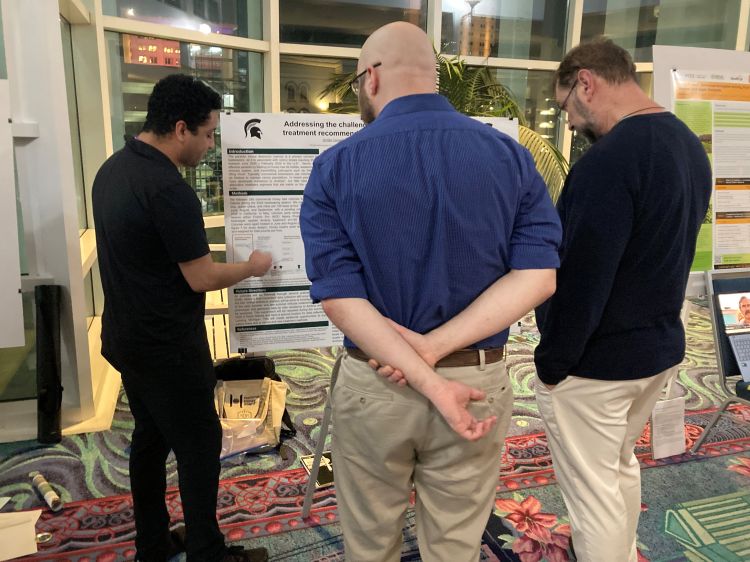
In January 2026, the American Association of Professional Apiculturists held its annual American Bee Research Conference (ABRC) in conjunction with the American Beekeeping Federation’s annual convention in Mobile, Alabama. Bee Culture published ABRC abstracts in two parts: 2026 ABRC Proceedings Part 1 and 2026 ABRC Proceedings Part 2. Bee Culture has also published ABRC abstracts from previous years. These abstracts may be of interest to beekeepers who are interested in learning about apiculture research that is underway and new research findings.
ABRC presentations included Michigan State University apiculture research and Extension. Assistant professor Meghan Milbrath’s graduate student Jordan Cauvel presented a poster, “Addressing the challenge of amitraz resistance: Varroa treatment recommendations for commercial beekeepers.” Apiculture Extension educator Ana Heck gave an oral presentation, “Managed Pollinator Protection Working Group.”
Associate professor of entomology Zachary Huang, PhD, also presented his research “Honey bees crash onto a water surface mostly in an inverted fashion,” which is described in the MSU Apiculture Research Updates February 2026 webinar recording.
The abstracts from the “Addressing the challenge of amitraz resistance: Varroa treatment recommendations for commercial beekeepers” and “Managed Pollinator Protection Working Group” presentations are shared below.
Addressing the challenge of amitraz resistance: Varroa treatment recommendations for commercial beekeepers
Cauvel J, Lee K, Rinkevich F, Milbrath MO
The parasitic mite Varroa destructor (varroa) is one of the primary causes of honey bee colony loss. Most commercial beekeepers have used the miticide amitraz to combat varroa infestations, but in recent years varroa mites have developed resistance. The objective of this work is to evaluate multiple varroa control strategies in a commercial beekeeping operation to develop guidelines for beekeepers, reducing the reliance on amitraz-based products. The 240 honey colonies from one commercial beekeeper were evaluated at four timepoints of the 2025 season. At each timepoint hive health metrics were taken including cluster size, queen status, mites levels, and nosema. Colonies received three treatments during the season: in May, colonies received either amitraz or formic acid; in June colonies received Formic pro, VarroxSan, Formic pro + VarroxSan, Towel Oxalic Acid, or no treatment (N=24 each group). In August (post-harvest), colonies received amitraz, VarroxSan, Formic pro, or Apiguard. Hives treated with Amitraz at timepoint 1 and 2, had significantly higher mite loads when compared with hives that received formic pro at timepoint 1 and 2. However, percentage growth of the colony between timepoints did not differ between treatment groups. These findings confer with previous studies that indicated a resistance to amitraz. This study suggests that relying on amitraz alone is an insufficient miticide strategy.
Managed Pollinator Protection Working Group
Oral presentation
Heck A
Michigan State University Extension coordinates the Managed Pollinator Protection Working Group, which includes university and government professionals from over 20 U.S. states and Canadian provinces. The working group meets monthly to receive professional development, collaborate, and share resources on reducing risks of pesticides to honey bees in agricultural settings and other topics related to managed pollinator health. The working group developed a presentation, online course, and other educational materials for pesticide applicators on how to protect bees from pesticides. Members also received training on crisis communication in agriculture, tropilealaps mite biology and identification, and preparedness and response plans for tropilealaps mites. The North Central IPM Center has supported the Managed Pollinator Protection Working Group since 2020.
Tropilaelaps training for apiculture Extension educators, specialists and other educators
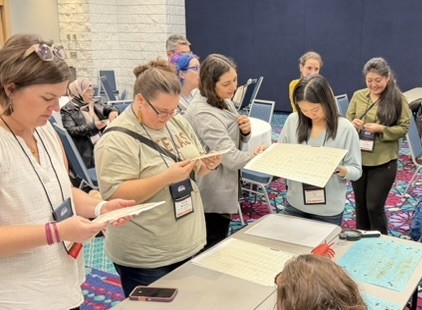
Apiculture Extension educator Ana Heck also coordinated a training prior to the American Bee Research Conference on tropilaelaps mites for the Managed Pollinator Protection Working Group, which is funded by the North Central IPM Center. The training, delivered by the Apiary Inspectors of America, was titled, “In-Person Tropilaelaps Mite Training: Hands-on trainings and preparedness discussions.” This in-person training built on three virtual trainings, two of which have recordings available online: Tropilaelaps Beekeeper Preparedness with Natasha Garcia-Andersen and Tropilaelaps Mite Monitoring, Diagnosis, and Management with Jenna Crowder and James Fulton.
Acknowledgments
This project is funded through the North Central Integrated Pest Management Center.
This work is supported by the Crop Protection and Pest Management Program, project award no. 2024-70006-43569, from the U.S. Department of Agriculture’s National Institute of Food and Agriculture.
Any opinions, findings, conclusions, or recommendations expressed in this publication are those of the author(s) and should not be construed to represent any official USDA or U.S. government determination or policy.