How do we measure livestock odor?
 Print
 Email
Understanding common livestock odor measurements.
As discussed in a previous MSU Extension article on livestock odor basics, livestock odor can affect the quality of life of nearby residents. When odors are frequent, persistent or unpleasant, they may lead to complaints and be considered a nuisance. Understanding how livestock odor is measured helps producers, communities and regulators evaluate odor concerns more objectively.
Unlike many other air contaminants associated with livestock production, odor is difficult to assess because it is a complex mixture of numerous compounds and is ultimately perceived by the human nose. No single compound can fully represent livestock odor. Some compounds, such as skatole and indole, may contribute disproportionately to odor perception even when present at very low concentrations. Consequently, several different approaches have been developed to evaluate livestock odor.
In general, two main approaches are used to evaluate odors. The first relies on chemical measurements, which can be broadly divided into measurements of individual indicator compounds and comprehensive chemical analyses. For instance, hydrogen sulfide can be measured using handheld gas meters and is sometimes used as a surrogate indicator for livestock odor. However, because livestock odor consists of complex mixtures of many odorants, the concentration of hydrogen sulfide often correlates poorly with the overall odor experienced by nearby residents.
Advanced analytical techniques, such as gas chromatography (GC) and gas chromatography-mass spectrometry (GC-MS), can simultaneously identify and quantify multiple odor-causing compounds. These methods provide valuable information about the chemical composition of livestock emissions but are often expensive and time-consuming. Moreover, even sophisticated instruments can measure only a fraction of the hundreds of compounds that may contribute to livestock odor, and they cannot fully capture how people perceive those mixtures. As a result, sensory-based odor measurement is widely used in livestock odor management. Rather than measuring individual compounds, this approach evaluates odor as a whole using the human sense of smell, which remains the ultimate receptor of odor impacts. Several odor measures fall into this category:
Threshold concentration
This is the most common measure of odor strength. It is determined using a dilution‑to‑threshold method. An air sample containing livestock odor is diluted with clean, odor‑free air until people can no longer detect the smell. The required dilution is reported as the odor concentration, expressed in odor units per cubic meter (OU/m3). By definition, 1 OU/m3 represents air that is just noticeable (more scientifically detectable) by the human nose.
Two methods are commonly used to measure threshold concentrations: olfactometry and scentometry.
- Olfactometry is the standard laboratory method. A field-collected odor sample is diluted to a series of concentrations using an olfactometer. At each dilution level, trained panelists are presented with one diluted odor sample and two clean air samples in random order. Testing continues until the panelists can no longer distinguish the odor sample from the clean air samples. Because people vary in odor sensitivity, measurements are based on responses from multiple trained panelists. Olfactometry is widely considered the most reliable method for determining odor concentration. However, it requires specialized equipment and trained personnel, making it relatively expensive and less accessible.
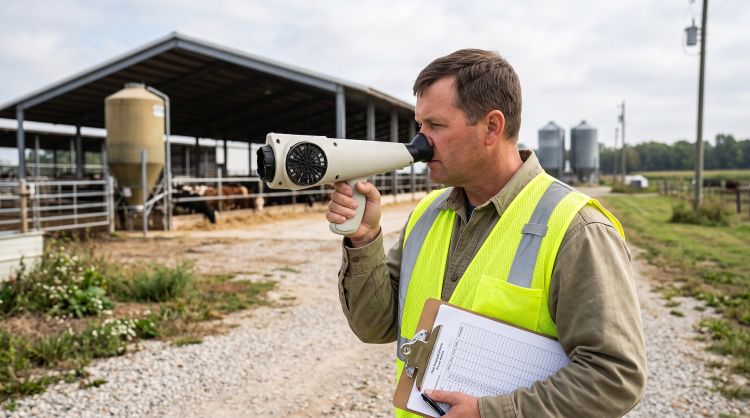
- Scentometry uses a portable device, such as a scentometer or Nasal Ranger, to estimate threshold concentration in the field. The device dilutes odorous air with filtered air and allows users to select from several predetermined dilution ratios. Although less accurate than laboratory olfactometry, scentometry is faster, less expensive and more practical for field applications.
Odor intensity
Odor intensity describes how strong an odor smells once it is detectable. It is typically evaluated using standardized rating scales, such as 0-5 or 0-7 scales, where higher values indicate stronger perceived odors. Unlike threshold concentration, which reflects whether an odor can be detected, intensity reflects how strong the odor appears to the observer. In some situations, odor intensity can be assessed through field observations or community surveys, making it a relatively simple and inexpensive method for evaluating odor impacts.
Persistence
Persistence describes how slowly an odor's perceived intensity decreases as it is diluted with clean air. In other words, it reflects the relationship between odor intensity and dilution. An odor with high persistence remains relatively strong even after substantial dilution, whereas an odor with low persistence fades more quickly. Persistence is typically determined by measuring odor intensity at a series of dilution levels and evaluating how rapidly the intensity declines. Because persistent odors remain noticeable over a wider range of dilution, they may remain detectable farther from the odor source.
Hedonic tone
Hedonic tone describes how pleasant or unpleasant an odor is perceived to be. It is typically rated on a scale ranging from very unpleasant to very pleasant. In livestock production, odors generally receive negative hedonic ratings, which means unpleasant. Odors perceived as more unpleasant are more likely to generate nuisance concerns, even when their measured concentration or intensity is moderate.
Odor descriptor
An odor descriptor is a word or short phrase used to describe the character of an odor, such as rotten egg, manure‑like or sour. Descriptors help communicate what an odor smells like and can sometimes provide clues about the compounds or facilities contributing to the odor. However, descriptors are subjective and do not indicate odor strength, concentration, or potential impact.
While terms like threshold, intensity, persistence and hedonic tone can be complex, understanding these measures might help communities and professionals better evaluate and address odor concerns effectively.
Table 1. Common odor measures and their analogies.
|
Term |
Definition |
Simple Analogy |
|
Threshold Concentration |
The point where a smell is just barely detectable. |
Can you smell it at all? |
|
Intensity |
The strength of the smell once it is detected. |
How strong is the smell? |
|
Persistence |
How slowly an odor fades when diluted with clean air. |
How sticky is the smell in the wind? |
|
Hedonic Tone |
The degree of pleasantness or unpleasantness. |
Is the smell good or bad? Or how good or bad is it? |
|
Descriptor |
Words used to characterize the smell (e.g., rotten egg). |
What does it remind you of? |
Takeaway messages
- Because livestock odor is a complex mixture of many compounds, chemical measurements alone cannot fully represent how neighbors and communities perceive odors.
- Odor concentration is only one part of the story. How strong an odor smells, how long it remains noticeable when diluted, and how unpleasant it is can all influence odor complaints and nuisance concerns.
- Understanding the different ways odor is measured provides a foundation for evaluating odor impacts and selecting effective odor management strategies.