Longtime Michigan dairy leader Doug Chapin encourages dairy farmers to invest in new MSU facility
 Print
Print Email
EmailThe Michigan Milk Producers Association is promoting two producer-led fundraising campaigns to support the new MSU Dairy Cattle Teaching and Research Center.
In addition to the written story, listen to the below podcast with MSU AgBioResearch Director George Smith and Doug Chapin, Michigan dairy farmer and chairman of the Michigan Milk Producers Association Board of Directors, on Spotify, Apple Podcasts and YouTube.
EAST LANSING, Mich. — In 1916, on the fourth floor of what is now the Justin S. Morrill Hall of Agriculture at Michigan State University, the Michigan Milk Producers Association (MMPA) was established.
The MMPA is a dairy farmer-owned cooperative and processor with a mission to market MMPA members’ milk, provide on-farm services and support the next generation of dairy industry leaders. Today, the organization has members in Michigan, Indiana, Ohio and Wisconsin. But its roots at MSU have led to a lasting partnership.
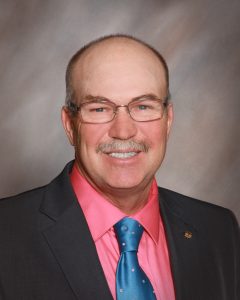
Doug Chapin, who operates Chapin Family Farms in Mecosta County, Michigan, alongside his son, Sam, serves as chairman of the MMPA Board of Directors. He was a leading voice in advocating for State of Michigan funding for the new MSU Dairy Cattle Teaching and Research Center, which opened in July 2025.
The $75 million facility is home to nearly 700 cattle, more than tripling the size of the previous herd. MSU researchers, educators and students are now equipped with the latest technology in dairy science, such as robotic milking systems, advanced feed centers, calf barns and milking parlors. The facility is also integrated with the MSU Anaerobic Digestion Research and Education Center, promoting opportunities in waste-to-resource solutions that create value-added products.
With the assistance of Chapin, the MMPA and other agriculture industry leaders, MSU secured $30 million from the state in 2022 to serve as a foundation for the center’s construction.
“We have a very unique situation in Michigan with our relationships with producers, MSU and the Michigan Legislature,” Chapin said. “One of the biggest reasons we were supportive of the investment was that we all saw it was time to update those facilities. When the window of opportunity came to get some state funds to get it kicked off, it was important for the industry to step up and say, ‘Let’s go for it.’ And it was great to see that all of Michigan ag stepped up. We all saw the need, and that need was fostered by the fact that we wanted to see MSU remain at the forefront of dairy research.”
Chapin said the perspective of producers was essential for legislators to hear, underscoring the urgency to keep Michigan among the top dairy industries nationwide. Michigan ranks first in the U.S. in milk production per cow and sixth in total milk production.
“I think what the Michigan Legislature could see from producers was that there’s a connection between us and the university that we needed to keep vibrant and strong,” he said. “By having the producers echoing the value of what they’re getting from MSU and talking about what we need more of, we could show there are wins for the university and for producers with a modernized dairy facility. This wasn’t just about the university. It was about producers, consumers and the growth of ag in Michigan.”
One of the aspects Chapin said he’s most excited about is that the center has already paid dividends through generating increased interest. He cited an influx of students eager to work at the facility and pursue careers in dairy, Michigan’s largest agriculture industry that contributes more than $15 billion to the state’s economy annually.
“I think an easy thing to see is how that facility can attract the best educators, researchers and students,” Chapin said. “The students are the biggest win we can get from this. In the dairy industry today, we have less farms. A lot of the talent we’re going to see is not from farm families. We need to attract the best students from varying backgrounds and get them excited about dairy.
“The other big thing the facility will allow for is a lot more research. Where the dairy industry is today, I find very exciting. Where the industry will be tomorrow will be determined by research. I don’t know all the questions we’ll need to answer in the future, but research will be the key to answering them. Training that next generation is how we keep up that momentum.”
Confronting the challenges of dairy farming is something MSU has assisted Chapin with since he took over his family’s farm. As he passes the torch to his son, he knows there will be significant hurdles.
“In my personal experience, my father died when I was quite young,” he said. “I didn’t have the mentor I was hoping for because of that. MSU Extension played a key role for me in my business, helping me make decisions that really helped set us up for success. I know my son will face some additional challenges moving forward. That’s just one example, but I think you’d be hard-pressed to find a producer who hasn’t benefited from MSU.”
While the initial state funding was crucial to get the project off the ground, additional support is required from the industry, MSU alumni and donors to maximize the facility’s impact. Chapin said the MMPA recognizes that need and is ready to assist.
Alongside the university, the MMPA is promoting two producer-led fundraising campaigns. The first encourages all Michigan dairy producers to donate $2.50 per cow in support of the center. With more than 400,000 dairy cows across the state, that would result in roughly $1 million. As part of this general campaign, the MMPA is soliciting producer funds to sponsor naming the facility’s large classroom.
The second initiative is the Dr. Joe Domecq Dairy Education Endowment, which recognizes Domecq’s lifetime of service to the dairy industry at MSU. Domecq, who has worked at the university for more than three decades, is coordinator of the MSU Dairy Education and Teaching Programs and an academic specialist in the Department of Animal Science.
The endowment will fund academic specialists and instructors throughout the dairy program’s curriculum, including herd management, genetics, nutrition and reproduction. Student activities such as judging, study abroad and internships will also be supported. Chapin said the MMPA will match any producer donations toward the endowment.
Donors of more than $10,000 can also honor their farm or a loved one with a plaque in the Michigan Dairy Hall of Fame, which will be prominently displayed at the center.
“At MMPA, our board has been very supportive of MSU and the new facility, and we knew we wanted to be involved in helping with funding,” Chapin said. “We as producers will benefit, so I think it’s good for us to be personally invested. I think it also helps demonstrate the value to the rest of the state. It sends a signal that this truly is important to the industry, so with all of our allied industries we work with, we want them to see that if it’s important to producers, it should be important to them as well.”
MSU AgBioResearch Director George Smith said the facility wouldn’t have been possible without the unyielding support from the MMPA, and the organization helping to raise additional funding is a demonstration of what makes Michigan agriculture special.
“We so appreciate MMPA’s role in raising these funds,” he said. “That partnership was foundational to securing the funding we have from the State of Michigan. To have MMPA step up even further and help raise additional dollars really shows how united the agricultural community is in Michigan, and we couldn’t be more thrilled at MSU to be a part of that effort.”
To show their gratitude for MSU, Chapin and his family have generously provided a leading gift for the campaign. He said it serves as a message of appreciation for past efforts and confidence in MSU moving forward.
“For me, I think it’s fair to recognize that MSU has brought me value,” Chapin said. “My son is coming behind me, and I know his needs will be just as great in the future as mine have been in the past. It’s not just a gift to say, ‘Thank you.’ It’s a gift to say, ‘We need you in the future.’ I think Michigan is poised to grow in the dairy industry, and I’m so glad MSU will be there to help us.”
To learn more about supporting the Dairy Cattle Teaching and Research Center, contact Kyle Cutler, director of development for the MSU College of Agriculture and Natural Resources, at cutlerky@msu.edu.
Michigan State University AgBioResearch scientists discover dynamic solutions for food systems and the environment. More than 300 MSU faculty conduct leading-edge research on a variety of topics, from health and agriculture to natural resources. Originally formed in 1888 as the Michigan Agricultural Experiment Station, MSU AgBioResearch oversees numerous on-campus research facilities, as well as 15 outlying centers throughout Michigan. To learn more, visit agbioresearch.msu.edu.