Michigan vegetable crop report – April 29, 2026
 Print
Print Email
EmailA warm and wet start for many is being tempered by cooler conditions ahead.
Weather
For the past few weeks, weather has been wet and warm prior to the current trough in the Jetstream, which is bringing on this cooler weather.
Check out Jeff Andresen’s weekly weather forecast.
Enviroweather app
Enviroweather Mobile was recently launched to provide growers with weather data while they are on the move. Read more about the new app in the following article and consider trying it out today.
Crop updates
We had an early sustained wet warmup this year that has put us ahead in certain developments, like winter rye cover crop biomass. There is some concern about termination and incorporation effort to ready fields for laying plastic. It might take more passes than usual, or more horsepower with bigger tools. Either way, the diesel is expensive and plastic-laying progress has been variable.
Inside, it is the season for transplant health concerns. Michigan State University Extension has released its greenhouse disease and insect management recommendations for 2026. Note, there are many pesticide trade names labeled for indoor non-bearing ornamentals that are the same or similar to trade names labeled for vegetables and outdoor field uses. You should be using them for their labeled purposes.
Asparagus
Asparagus harvest started in southwest Michigan prior to enduring a freeze. In west central Michigan, first harvest is still upcoming as spears emerged and are now in “cold storage.”
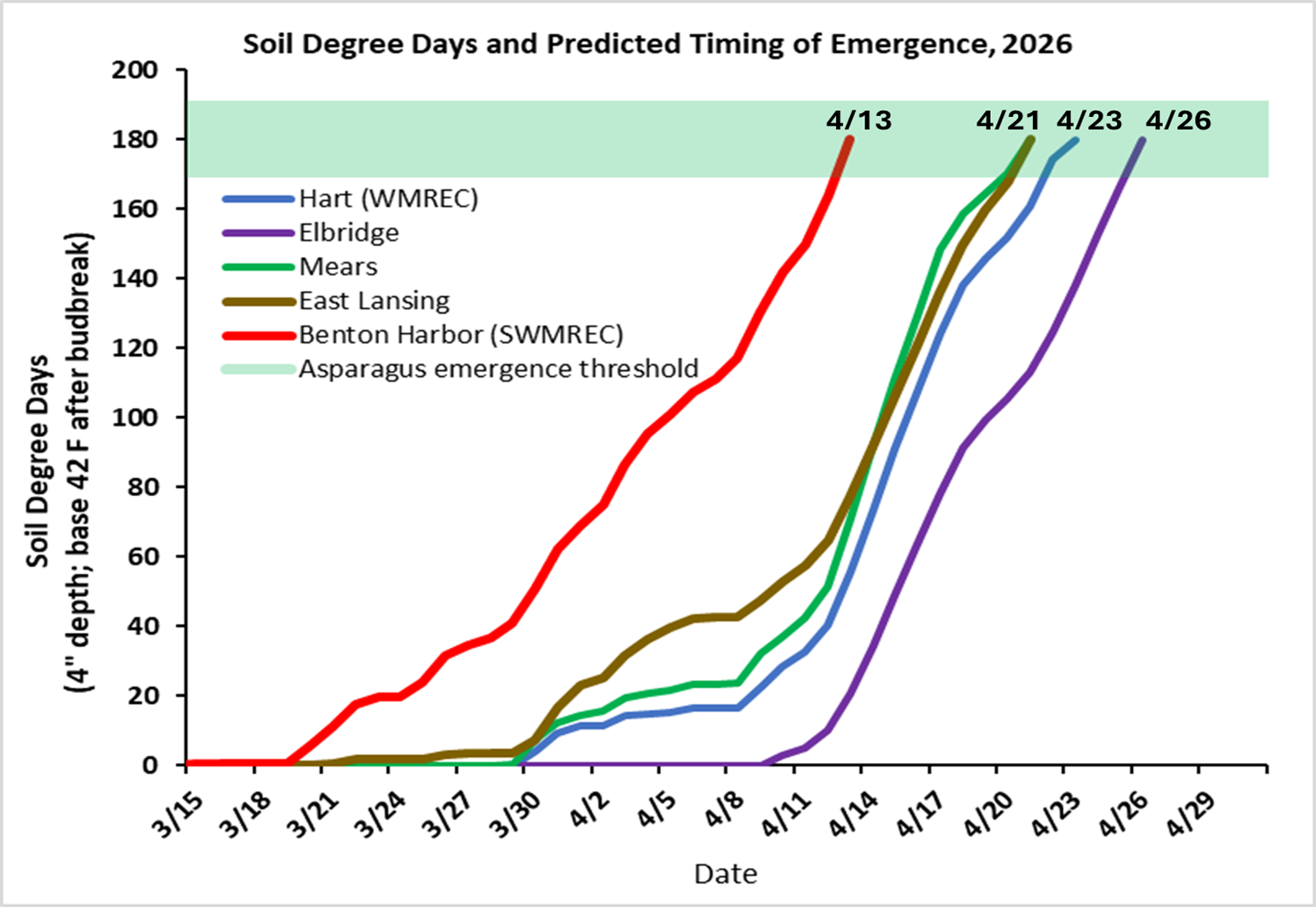
MSU’s asparagus emergence model shows regional differences in the timing of emergence, defined as 25% of crowns having a spear taller than 1 inch, based on soil temperature data (see Figure 1.). Actual emergence was generally within a few days of the predicted timing, with variation by variety, planting depth, aspect and groundcover.
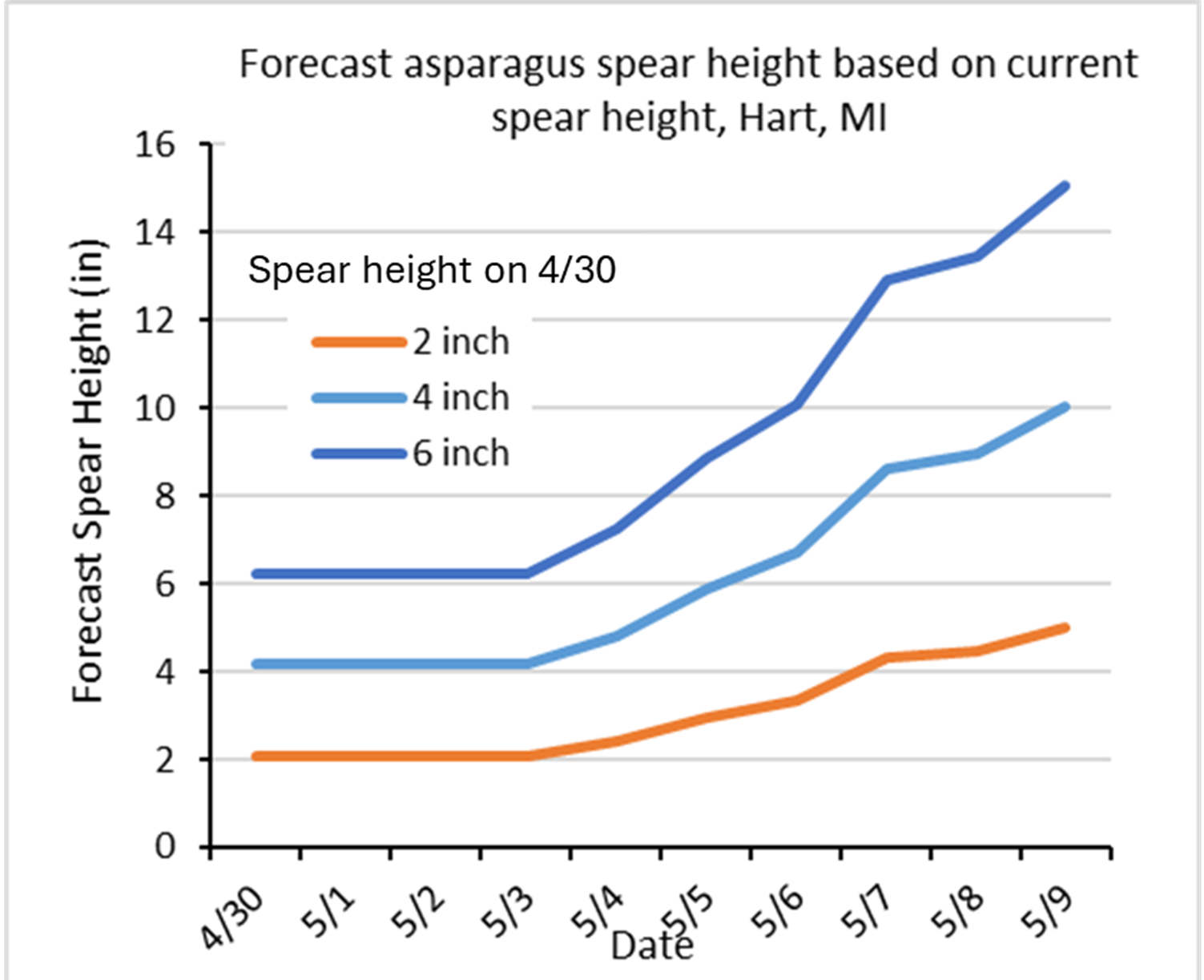
Note that the time from emergence to harvest can range anywhere from days to weeks depending on subsequent air temperatures. Things moved quickly in the southwest region after emergence, but most fields in the west central region have spears between 1–6 inches and will be stalled out with this week’s cool temperatures. Estimates of minimum average air temperatures for spear growth range from 42-50 degrees Fahrenheit. Spear growth also depends on the height of spears. Combining this information with the weather forecast in Hart, you can see we are likely at least a week away from harvest for fields with most spears less than 4 inches.
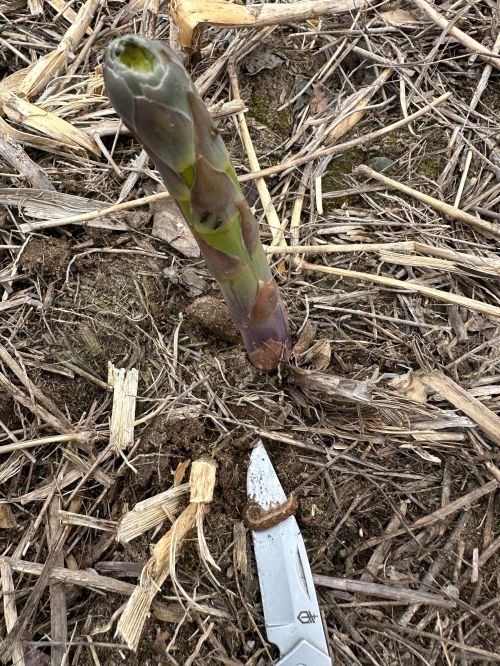
Consultants in west central Michigan reported finding active white cutworm in Oceana County asparagus. This caterpillar hides in the soil at the base of spears during the day and climbs them at night to clip the tip. Edges are ragged and look more munched compared to knicks from mowers or carts. Permethrin is effective and has a one-day preharvest interval.
Root crops
Carrots, parsnips, potatoes, beets, turnips and radishes are being planted on some farms and up already. Onions and shallots have been planted on some farms as seeds, sets and transplants. Bareroot transplants from Arizona were good quality this year.
Carrots, beets and onions are early risers that can germinate in cooler conditions, but they go slowly and don’t compete well against weeds that germinate under similar conditions. Here are some resources on that:
- Weed Management in Carrots by Cornell Vegetable Program
- Herbicides for in-season weed management in red beets by Michigan State University Extension
- Early season onion weed control by Michigan State University Extension
- Onion weed control for 2019 by Michigan State University Extension
- Onion weed control during cold weather by Michigan State University Extension
Cereal rye is an excellent cover crop but stands of small-seeded vegetables like carrots can be reduced if they are planted too soon after it is incorporated. This negative effect is strongest after rye is incorporated into the soil and generally dissipates with time. Risks are also greater when rye biomass is higher (more, taller rye) versus lower (shorter or sparser). Impacts on stands may happen a variety of ways: rye debris may physically create a poor seedbed, microbial decomposition of rye tissue can have negative effects, certain pests/diseases can be promoted, or there may be “allelochemicals” in the rye that inhibit seedling growth. A common recommendation is to wait at least seven to 14 days after incorporation before planting to reduce risk of injury (shorter delay for small rye stands, longer delay for larger rye stands).
Cucurbits
Zucchini is starting to be planted. Squash and cucumber transplants are hardening off. For situations where cucurbits have been planted and air temperatures fall to levels that risk chilling injury, row covers should be deployed to protect the vulnerable seedlings from the cold, especially if planted from transplants that are not hardened off sufficiently. While a chore for larger plantings, blanketing the seedlings in row cover can add a buffer of several degrees for any young warm-season plants, including sweet corn.
Brassicas and greens
Broccoli, cabbage, cauliflower and other brassicas have been planted. Lettuce and celery transplanting is ongoing. Cabbage maggot spring peak flight, a life stage with higher risk of crop damage, is approaching in parts of Michigan. Monitor the projected development of this pest with the MSU Enviroweather cabbage maggot degree-day model.
Garlic
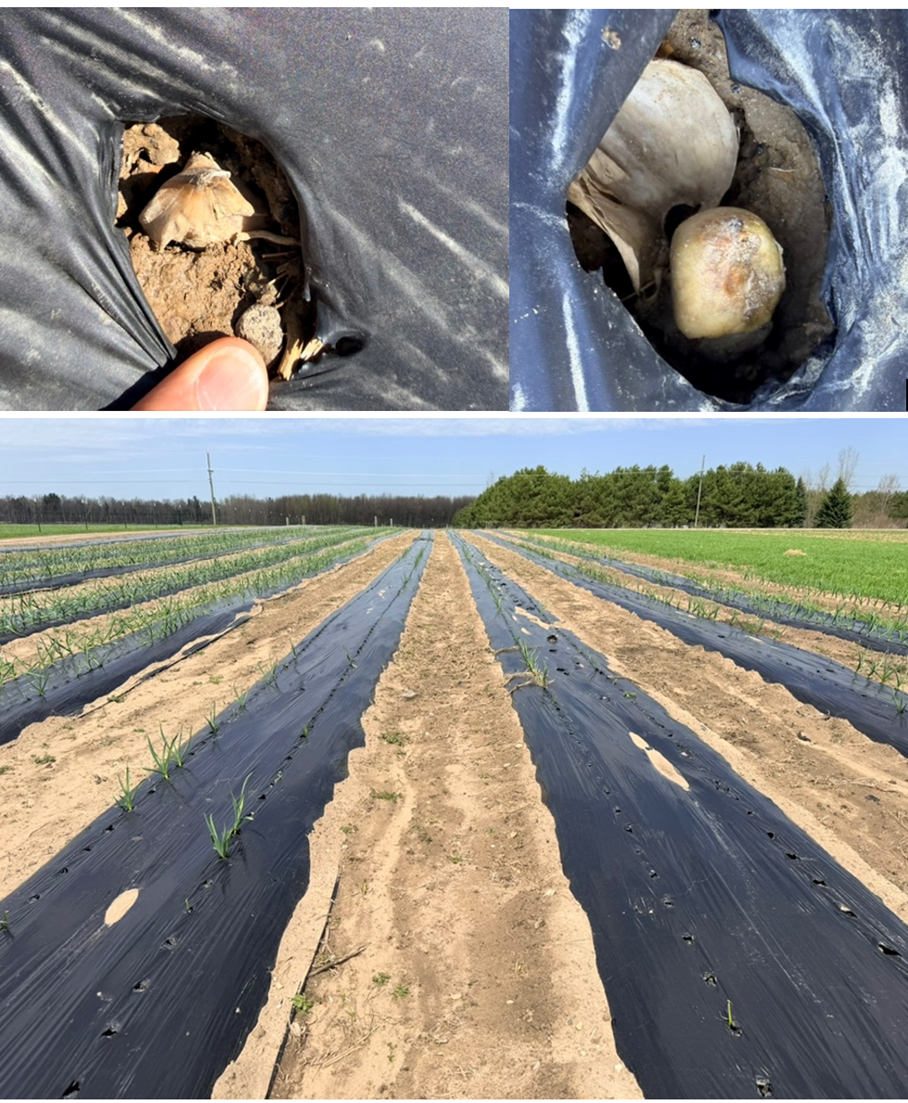
Garlic rot and poor emergence have been reported by multiple growers in eastern Michigan. A couple samples have been submitted to MSU Plant and Pest Diagnostics to rule out disease and insect issues. All affected growers planted garlic on black plastic mulch and suspect the issue may be related to environmental conditions, particularly harsh winter and freeze-thaw cycles. Potential causes of winterkill and early spring stunting include:
- Late planting, which limits root establishment before winter
- Early clove cracking, allowing secondary pathogen to colonize cloves
- Stem and bulb nematodes that in low amounts can weaken the clove and lead to fewer plants successfully overwintering
- Seedcorn maggot fly larvae damage in early spring, which can mimic winterkill
- Herbicide carryover from previous crops
- Saturated soils exposed to repeat freezing and thawing
To reduce risk, plant garlic September–early October, crack seed within seven days of planting, avoid fields with recent herbicide applications, improve drainage with raised beds in heavier soils, and monitor for early-season insect injury.
Fruiting vegetables
Greenhouse tomatoes and peppers are setting fruit, sizing and coloring, with first harvests starting in southwest Michigan. Tomato transplants are being hardened off for early field plantings.
The most common and concerning pests of vegetables that share space with flowers are aphids, thrips and mites. Aphids and thrips spread viruses and mites generate cryptic and long-lasting effects as well. While many products work well on spider mites in addition to thrips and aphids, broad mites deserve some special attention, and growers could benefit in having a heavy hitting product just for those.
Here are some ingredients that have some efficacy overlap, taken from “Greenhouse Insect Pest Management 2026” by Michigan State University Extension. Finding an inclusive label for vegetables and ornamentals is the tricky part. Note that employing biological natural enemies precludes insecticide use and are best employed early. Biopesticides are most effective when applied early and often. They may require specific application procedures, but offer several advantages including broad labels for use across ornamentals and vegetables, reduced risk to workers, and additional modes of action.
Chemicals
- abamectin – aphids, mites, thrips, Sirocco ornamental label and Agri-Mek veg label
- acetamiprid – aphids, thrips, Enkounter labeled for ornamentals and veg
- cyantraniliprole – aphids, thrips, Mainspring Xtra labeled for ornamentals and veg
- dinotefuran – aphids, thrips, Safari labeled for ornamentals and veg
- flonicamid – aphids, thrips, Airaxo ornamental label and Beleaf veg label
- spinetoram – aphids, thrips, XXPire ornamental label and Radiant veg label
- spirotetramat – aphids, mites, thrips, Kontos ornamental label and Movento veg label
Broad mite heavy hitters
- chlorfenapyr – effective for thrips too, Pylon labeled for ornamentals and fruiting veg
- fenazaquin – Magus ornamental label and Magister veg label
- fenpyroximate – Akari labeled for ornamentals and greenhouse tomatoes, peppers, cucumbers
- pyridaben – Sanmite labeled for ornamentals and greenhouse tomatoes, cucumbers
Biopesticides
- azadirachtin – aphids, thrips, many labeled for ornamentals and veg including AzaGuard, Aza-Direct, Molt-X
- Beauvaria bassiana – aphids, mites, thrips, many labeled for ornamentals and veg including BotaniGard, Mycotrol, and BioCeres
- Isaria fumosorosea – aphids, mites, thrips, Ancora labeled for ornamentals and veg
- Metarhizium brunneum – aphids, mites, thrips, Met52 labeled for ornamentals and veg
- mineral oils – aphids, mites, thrips, many labeled for ornamentals and veg
- potassium salts of fatty acids – aphids, mites, thrips, M-Pede labeled for ornamentals and veg
Biological natural enemies
- Amblyseius swirskii – thrips, mites
- Anystis baccarum – aphids, thrips
- Neoseiulus californicus – thrips, mites
- Orius – mainly thrips, less aphids and mites
- Lacewings – mainly aphids, less thrips
Legumes
Peas are in and up on some farms.
Sweet corn
Sweet corn is being seeded on many farms. The rare super early plantings are up on some farms.
Strawberries
Covered plasticulture strawberries made it through the frosts, with harvests expected mid-May. Uncovered matted-row crops lost some flowers but many unopened flowers were undamaged. We are at the tail end of the spring herbicide window before preharvest intervals block out uses.
Recordings of the MSU Veggie Virtual Coffee Break Series
Missed the 2026 MSU Veggie Virtual Coffee Break Webinar Series? Never fear, this year’s slate of webinars were recorded and are available for viewing at the following links:
What Still Works - and What's New - in Onion Thrips Management
Brian Nault, Cornell University
Raising Healthy Tomato Transplants by Managing Bacterial Diseases
Gary Vallad, University of Florida
Understanding Organic Fertility Sources in Vegetable Systems
Zack Hayden, Michigan State University
Protecting Your Cucurbits for the Long Haul
Laura Ingwell, Purdue University
Using Soil Steaming to Control Weeds and Pathogens in High Tunnels
Becky Maden, University of Vermont
If you have topics that interest you that you would like to see featured in next year’s webinar series, don’t hesitate to drop us a line!
Produce Food Safety On-Farm Readiness Reviews
Schedule an On-Farm Readiness Review (OFRR) today for a 2-hour educational visit that takes place during the harvest season and is meant to be casual and low stress. Everything discussed during an OFRR is confidential and focused on ways you can reduce your own risks in relation to produce safety. There is no pressure to take our advice either, we are just here to support you in your produce safety efforts!
Events
- May 6, 2026: Beginning Farmer Field Day - Soil Health, Pollinators, Beneficials – Saginaw, MI
- May 12, 2026: TomSPOT Webinar Series: Aerosolized dispersal of Xanthomonas euvesicatoria pv. perforans during spray applications – Virtual
- May 13-14, 2026: 2026 Agritourism Summit – Acme, MI
- May 19, 2026: Drip by Drip: Building Irrigation Know-How, Saginaw Valley Research and Extension Center, Frankenmuth, MI
- June 2-4, 2026: 2026 Conservation Drainage Network Annual Meeting – East Lansing, MI
- June 3, 2026: Beginning Farmer Field Day - Agritourism, Farm Marketing, Farm Business Management – Freeland, MI
- June 10, 2026: Food Grade Grains Field Day at Boyer Livestock – Clarklake, MI
- June 17, 2026: Food-Grade Grains Field Day at Kellogg Biological Station – Hickory Corners, MI
- June 18, 2026: Healthy Habitats and Productive Pollinators – Flint, MI
- June 20, 2026: Michigan Farm Bureau Farmers Teaching Farmers Event – Lansing, MI
- June 22-23, 2026: State of the Western Lake Erie Basin Conference – Adrian, MI
- June 29, 2026: Technical Assistance Provider Training for Pay for Performance Program – Adrian, MI
- July 21, 2026: Washtenaw TOPP Farm Tours – Whitmore Lake/Dexter/Willis, MI
- July 31, 2026: Berrien County Organic Agriculture: Tour 3 Value-Added & Agritourism Farms – Sodus/Buchanan/Three Oaks, MI
- August 11, 2026: West Michigan Organic Farm Tour: Explore Farm to Institution Markets from schools to hospitals – Muskegon/Whitehall, MI
- August 18, 2026: Northwest Michigan TOPP Field Day: Farming for People, Purpose, and Profit – Petoskey, MI
- August 20, 2026: Hillsdale Nutrient Management Field Day – Waldron, MI
- August 28, 2026: Washtenaw Conservation District Field Day – Ann Arbor, MI
- September 9, 2026: MSU Extension Monroe County Field Day – Monroe, MI
- September 10-11, 2026: Great Lakes Tek Flex – Benton Harbor, MI
- September 16, 2026: 2026 Midwest Mechanical Weed Control Weed Day – Benton Harbor, MI
- September 22-24, 2026: Farm Science Review 2026 – London, OH
- October 4-6, 2026: Northern Michigan Small Farm Conference – Bellaire, MI
- November 4-6, 2026: Michigan Agritourism 20th Anniversary Convention – Frankenmuth, MI
- December 8-10, 2026: Great Lakes Fruit, Vegetable, & Farm Market Expo – Grand Rapids, MI
This work is supported by the Crop Protection and Pest Management Program [grant no 2024-70006-43569] from the USDA National Institute of Food and Agriculture. Any opinions, findings, conclusions, or recommendations expressed in this publication are those of the author(s) and do not necessarily reflect the view of the U.S. Department of Agriculture.