Michigan vegetable crop report – September 2, 2026
 Print
Print Email
EmailThis will be the last vegetable crop report for the season. Thank you for reading and please reach out to your local MSU Extension vegetable educator if you ever need assistance.
Weather
- Scattered showers and thunderstorms Wednesday, Sept. 2, with some strong storms possible afternoon and evening hours. Hot and humid to the south. Scattered showers and thunderstorms continuing Thursday through Saturday. Mostly fair, dry and cooler Sunday into early next week.
- High temperatures from the mid-upper 70s north to the low 90s Wednesday, gradually falling back to the upper 70s to the north to mid-80s to the south by Saturday, to the mid-upper 70s early next week. Low temperatures from the upper 50s to the north to low 70s to the south Thursday cooling to the upper 50s in the north to mid-60s in the south Saturday to the mid-upper 50s early next week.
- Medium range outlooks call for a continuation of warmer than normal temperatures with near to above normal precipitation totals.
- Latest long lead outlooks for the fall season call for near to above normal mean temperatures and near to below normal precipitation totals.
The Midwest Mechanical Weed Control Field Day returns to Michigan
The Midwest Mechanical Weed Control Field Day is on Sept. 16, 2026, at the Southwest Research and Extension Center in Benton Harbor, Michigan. The event will feature hands-on demonstrations of mechanical weed control equipment and emerging technologies. Vegetable growers can learn about new tools and strategies for improving weed management. Learn more about the event in the following article or visit the event registration page.
Crop updates
Asparagus
Between 7-10 disease severity values (DSVs) accumulated between August 25-31 at six sensors MSU Extension is monitoring in Oceana County asparagus. A fungicide application would have been due Monday at these locations if nothing had been applied since August 15-20.
The Tomcast Disease model can be a guide to help you determine when to end your fern spray program. If we are seeing DSV values mostly in the 1s and 2s with the occasional 3, weather could still be conducive to disease development. If there are mostly 1s, a few 2s and 0s, risk is lower. Lastly, for a final spray, consider applying azoxystrobin since it is locally systemic and may last a bit longer than a protectant.
Carrots and celery
For carrots, 8 DSVs accumulated between August 25-31 at two sensors in Oceana County carrots MSU Extension is monitoring. A fungicide application would have been due Monday at these locations if nothing had been applied since August 18-21.
Cucurbits
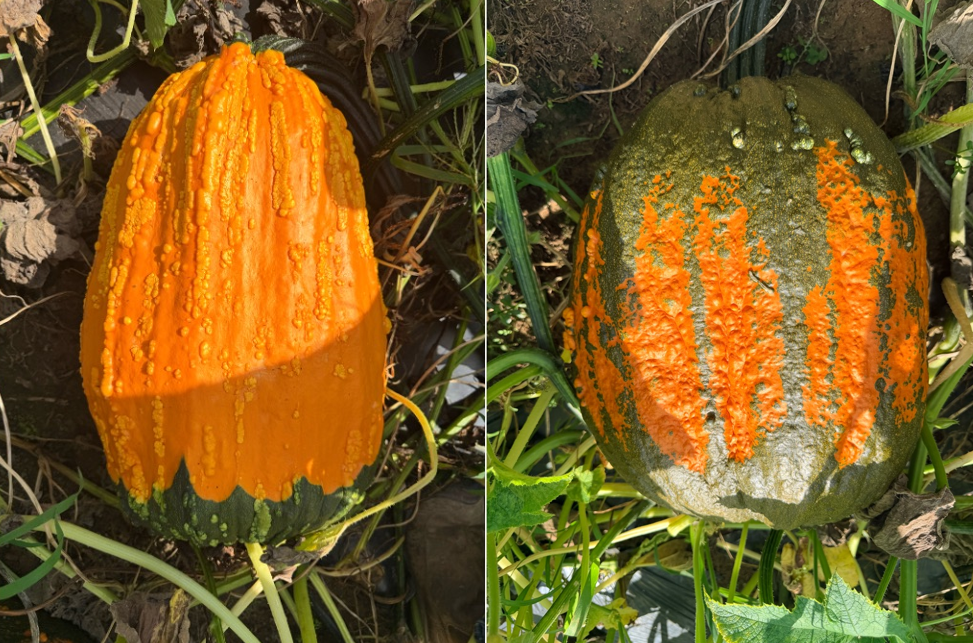
Pumpkins are coloring early for many people. Pumpkin management in the final stretch was written to guide your late summer decisions. Current weather conditions have been favorable for disease development, and powdery mildew is no exception. Although powdery mildew appeared later than usual this season, it is progressing rapidly. The earlier report from July includes recommendations for managing powdery mildew if you are looking for additional information.
Cucurbit downy mildew is being reported in more and more counties across Michigan. Read the latest article on cucumber downy mildew.
Cucurbit downy mildew spores continue to be captured across Michigan State University’s trap network. To date, all spores are clade 2, which affects cucumbers and melons. Clade 1, which affects pumpkins and squash, has not been detected (and only occurs some years in Michigan). Read this article for more information and a list of effective fungicides. As always, you can track the spread of downy mildew with the Cucurbit Downy Mildew forecasting website.
Fruiting vegetables
Fruit quality issues are popping up all over, and Alternaria and/or bacterial diseases can be seen firing up the plant from the base. Anthracnose and bacteria are the most common pathogens that infest fruit, but sometimes Septoria can show up as well as late blight from Phytophthora and Buckeye Rot from a different Phytophthora. Zippering, catfacing, sun scald, chilling injury and yellow shoulders are often an environmental issue, and gold fleck is commonly associated with thrips. This K-State article outlines many of these tomato fruit disorders with pictures, but here are some more.
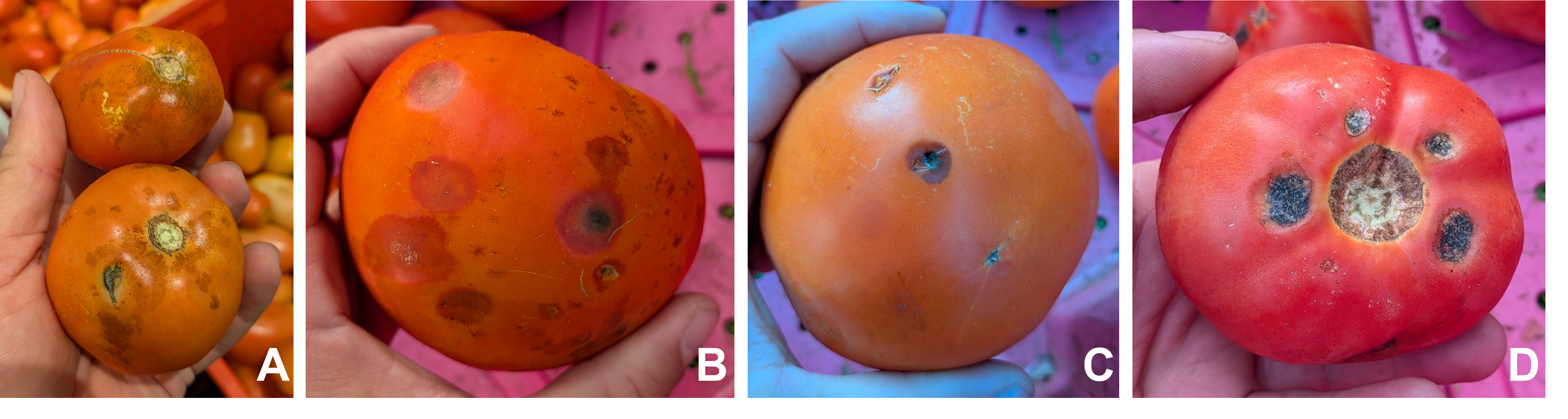
In the slate of pictures above, different things are happening that result in confusing diagnosis of issues.
- Chilling injury commonly seen in late summer and early fall, and sometimes from poor storage conditions. From the Tomato Compendium of Tomato Diseases and Pests, “chilling injury can be caused when temperatures remain above the freezing point but below 12.5 C (54.5 F) for a period of time. The amount of time needed to cause injury to tomato fruit depends on temperature. Shorter times are required with lower temperatures, and longer times are required with higher temperatures. Tomatoes subjected to higher temperatures before chilling are more sensitive to injury than those exposed to lower temperatures before chilling.” Also, “green tomatoes are more sensitive to this type of injury than ripe tomatoes”. The week of Aug 22 saw outdoor temperatures dip below 54.5 F for several hours in an early taste of fall. Additionally, tomatoes are commonly picked underripe and stored in coolers in which this sort of symptom can sometimes be found.
- This is an anthracnose infection, carried over from the field. But, if you’ve ever poured a bucket of tomatoes into another container or driven over bumpy terrain with tomatoes in lugs, you know that this also looks like bruising from dozens of tomatoes bonking into each other showing up later in storage. Going into last week’s cool spell, anthracnose seemed to pop up everywhere. The flat spots with a progressively rotting center caused by this pathogen can be readily found on fruits still hanging from plants in the fields when symptoms are advanced, but fruit with early infections can look fine at picking and worse later. According to the Midwest Vegetable Production Guide fungicide efficacy table for fruiting vegetables, effective products for preventative treatment of Anthracnose include Bravo, Cabrio, Priaxor, Quadris, Quadris Top, Aprovia Top, and Revus Top.
- A puncture wound, perhaps from a bird, has become infected. It doesn’t matter so much what is infecting it. The problem was the puncture. This can sometimes happen to the tips of pointy tomatoes, like San Marzanos, being plunked into buckets during harvest. The tips split and can be confused with blossom end rot after a few days in storage.
- This is a classic shoulder bruising scenario. Placing tomatoes on their shoulders is the most stable position for moving them around and distributes their weight more evenly than on a more concentrated point on their bottoms. But, if the tomato is a huge beefsteak, or more tomatoes are piled on top or bounced around in transit, then tissues start breaking down on those pressure points.
Sweet corn
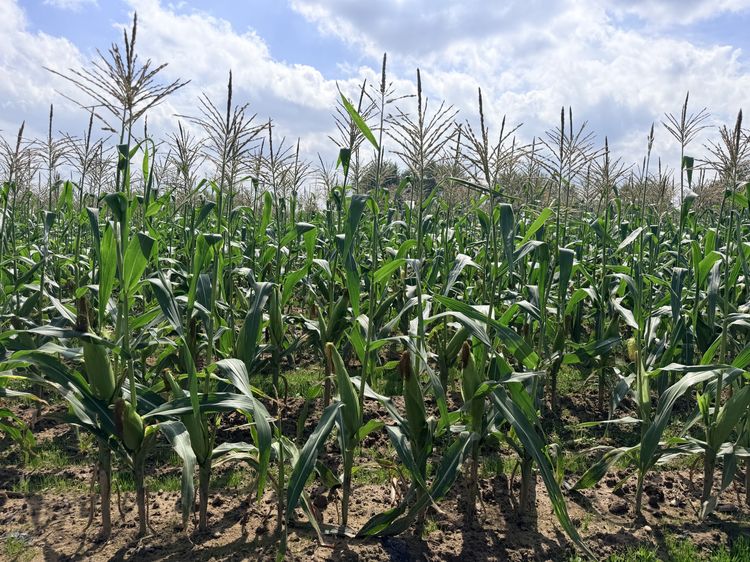
Some areas on the east side experienced drought conditions last 4-6 weeks, which affected sweet corn growth and development. However, following recent rain, crop conditions have improved and later planting corn ears are sizing up well.
Timing is key for getting good earworm control, all because of how this pest behaves. Momma moths lay eggs on green silks, and egglaying declines once silks brown and die. This means programs should be initiated soon after tasseling when silks start to emerge and can stop once silks are brown. Once on the silks, the eggs take about 2-6 days to hatch. Exactly how long they take to hatch depends on temperature, with faster hatch times as it gets warmer. Silks also grow faster as it warms, which means new, unprotected silk emerges quicker. Insecticide needs to be on the silks when caterpillars hatch so they contact it and die before escaping to the husk, where we can’t reach them with sprays. This is why some extension literature recommends tightening spray intervals when temperatures are consistently over 80 F. It is also why the tightest recommended spray interval is 2 days (the minimum amount of time it takes for eggs to hatch). Lastly, most Extension literature recommends tightening spray intervals as trap catches increase. The assumption is that more moths means more egglaying, and more opportunity for caterpillars to hatch and slip through the cracks in our spray program. So, taken all together, intervals could be tightened (or relaxed) based on trap catches and temperature.
The last key ingredients to determining spray interval are your customers, capabilities, and management style. Some growers prefer to be on tight spray intervals the entire season, either because that’s their style, or because the consequences of even a low level of earworm are high (e.g., rejected loads by customers with low tolerances). Others spray at broader intervals and then tighten them once captures increase. And just what a “broad” and “tight” interval means also depends on grower and customer risk tolerance, and available time. Whatever works for you is the right answer!
Corn earworm trap numbers were variable across locations Michigan State University Extension is monitoring, with not all traps reporting this week.
Table 1. Corn earworm captures. Total in trap for week1 (avg # per night2).
|
Week |
Ottawa Co.4 |
Oceana Co.4 |
Washtenaw Co.3 |
Monroe Co.3 |
Saginaw Co.3 |
Lapeer Co.3 |
Genesee Co.3 |
Midland Co |
|---|---|---|---|---|---|---|---|---|
|
June 28 |
15 (1.5) |
- |
- |
- |
- |
- |
- |
- |
|
July 5 |
15 (1.5) |
0 |
- |
- |
- |
- |
- |
- |
|
July 14 |
15 (1.9) |
5 (0.8) |
0 |
- |
2 (0.2) |
6 (0.8) |
1 (0.1) |
- |
|
July 21 |
10 (1.4) |
8 (1.1) |
0 |
0 |
10 (1.4) |
1 (0.1) |
0 |
1 (0.1) |
|
July 28 |
10 (1.7) |
17 (2.4) |
0 |
0 |
4 (0.6) |
0 |
0 |
1 (0.1) |
|
August 4 |
4 (0.8) |
13 (1.9) |
0 |
2 (0.3) |
2 (0.2) |
0 |
0 |
1 (0.1) |
|
August 11 |
- |
- |
1 (0.1) |
2 (0.1) |
1 (0.1) |
0 |
0 |
0 |
|
August 18 |
188 (11.8)* |
83 (5.9)* |
- |
16 (2.3) |
0 |
5 (0.7) |
6 (0.8) |
0 |
|
August 25 |
85 (17.0) |
332 (47.4) |
- |
12 (1.7) |
2 (0.2) |
- |
16 (2.3) |
6 (0.8) |
|
September 1 |
- |
- |
- |
4 (0.8) |
- |
- |
20 (2.8) |
11 (1.3) |
1Total number collected since last trap check; 2The total number divided by the number of nights since the last trap check; 3Cloth Heliothis traps track trends but catch less moths overall; 4Wire Harstack traps capture more moths. *This is a two-week total as traps were not emptied the week of August 11.
The insect forecast website predicts a low risk of additional corn earworm migration for September 2 and 3.
Pay-for-Performance Program
The Pay-for-Performance (PfP) Program, led by Michigan State University’s Institute of Water Research in partnership with the Michigan Department of Agriculture and Rural Development (MDARD), provides financial incentives to farmers who implement conservation practices that improve water quality. Rather than paying solely for adopting conservation practices, the program rewards environmental outcomes by estimating the phosphorus reductions achieved on participating fields. Eligible practices include cover crops, reduced tillage, nutrient management, conservation crop rotations, drainage water management, filter strips, and conservation land set aside.
The program is currently available to eligible corn, soybean, wheat, and hay producers within the Western Lake Erie Basin in Southeast Michigan. Farmers interested in enrollment opportunities, eligibility requirements, and incentive payments are encouraged to visit the PfP website at iwr.msu.edu/pfp or contact David DeYoung at deyoun59@msu.edu or Chris Galbraith at galbra53@msu.edu for more information.
Produce Food Safety On-Farm Readiness Reviews
Schedule an On-Farm Readiness Review (OFRR) today for a two-hour educational visit that takes place during the harvest season and is meant to be casual and low stress! Everything discussed during an OFRR is confidential, and focused on ways a grower can reduce their own risks in relation to produce safety. There is no pressure to take our advice either, we are just here to support you in your produce safety efforts!
Events
- September 9, 2026: Tillage & Soil Health Field Day – La Salle, MI
- September 10-11, 2026: Great Lakes Tek Flex – Benton Harbor, MI
- September 16, 2026: 2026 Midwest Mechanical Weed Control Weed Day – Benton Harbor, MI
- The Midwest Transition to Organic Partnership Program (TOPP) has provided funding to cover admission for any Illinois or Indiana grower and the first 50 Michigan farmers interested in attending this year’s event. Illinois farmers, please use the coupon code ILLINOIS26 when registering. Indiana growers, please use the coupon code INDIANA26, and Michigan farmers please contact Mariel Borgman at mborgm@msu.edu for coupon code.
- September 16-17, 2026: Thumbs-up for Sustainability Farm Tour for beginning farmers.
- September 22-24, 2026: Farm Science Review 2026 – London, OH
- October 1, 2026: “I have no fogging clue!” Greenhouse Workshop - Deneweth’s Garden Center, Macomb, MI
- October 4-6, 2026: Northern Michigan Small Farm Conference – Bellaire, MI
- Michigan's Emerging Farmers team is funding 20 farmers to attend this. Funding support will include conference registration fees (including the Sunday farm tour), lodging near the conference, two shared meals, and a stipend to support participants that can be used to cover travel costs. Farmers and producers can apply by Aug. 20. After the short application is submitted, applicants will be notified of their award by Aug. 21 and be asked to accept it and register with the Michigan's Emerging Farmers team by Aug. 30. Accepted participants will be required to attend the full conference (Sunday-Tuesday) as well as a networking lunch with other participants and NIFBE MEF team members, and complete a post-conference survey. A pre-conference virtual orientation session will be optional for participants.
- November 4-6, 2026: Michigan Agritourism 20th Anniversary Convention – Frankenmuth, MI
- December 8-10, 2026: Great Lakes Fruit, Vegetable, & Farm Market Expo – Grand Rapids, MI
- January 6-7, 2027: Bi-State Organic Grains Conference – Fort Wayne, IN
- January 7-8, 2027: Minnesota Organic Conference – Saint Cloud, MN
- January 7-9, 2027: Southeast Regional Fruit & Vegetable Conference – Savannah, GA
- January 8-9, 2027: Practical Farmers of Iowa Annual Conference – Des Moines, IA
- January 10-12, 2027: Kentucky Fruit and Vegetable Conference – Bowling Green, KY
- January 17-19, 2027: Growing Wisconsin Conference – Wisconsin Dells, WI
- January 18-19, 2027: 2027 Ohio Produce Network
- January 21-22, 2027: Minnesota Fruit & Vegetable Grower Association Expo - Waite Park, MN
- January 26-28, 2027: Indiana Horticulture & Small Farm Conference – Danville, IN
- January 27-28, 2027: CWF Organic Expo – Bay City, MI
- January 28-29, 2027: Organic Vegetable Production Conference – (Virtual)
- January 29-30, 2027: Organic Association of Kentucky Annual Conference – Cave City, KY
- February 2-4, 2027: 2027 Winter Potato Conference - Grand Rapids, MI
- February 2-4, 2027: Mid-Atlantic Fruit & Vegetable Convention – Hershey, PA
- February 5-6, 2027: Organic Vegetable Production Conference – Madison, WI
- February 10-13, 2027: National Farm Machinery Show – Louisville, KY
- February 12-14, 2027: Annual OEFFA Conference - Wooster, OH
- February 17-18, 2027: Ontario Fruit & Vegetable Convention – Niagara Falls, ON
- February 25-27, 2027: Marbleseed's 38th Annual Organic Farming Conference - Delavan, WI
- March 16-17, 2027: Midwest Cover Crop Council Annual Conference – St. Charles, MO
- March 29-31, 2027: Farm Stop Conference – Ann Arbor, MI
This work is supported by the Crop Protection and Pest Management Program (grant no 2024-70006-43569) from the USDA National Institute of Food and Agriculture. Any opinions, findings, conclusions, or recommendations expressed in this publication are those of the author(s) and do not necessarily reflect the view of the U.S. Department of Agriculture.