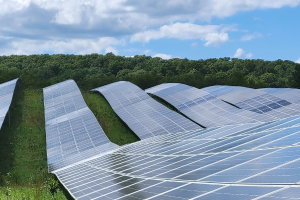
Solar farms may still be farms
 Print
Print Email
EmailForage research points to scalable agrivoltaic solutions.
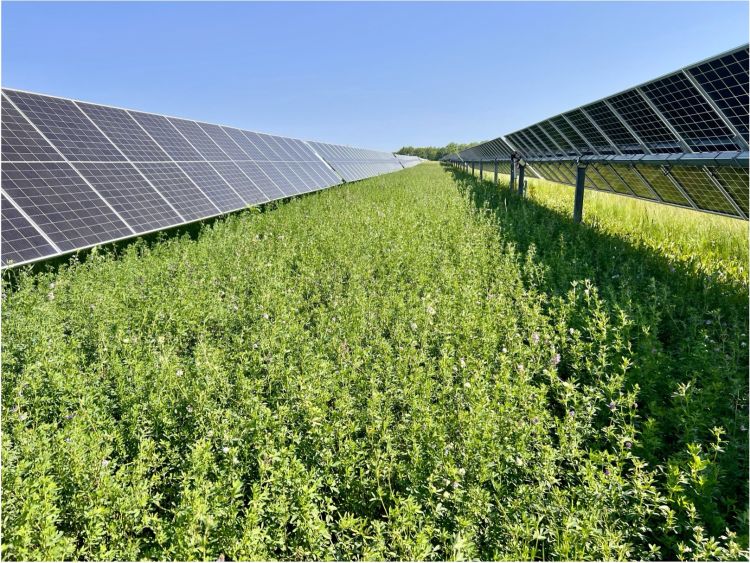
Researchers from The Ohio State University Extension say growing alfalfa and grass hay between utility-scale solar arrays may offer a scalable, economically viable path forward for agrivoltaics in the Midwest.
During the MI Ag Ideas virtual session Growing Grass and Alfalfa Hay Between Solar Arrays hosted by Michigan State University Extension, The Ohio State University Extension Field Specialist Eric Romich and Assistant Professor and State Small Ruminant Extension Specialist Brady Campbell shared early findings from a U.S. Department of Energy–funded research project examining forage production inside an operating solar facility in Ohio.
“This is a topic that is relevant in many states across the Midwest,” Romich said. “Hopefully, there’s something related to this research that you can take and apply to your communities back home.”
The project focuses on forage crops—specifically alfalfa and a cool-season grass hay mix as a practical agrivoltaic solution that can function at megawatt scale. According to Romich, most agrivoltaic projects nationally remain small and focus primarily on pollinator habitat or grazing. “We were really interested in trying to find solutions that were scalable and economical.”
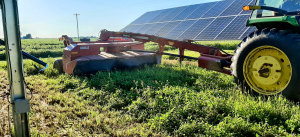
The research team established replicated forage plots between solar arrays and compared yields to control plots planted outside the array. Over two growing seasons, researchers collected data on forage yield, quality, equipment performance and soil compaction.
Despite drought conditions during the establishment year, results were encouraging. In the second year, alfalfa grown between panels produced yields comparable to control plots, even at reduced seeding rates. Campbell said that the finding has important cost implications. “You could actually get the same amount of yield and save 25% on your seed cost,” he noted.
Forage quality also remained high. “As you’re thinking about growing good quality feedstuffs within these alleyways, alfalfa does a nice job,” Campbell said. “It establishes well, it does well within these areas, it has a good yield to it, and also good quality.”
Cool-season grass hay showed similar promise, with some solar alley plots producing greater estimated yields than controls. Campbell said crude protein levels were well-suited for many livestock classes, including beef cattle and small ruminants.
The project also examined soil impacts associated with solar construction. Using pre-construction baseline measurements, the team tracked soil compaction over time and observed improvement after one year of forage cropping. “After one year of cropping, we start to see some reduction in that compaction,” Romich said.
Both researchers emphasized that success depends on thoughtful site design. Drainage, panel layout, alley width, and minimizing obstructions are critical. “This is going to require upfront commitments,” Romich said, adding that agrivoltaics must be considered during project design, not added later.
Campbell framed the work as part of a larger opportunity for agriculture. “The exciting part for me was being able to see us produce a product that’s viable in the marketplace and is of good quality,” he said. “That’s what really matters for producers.”
If you have questions about agrivoltaic opportunities, please contact Charles Gould, Michigan State University Extension Bioenergy Educator, at 616-834-2812 or gouldm@msu.edu. The MSU Extension Agricultural Bioenergy and Energy Conservation website has additional information on renewable energy.