The case for cattle on solar farms
 Print
Print Email
EmailNew grazing strategies challenge the idea that cattle don’t belong on solar sites and suggest they may thrive there.

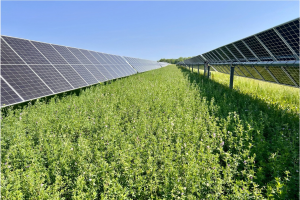
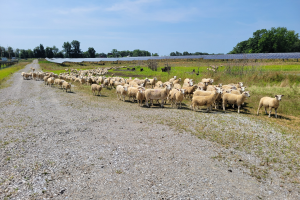
Solar grazing has largely been associated with sheep, but a Virginia-based farmer and entrepreneur believes cattle may be the next frontier if they are bred and managed correctly.
During a recent MI Ag Ideas to Grow With virtual conference session, Jess Gray, CEO of Gray’s LAMBscaping, LLC and board member of the American Solar Grazing Association, introduced the concept of inverter cattle, a purpose-built composite breed designed specifically for grazing solar energy sites.
“We spend a lot of money mowing things that cows would love to eat,” Gray said. “So, Marcus and I got to thinking, what would it take to get our cows out onto solar?”
Gray explained that solar sites present a unique challenge: they combine agriculture with an energy workforce that is often unfamiliar and uncomfortable with livestock. “If people are afraid of my sheep, they’re going to be afraid of cows,” she said. “We wanted animals that honestly couldn't care less who’s in that pasture.”
To meet that need, the Grays began selectively breeding cattle with traits suited for solar environments. These included docility, disease resistance, moderate size, heat tolerance and the ability to thrive on pasture with minimal intervention. “We are 100% pasture-based,” Gray said. “We want animals that can make the most out of whatever is present there.”
The result is inverter cattle, a composite breed drawing from Dexter, Belted Galloway, Piney Woods, and American Milking Devon genetics. Gray said the goal is longevity and efficiency rather than maximum size. “We’re looking at about 1,000 pounds,” she said. “Not miniature cattle, but also not full-size animals that intimidate people.”
Gray stressed that management is key. “This idea that cattle are a bull in a China shop—that’s constantly being proven wrong,” she said. “If animals have food, water, minerals, and good management, they’re not likely to find themselves in trouble.”
Solar grazing also offers economic and environmental benefits. As a third-party vegetation manager, Gray is paid per acre to control plant growth under panels. She noted that industry payments typically range “up to $600 per acre depending on location and expectations.”
Beyond revenue, Gray said livestock performance can actually improve on solar sites. “Our animals on solar thrive and grow better, faster, and cheaper for us than the ones we have on pasture at home,” she said, pointing to consistent shade, longer green forage, and protection from extreme weather.
Gray also emphasized the value of multi-species grazing. “I want to see our cows go out on sites with our sheep,” she said. “You get better pasture utilization, parasite control, predator abatement, and stacked enterprises.”
Looking ahead, Gray believes cattle could also improve public acceptance of agrivoltaics. “A lot of people recognize cattle as farming,” she said. “Pairing cattle with solar helps people see this land as productive, not lost.”
Her message to farmers and developers alike was clear: “There isn’t a whole lot that needs to be changed,” Gray said. “It’s about working with what’s already there and managing it well.”
If you have questions about agrivoltaic opportunities, please contact Charles Gould, Michigan State University Extension Bioenergy Educator, at 616-834-2812 or gouldm@msu.edu. The MSU Extension Agricultural Bioenergy and Energy Conservation website has additional information on renewable energy.