The dairy cow that doesn’t show heat: What is she really telling us?
 Print
 Email
Determining when a cow returns to fertility is critical for breeding decisions.
New research shows a missed heat alert early postpartum isn't just an inconvenience; it is one of the earliest signals of a cow's overall fertility, and a closer look at why so many “quiet” cows are being misread.
Why does early heat predict good fertility?
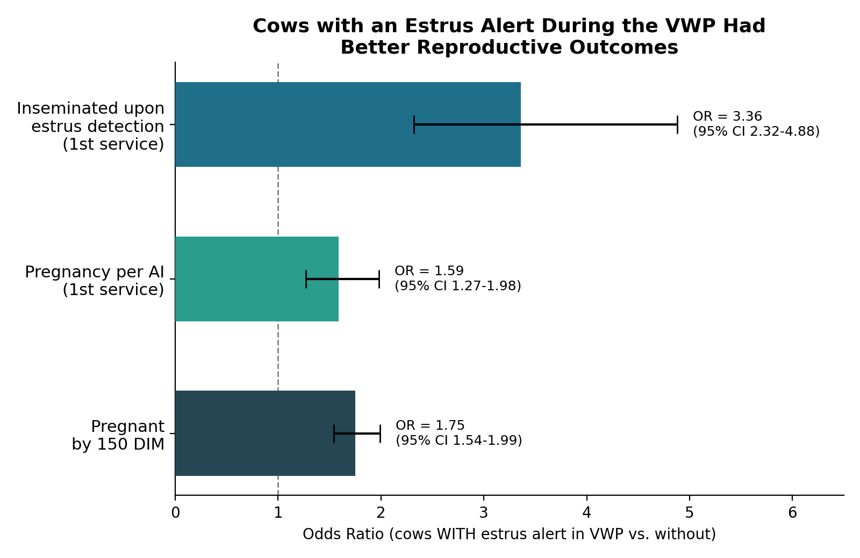
Across thousands of lactating Holstein cattle, cows that showed at least one estrus alert within the voluntary waiting period (VWP) were 3.4 times more likely to be bred off a spontaneously detected heat, had 59% greater odds of conceiving at first service, and were 75% more likely to be pregnant by 150 days in milk. This effect is independent of the herd, country, or monitoring brand, which tells us this isn't a coincidence of one farm's management.
A cow that shows a strong, detectable heat early in lactation has almost certainly already resumed normal ovarian cyclicity, and cycling early is tied to how well she recovered from the stress of calving: no uterine infection, acceptable body condition loss and no major metabolic disorders like ketosis. In other words, an early heat is the cow telling us her whole transition period went reasonably well. Cows that don't show heats early in lactation tend to carry that disadvantage through the entire lactation: lower conception rates, more days open, a greater chance of pregnancy loss later and greater chances of being removed from the herd.
A recent study evaluated 2,198 lactating Holstein cows across seven commercial monitoring brands from multiple countries and evaluated the accuracy of the monitor based on serial collection of blood progesterone, which was used as a gold standard to confirm ovulation and therefore determine if the cow is cycling.
When comparing the blood progesterone results to the alerts given by the monitor, nearly 80% of cows had truly resumed cyclicity by about 49 days in milk, but only 64% ever triggered an estrus alert on the monitor. Having an alert within the VWP had a sensitivity of 70% (correctly identified cows as cycling), specificity of 60% (correctly identified cows as not cycling), and a negative predictive value of only 35%, meaning a no-alert reading on the monitor is a poor guarantee that a cow hasn't cycled. Roughly three out of four cows with no detected heat had already ovulated, and performance varied widely among monitors, with sensitivity ranging from 34% to 92% across study groups. On the other hand, the positive predictive value was 88%, meaning the occurrence of an alert in early lactation is a great indicator that the cow is likely back cycling again.
The first estrus following calving is often characterized by weak or undetectable estrous behavior. Elevated exposure to estrogen during late gestation may influence the behavioral manifestation of the first postpartum estrous cycle, despite the occurrence of normal ovulation. Thus, failure to detect estrus during this period may reflect limitations and the reduced intensity of estrous expression rather than the monitoring system not functioning well or the absence of normal reproductive activity.
What does this mean for breeding decisions?
Targeted reproductive management is a data-driven herd management approach that uses individual cow monitoring technology to customize breeding strategies instead of applying the same protocol to the whole herd. Cows with a detected heat are strong candidates for spontaneous breeding, with less reliance on synchronization protocols. Cows with no alerts are good candidates for synchronization, but producers should expect that a large portion of that group could be cycling normally already, just silently, rather than assuming the whole group is not cycling.
Bottom Line
- An estrus alert during the VWP signals a healthy transition period and cows with an alert had 55–99% greater odds of pregnancy.
- A no-alert reading doesn't mean not cycling. About three out of four undetected cows had already ovulated, likely due to a weak or silent first heat rather than true anestrus.
- Monitors are strong at confirming cows are cycling (88% positive predictive value) but weak at ruling detecting non-cycling/ anestrus cows (35% negative predictive value).
- A simple strategy: spontaneous breeding for cows that show heat and synchronization protocols for cows that don’t show heat can cut protocol use and cost without sacrificing pregnancy rate.