Transforming the student experience: MSU Dairy Cattle Teaching and Research Center
 Print
Print Email
EmailMSU's new dairy facility is driving innovative research and preparing the next generation of dairy industry leaders.

When Riley Barber came to the College of Agriculture and Natural Resource (CANR) as an undergraduate student, she had no experience in agriculture. Growing up in Rochester Hills, MI, Barber never imagined she would one day pursue a career in the dairy industry.
But Barber quickly found a home in the Department of Animal Science, and through experiential opportunities in the MSU Dairy Program, she developed a passion for dairy nutrition and research.
“The Department of Animal Science creates classes, programs and clubs that are accessible to everyone, whether they have experience in agriculture or not,” said Barber. “The MSU Dairy Program has provided me with countless hands-on experiences that have shaped my career.”
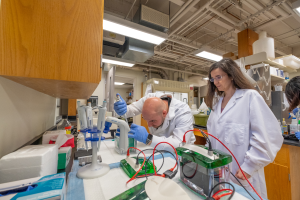
After completing her undergraduate degree, Barber continued her education as a graduate student, earning her master’s degree from MSU this summer. Her research focused on the use of fatty acid supplementation in lactating dairy cows and evaluating its impacts on milk production and greenhouse gas emissions. She is now pursuing a Ph.D. in Dairy Science from the University of Wisconsin – Madison.
“My goal for my academic research is to continue to find ways to make dairy farming more sustainable. Ultimately, I want my research to provide practical solutions that can be implemented on commercial dairy farms.”
‘Significant differences’
Prior to the opening of MSU’s new $75 million Dairy Cattle Teaching and Research Center in July 2025, Barber worked on research projects at MSU’s previous 1960s-era dairy farm. Having worked in both environments, she said the difference between the old farm and the new center is striking.
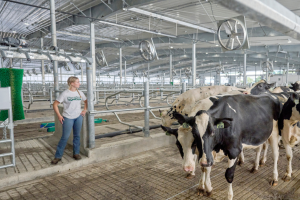
The modern 165,000-square-foot cattle barn houses more than 680 cows, more than tripling the previous herd size. Barber said this larger herd allows students, faculty and staff to conduct research in a much more timely manner, while the expanded facility has made their work more efficient.
“At the old facility, the milking parlor was small and confined, with farm staff and research staff often sharing the same space,” she said. “In the new facility, a subway runs underneath the milking parlor, allowing research staff to easily collect milk samples without disrupting the milking process.”
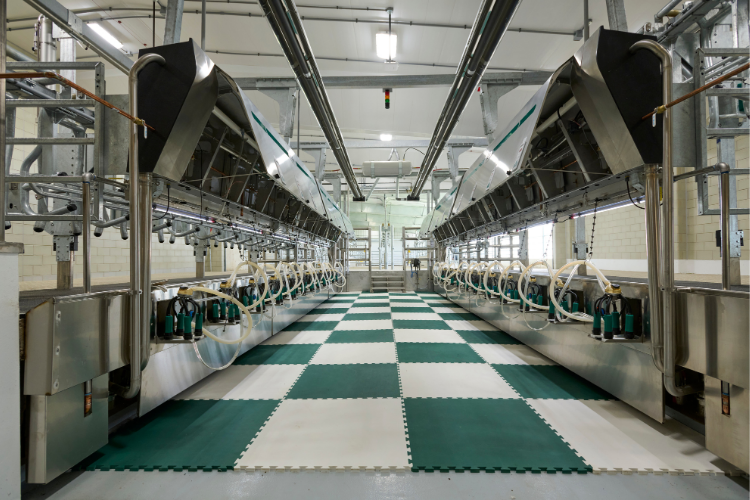
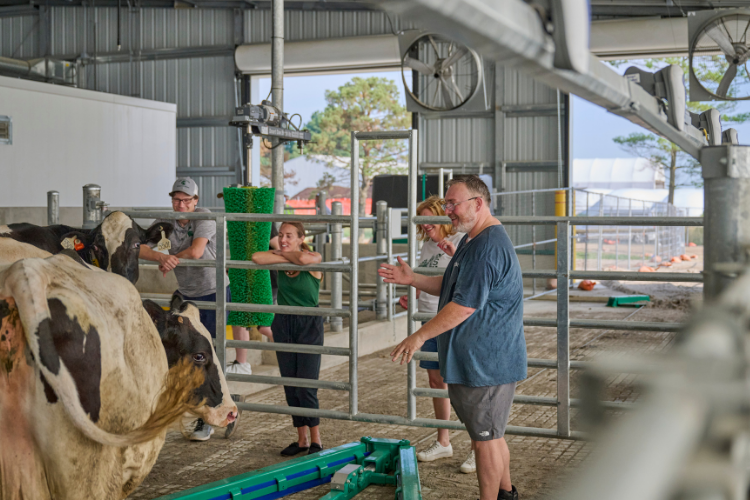
In addition to streamlining research operations, Barber said the new facility has focused on the comfort and well-being of the cows that call the MSU Dairy home. The herd is now housed on sand bedding, and new feed bins allow researchers to conduct feeding trials within free-stall pens while monitoring cow's daily feed intake. The barn also features an advanced ventilation system, along with scratching and grooming brushes that support animal health and comfort.
“The new MSU Dairy Cattle Teaching and Research Center is innovative and up to date with current technologies being used in this field. It’s made conducting research more efficient while providing a better environment for both the cows and the students working with them.”
Connecting consumers and producers
Beyond the day-to-day operational improvements, Barber’s favorite aspect of the new Dairy Cattle and Research Center is how it has become a hub for educating the public about the modern dairy industry.
She said the layout of the facility allows for easy and efficient public tours. There are multiple classrooms, a conference room and a lobby space that allows visitors to learn more about dairy production and watch the milking process. While the Dairy Program has always been committed to public outreach, Barber said the integrated design of the new dairy is making these efforts far more effective.
As Michigan's largest agricultural sector, the dairy industry generates more than $15.7 billion in annual economic impact. Yet despite dairy's vital role in the state's economy, many consumers remain disconnected from the production process. Barber said the new MSU Dairy can help close this divide by educating the public about the industry's impact in Michigan while inspiring students to explore careers in the field.
“These outreach opportunities are extremely valuable,” she said. “We are bridging the gap between consumers and producers and providing the public with a firsthand look at modern dairy farming.”
MSU and CANR will host the official building dedication of the Dairy Cattle Teaching and Research Center on October 8, 2026.
A $30 million investment from State of Michigan provided the initial funding for the project, but additional private support from alumni and stakeholders in the dairy industry is needed to fully realize the farm’s long-term vision for programming and research.
To explore special naming opportunities at the MSU Dairy, contact: Kyle Cutler, cutlerky@msu.edu, Director of Development, College of Agriculture and Natural Resources. Learn more: www.canr.msu.edu/dairy-facility-campaign