Why understanding how insect pests get to your field matters for scouting
 Print
 Email
Understanding how insect pests colonize crop fields provides a practical framework for improving scouting, detecting insect infestations earlier, and making more informed pest management decisions.
Scouting is the foundation of integrated pest management (IPM), but scouting every acre is not feasible given time constraints. Doing the best possible job is always a balancing act between getting “good enough” information to make a decision and getting all scouting tasks complete.
Tailoring your scouting efforts to target when and where pests are active can be one way you can walk this balancing act. To put it another way, understanding pest biology, how they enter and spread into fields can help make your scouting time count.
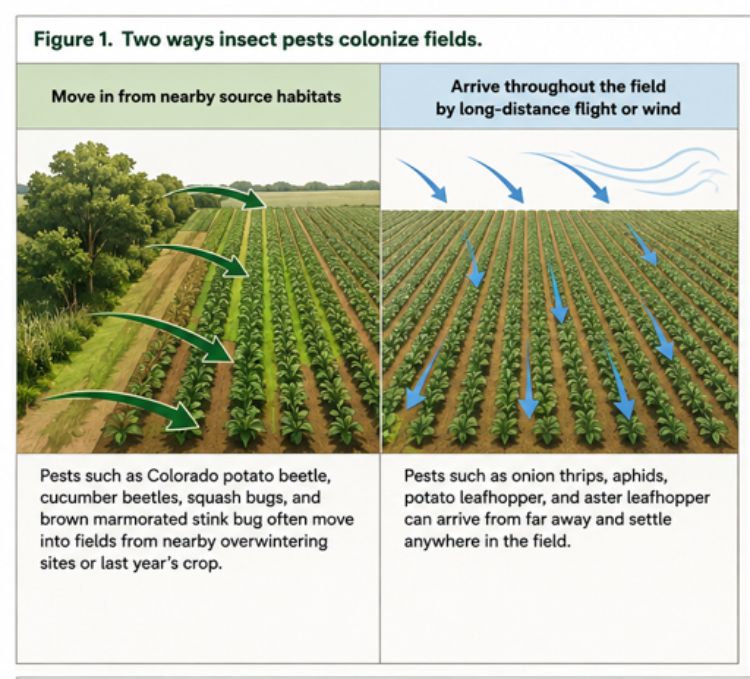
One way to make scouting more efficient is to understand how insect pests typically colonize and spread through fields (Table 1). For some pests, the source population is nearby, such as in last year's crop, the surrounding vegetation or overwintering habitat. Others arrive from miles away on prevailing winds (Figure 1).
How a pest moves into a crop, or colonizes it, often determines where infestations begin. After colonization, some species spread relatively evenly across fields while others develop localized hotspots as populations increase. Understanding these patterns helps inform a scouting strategy throughout the season.
Table 1. How common vegetable insect pests typically enter and spread within fields, and how this influences scouting.
| How pests typically enter and spread within fields | Michigan vegetable pest examples | Where infestations usually begin | How to scout |
|---|---|---|---|
| Move into fields from nearby source habitats | Colorado potato beetle, cucumber beetle, squash bug, cabbage maggot, carrot weevil | Field margins, especially adjacent to last year's crop, hedgerows, wooded areas, or weedy field borders | Begin scouting field edges early in the season, subsequently start checking the entire field to determine whether populations are spreading. |
| Colonize throughout the field by long-distance flight or wind-assisted movement | Onion thrips, aphids, leafhoppers | Can appear almost anywhere in the field, although colonies often develop after colonization | Walk a W- or X-pattern and sample plants throughout the field. Avoid making decisions based only on observations from field edges. |
| Initially scattered but develop localized hotspots as populations build | Two-spotted spider mite, diamondback moth, imported cabbageworm, cabbage looper, tomato hornworm | Hot, dry areas, stressed plants, next to driveway or greenhouse / hoophouse | Scout across the field while revisiting known hotspots to determine whether populations are expanding and whether additional management is needed. |
Although many insect pests fit one of these general patterns, their distributions continue to change as populations reproduce and disperse. As a result, scouting strategies should also adapt throughout the growing season.
Pests that move into fields from nearby habitats
Many important vegetable insect pests colonize newly planted fields by moving from nearby source habitats. Because Michigan vegetables are typically grown in rotation, these insects rarely emerge from the field itself.
Instead, pests like Colorado potato beetles disperse from overwintering sites near last year's potato fields, while cucumber beetles and squash bugs move into newly planted cucurbit fields after overwintering in protected habitats surrounding last year’s fields. Typically, these are insects that are weak fliers and/or walk over to the crop field from the overwintering site.
Crop rotation does more than break pest life cycles: it also increases the distance many insects must travel to locate this year's crop. Whenever possible, increasing the distance between this year's field and last year's host crop can help delay colonization by pests that move from nearby source habitats.
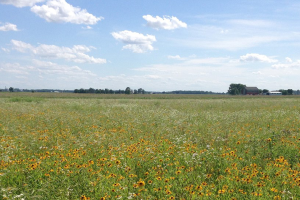
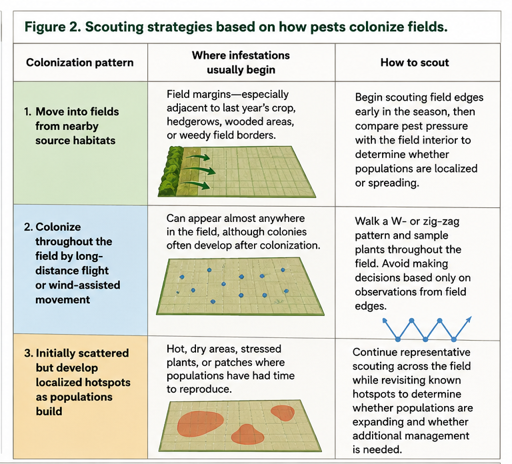
When scouting these pests, begin by carefully examining field margins, particularly those adjacent to last year's host crop, wooded areas or unmanaged vegetation (Figure 2). Compare pest pressure at the field edge with observations farther into the field. If insects remain confined primarily to field margins, continue monitoring to determine whether populations are expanding before making management decisions for the entire field. In some situations, edge-focused insecticide applications may be sufficient.
Pests that colonize throughout the field
Other pests, including thrips, aphids and leafhoppers, travel over long distances by active flight or wind-assisted movement such as weather fronts. These insects can “rain down” at locations throughout a field and do not just enter from the edge.
For these pests, observations from a field edge rarely represent the entire field. Instead, use an X- or W-shaped scouting pattern and examine plants from multiple locations throughout the field (Figure 2). This approach provides a more representative estimate of pest pressure and reduces the chance of over- or underestimating infestations.
Why scouting through the season is important
Colonization is only the beginning. Regardless of how pests first enter a field, their distributions continue to change as populations reproduce and spread. A field that appears nearly pest-free one week may exceed treatment thresholds the next. Likewise, pests that initially occur along field edges may eventually spread throughout the field, while insects that arrive throughout the field may later become concentrated in localized hotspots.
Two-spotted spider mites provide a good example. Although they may initially occur at very low densities, populations often develop into hotspots in hot, dry portions of fields or on drought-stressed plants. Aphids and caterpillars can also become concentrated in patches as colonies develop or larvae feed.
For this reason, scouting should be viewed as a continuous process rather than a single event. Regular scouting allows the detection of changes in pest populations before economic losses occur and provides the information needed to make timely management decisions. Insect populations are naturally dynamic over both space and time, making repeated scouting essential for effective IPM.
This work is supported by the Crop Protection and Pest Management Program (grant no 2024-70006-43569) from the USDA National Institute of Food and Agriculture. Any opinions, findings, conclusions, or recommendations expressed in this publication are those of the author(s) and do not necessarily reflect the view of the U.S. Department of Agriculture.