


Urban & Regional Planning Practicum
Spring 2027 Call for Projects
We are currently accepting project proposals for the Spring 2027 Planning Practicum.
Applications are available as PDFs or MS Word Documents.
Email completed applications to Jesus J. Lara, Ph.D. at: jjlara@msu.edu
Proposal Deadline: December 1, 2026
Planning Communities. Building Partnerships. Preparing Tomorrow's Planning Leaders.
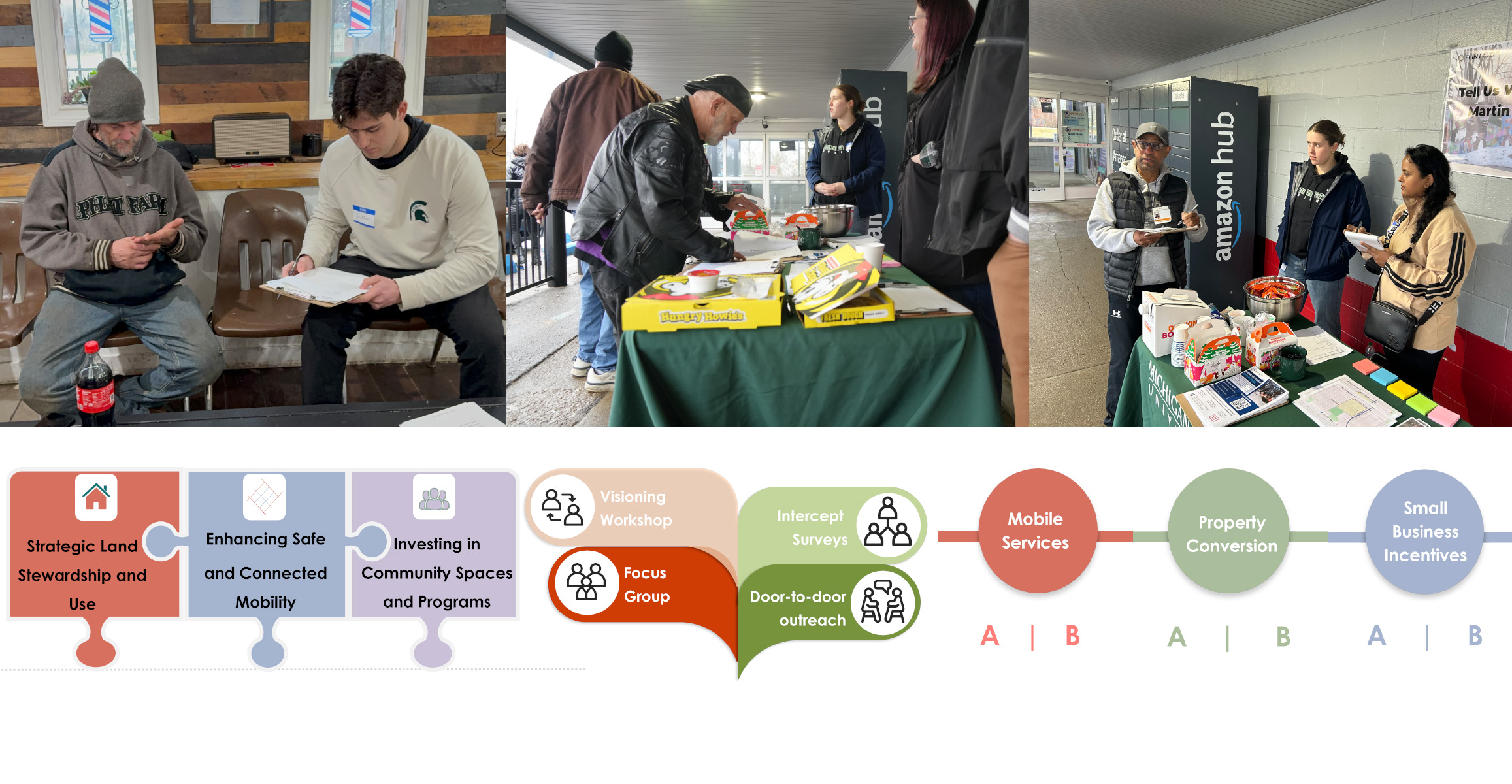
The Urban & Regional Planning Practicum is the signature capstone experience of Michigan State University’s Urban & Regional Planning Program. Through semester-long partnerships with municipalities, public agencies, nonprofit organizations, and community groups, students work with community partners to address real planning challenges and develop practical, implementation-oriented recommendations.
Working in faculty-guided teams, students apply research, community engagement, spatial analysis, planning and design, and policy analysis to real-world projects across Michigan. Each project culminates in professional planning products and actionable recommendations that help community partners advance locally identified priorities while preparing students for professional planning practice.
EXPLORE FEATURED PROJECTS | VIEW PROJECT REPORTS
Community Impact by the Numbers
| 50+ | Communities Served |  |
| 75+ | Community Partners | |
| 500+ | Students Engaged | |
| 100+ | Professional Planning Reports | |
| 28+ | Years of Community Partnership | |
| 4 | APA Award-Winning Student Projects (2018,2024 & two in 2026) |
A Living Laboratory for Community-Engaged Planning
Each year, Practicum teams work with communities on planning challenges ranging from neighborhood revitalization and economic development to housing, transportation, climate resilience, placemaking, and sustainable urban design.
Guided by faculty and informed by community knowledge, students follow a structured planning process that integrates research, analysis, public engagement, concept development, and implementation planning. This process allows students to navigate the opportunities and complexities of professional planning practice while producing work that responds to community priorities and supports local decision-making.
Through each partnership, the Practicum connects university knowledge with local experience to turn community priorities into practical planning strategies. Communities gain additional capacity, research, and new perspectives, while students develop the skills and professional experience needed to become thoughtful, collaborative, and practice-ready planners. Together, these partnerships demonstrate the value of community-engaged planning in creating meaningful and lasting impact across Michigan.
 Print
Print Email
Email