


Community Change Guide for Breastfeeding
Community breastfeeding support (also called lactation support) makes it easier for families to feed their babies comfortably and confidently.
This can help families:
- Reduce stress.
- Meet their feeding goals.
- Promote inclusive and family‑friendly values.
- Support staff morale and retention in workplaces.
This resource is designed for community champions who want to build or strengthen breastfeeding‑friendly environments in community settings, workplaces and early childhood programs.
Use this Community Change Guide for Breastfeeding to find practical steps, examples and tools for getting started. The guide follows Michigan State University Extension’s Six-Step Model to Community Change to help you move from identifying needs to taking action and sustaining improvements over time.
Here's how:
Step 1: Identify the need
Organizations can identify a community need for lactation support in several practical ways:
Talk with the people you serve: Ask parents and caregivers if they feel comfortable breastfeeding or pumping onsite. You can include short questions in existing surveys, registration forms or intake conversation. Simple questions might include:
What would make this space feel more welcoming for you and your baby?
Do you have suggestions for improving breastfeeding or pumping support at this location?
Observe your environment: Look around your space and note whether there are private, comfortable places to breastfeed or pump. Notice gaps such as limited seating, a lack of privacy or no accessible electrical outlets. Pay attention to staff observations. Have families asked about private spaces or seemed unsure about where they can feed their baby? Are the only options restrooms? Consider who you serve. If your site regularly serves parents with newborns, infants or toddlers, there is likely a need for lactation support.
Review your policies and practices: Check whether your organization has written guidance on supporting lactating families. Look for gaps, such as no designated space, unclear staff expectations or policies that are missing, outdated or hard to find.
Tool for identifying the need: Use the Identify the Need Guide and Worksheet to learn more about ways to identify a strong community need for breastfeeding support.
Step 2: Bring people together
Lactation support changes are more likely to last when more than one person supports the effort.
If possible, start by identifying two to four people who care about this issue and have influence in the setting you want to improve. Depending on your focus, this might include staff, parents, or community volunteers. This does not need to be a formal committee. A simple Lactation Support Team can begin with one short conversation and a shared goal, such as:
What is the need we are trying to address?
What is one realistic change we can try?
How will we communicate the goal and encourage participation?
Who will help support the change so it does not rely on one person?
Not every organization or business can form a team right away. If you are leading this change on your own, that is still a strong place to start. Often, one person’s first step shows what is possible and helps build support over time.
Tip: Keep the first ask small. Many teams start with one quick win that is easy to try and easy for others to support.
Tool for bringing people together: Use the Bring People Together Guide and Worksheet to identify and engage people who should be part of your lactation support team.
Step 3: Explore what's working
Before making a change, take time to consider the strengths, gaps and opportunities for improvement associated with your current or planned lactation space. This will help your team be thoughtful about changes that are realistic and most helpful to your breastfeeding families.
Ideas for putting what's working into practice
Across Michigan, community organizations and businesses are making meaningful, lasting changes to support breastfeeding. The ideas below show different ways communities are creating supportive lactation spaces.
Idea 1: Lactation space at a community organization in Oakland County
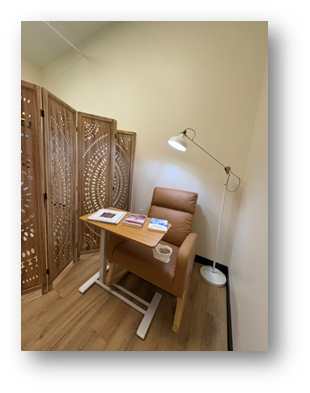
A local nonprofit in Oakland County serves primarily Spanish‑speaking and immigrant families. The organization created a clean, private and welcoming lactation space for families visiting the resource center. The space gives parents a safe place to feed and rest with their babies, with a lactation consultant on staff for support. Staff and community leaders helped shape and promote the space. Because it builds on existing services and uses a dedicated area that people already care for, the lactation space has become part of daily operations and is easier to maintain over time.
Photo credit: Ghaida Havern
Idea 2: Lactation space at an outdoor event with a local WIC agency
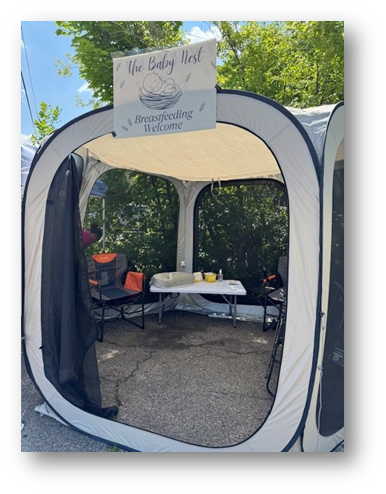
Genesee County Women, Infants & Children (WIC) serves low-income pregnant and postpartum women, breastfeeding parents and young children. WIC Breastfeeding Peer Counselors already lead outreach and education. For outdoor events, they created a welcoming lactation space where parents can breastfeed, pump, rest or ask questions. By adding lactation support to events WIC already hosts, the space feels natural, visible and easy for families to use.
Photo credit: Ghaida Havern
Idea 3: Breastfeeding support policy
Another approach is creating or updating a local breastfeeding support policy at your site. Policies can include specific goals, such as providing at least one safe and comfortable space for employees to use, or they can use more general language. The most important thing is that your policy is tailored to your organization. Customizing the policy to your specific setting makes it easier for you to adopt, implement and sustain the change.
Tool for exploring what's working
Use the Explore What’s Working Guide and Worksheet to find a list of guiding questions to help you determine your community's assets, opportunities and readiness for change.
Check out Michigan State University Extension’s Stories of Change for more ideas.
Step 4: Gather resources
These trusted resources can help you plan, implement and sustain your breastfeeding support work. Each resource offers tools and examples that can be adapted to fit the needs, capacity and culture of your organization.
Michigan State University lactation support resources
Breastfeeding and Returning to Work Part 1 and Part 2: Supporting breastfeeding parents in the workplace is important to maintain breastmilk as a primary source of nourishment for babies. Learn more about breastfeeding rights in the workspace and practical tips when returning to work.
Breastfeeding Friendly Environments Change Guide: This resource explains how to create a comfortable, private and accessible lactation space along with supportive environmental features. This document helps you design a welcoming environment that supports breastfeeding employees, visitors and clients.
Lactation Station Story at a Michigan Fair: Learn how Michigan State University Extension collaborated with community partners to create a designated private and clean space for nursing parents at St. Clair County 4-H and Youth Fair.
Local Breastfeeding Support Policy Change Guide: This highlights ideas you can include when developing or updating a breastfeeding support policy. It helps you quickly identify policy elements that strengthen support for breastfeeding across your organization.
Other lactation support resources
Michigan Women, Infants & Children (WIC) Program: WIC helps families access nutritious foods, breastfeeding assistance and resources that improve pregnancy outcomes and child development.
Michigan Breastfeeding Network: A statewide coalition that works with partners to drive system-level change centered on the needs of Michigan families with young children.
U.S. Breastfeeding Committee (USBC): Policy, Systems and Environmental (PSE) Change Resources: Organizations can get help to strengthen their breastfeeding support by getting evidence-based materials on health impacts, policy development, equity considerations and environmental supports.
U.S. Department of Agriculture (USDA): WIC Breastfeeding Support: Organizations can find help to enhance their breastfeeding promotion efforts on social media by receiving customizable, evidence informed messages.
Tool for gathering resources: Use the Gather Resources Guide and Worksheet to guide your review of trustworthy sources, practical strategies and real‑world examples.
Step 5: Make a plan and act
A strong plan does not need to be complicated. The most effective approach is to choose one goal, select one strategy and test it for 4-6 weeks.
First, choose the system you want to improve. Ideas are:
Improve or create a physical space that supports lactation.
Update your organization's lactation policy.
Provide staff training and awareness.
Improve or create breastfeeding communication and/or signage.
Next, pick one clear goal. This helps prevent the process from feeling overwhelming and supports steady progress. Examples are:
Ensure employees know where the lactation space is and how to access it.
Update your lactation policy to be more inclusive and easier to understand.
Provide supervisors with guidance on supporting employees who need pumping breaks.
Increase visibility of lactation-friendly messaging throughout the building friendly messaging throughout the building.
Finally, try one quick win for 4-6 weeks. Choose something realistic. Here are some high impact starter options:
Add a comfortable chair, table and outlet to your private lactation space.
Post a privacy sign, such as “Lactation Room in Use.”
Stock the room with basic supplies, such as cleaning wipes or a small trash bin.
Provide refrigeration space for storage of breastmilk.
Email staff a short message explaining available lactation supports.
Include your lactation support information in new employee onboarding materials employee onboarding materials.
Tool for making a plan and taking action: Use the Make a Plan and Act Guide and Worksheet to map out an action plan and identify simple steps to start.
Step 6: Reflect and share what you learned
After you try a change for 4-6 weeks, take a few minutes to reflect on what worked, what felt realistic and what you might adjust moving forward. Reflection helps you strengthen your approach and builds momentum over time.
Ask simple reflection questions
What worked well?
What challenges came up and what helped?
What would make this easier to continue?
What is one next step to keep going or expand the change?
If your change is working, consider sharing it with others. Even a short message at a meeting, email or informal conversation can help build buy-in and encourage wider participation.
Tool for reflecting and sharing: Use the Reflect and Share Guide and Worksheet to help you tell your story of change.
Breastfeeding Key Resources
All key resources below are free to use and share. Additional resources can be found under the "Step 4: Gather resources" section.
Breastfeeding Friendly Environments Change Guide
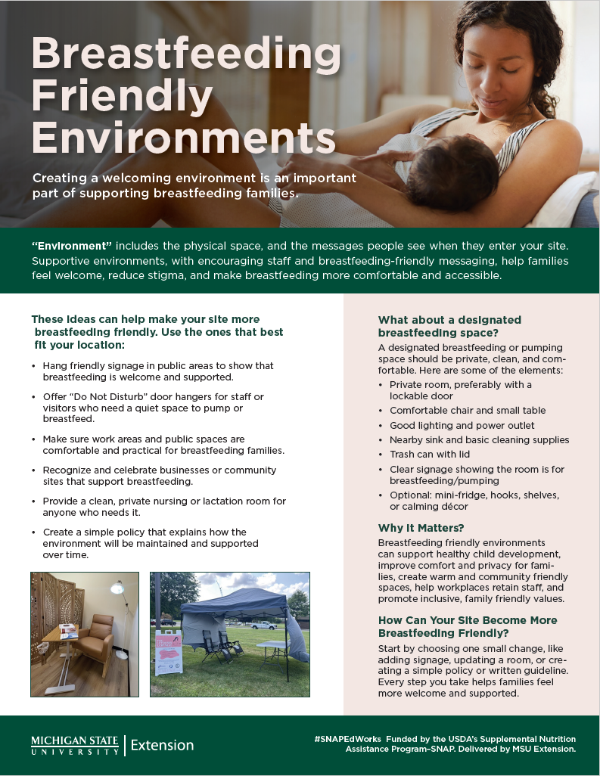 This resource explains how to create a comfortable, private, and accessible lactation space along with supportive environmental features. This document helps you design a welcoming environment that supports breastfeeding employees, visitors, and clients.
Local Breastfeeding Support Policy Change Guide
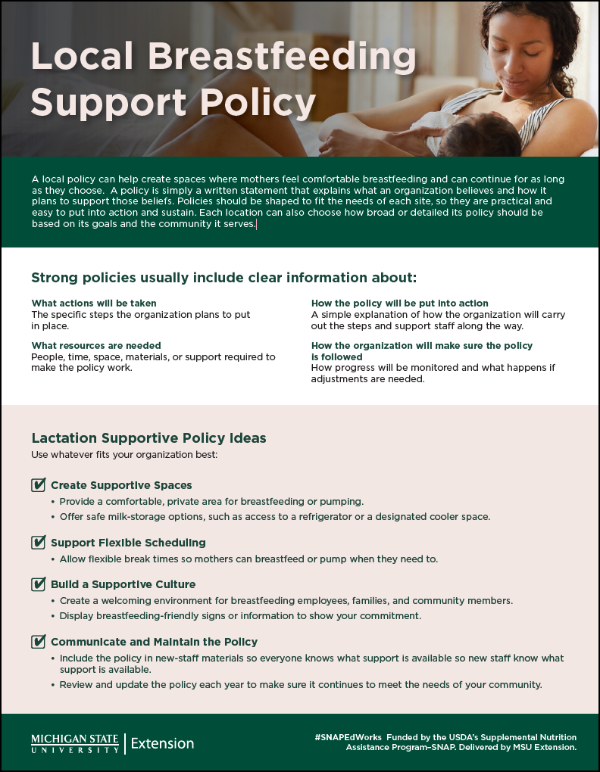 This resource highlights ideas you can include when developing or updating a breastfeeding support policy. It helps you quickly identify policy elements that strengthen support for breastfeeding across your organization.
Michigan WIC Program
 WIC helps eligible families access nutritious foods, breastfeeding assistance, and resources that improve pregnancy outcomes and child development.
 Print
Print Email
Email