


Community Change Guide for School Wellness Policy
Local wellness policies reflect a district’s commitment to student wellbeing.
A local school wellness policy (wellness policy) is a federally required document that outlines a school district’s policies and practices that promote health and wellbeing. Strong policies can:
- Improve access to healthy food.
- Increase opportunities for physical activity.
- Strengthen family and community engagement.
This resource is designed for community champions who want to update their school district’s wellness policy.
Use this Community Change Guide for School Wellness Policy to find tips for getting started, practical examples and reliable tools to update and review local school wellness policies. This guide follows Michigan State University Extension’s Six-Step Community Change Model to help you move from identifying a need to taking action and sustaining changes.
Here's how:
Step 1: Identify the need
All school districts that participate in the National School Lunch and Breakfast Programs are required to maintain a local school wellness policy and complete a formal review of it at least once every three years. This is called a Triennial Assessment. Under a federal regulation stated in a 2016 Final Rule, districts must take appropriate action to remain in compliance with the state and federal rules. Reasons to update or review a policy include:
The school district is due for a Triennial Assessment.
A school or district wants to establish an annual review process.
A school or district desires to promote and help sustain healthy practices by including them in their wellness policy.
Naming the reason why change is needed is the first step toward building a stronger, more sustainable policy. It can be useful to look at your district’s current strengths, gaps and priorities.
Tool for identifying the need: Use the Identify the Need Guide and Worksheet for suggested questions, ideas and examples of how to clarify a specific need, why it matters and what benefits it could have for staff, students and community members.
Step 2: Bring people together
Strong wellness policies are built and maintained through shared leadership. Federal regulations require districts to include multiple people in wellness policy development, implementation and review, called a “wellness committee.” A wellness committee represents diverse perspectives and should include decision makers and experts in nutrition, physical activity and district wellness. Some districts have existing wellness committees or health teams that take on this work. Others will need to recruit and invite team members. This might include:
District and building administrators
Teachers and support staff, especially health and physical education teachers
Food service team members
Health staff (school nurses, aides)
Parents
Community partners
Custodial staff
Students
Identifying a “champion” can help move the work forward, especially when capacity is limited. Be prepared to explain why this process is important and what it might look like. Key questions for your team are:
Who will lead and organize this work?
What responsibilities does each person have?
How will decisions be recorded?
How will progress be shared with others who need to know?
How will the work continue if members leave or new people join?
Tool for bringing people together
Use the Bring People Together Guide and Worksheet to identify people to include in your action team.
Learn about what a wellness committee is and how to recruit members using the U.S. Department of Agriculture's Outreach Toolkit.
Step 3: Explore what’s working
Successful school districts often use a combination of assessment tools, facilitated planning processes and ongoing wellness committee engagement to guide wellness policy work. Example goals that the district might want to focus on include:
Evaluate and update wellness policies using the Wellness School Assessment Tool (WellSAT) and other tools.
Align policy with daily practice and district planning.
Engage families and community partners.
Ensure policies meet federal and state requirements.
Reflect current practices and highlight unique initiatives.
Create and maintain an active wellness committee.
Put the policy into action and document progress.
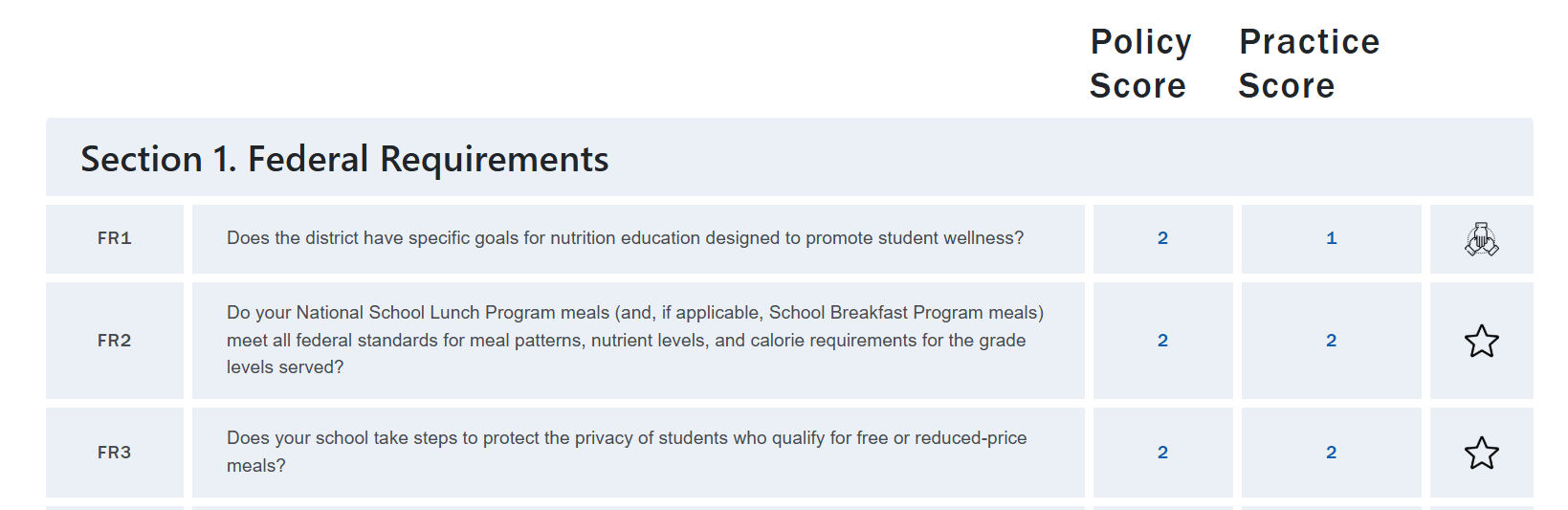
Example of a WellSAT scorecard
School districts in Michigan have partnered with Michigan State University Extension to reach many of these goals. They made commitments to improve the wellbeing of their school communities in different ways that reflected their needs. Their efforts towards district-level change to create healthier school environments highlight what is possible through wellness policy work.
Tool for exploring what's working
Use the Explore What’s Working Guide and Worksheet to guide you through this conversation.
Check out Michigan State University Extension’s Stories of Change for more ideas.
Step 4: Gather resources
Once you have identified your needs and explored possible approaches, the resources below can help you complete required assessments, strengthen policy language, develop action plans and document progress.
Michigan State University local school wellness policy resources
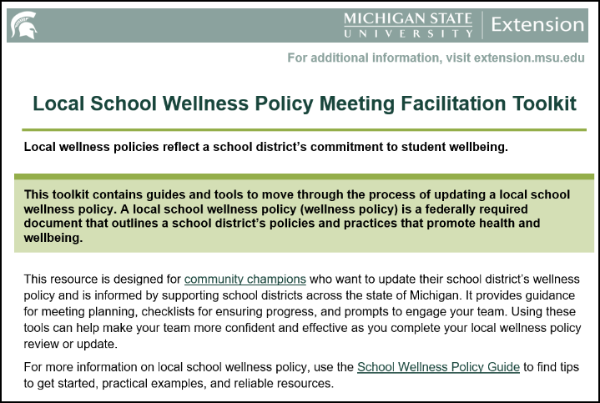
Local School Wellness Policy Meeting Facilitation Toolkit: Step-by-step tool for organizing assessment, review and update activities. It helps teams stay on track and meet federal requirements.
MSU Extension School Wellness and Nutrition resources: Articles and guidance supporting school wellness, nutrition and physical activity. It builds background knowledge and provides inspiration for updated policies and practices.
Michigan Department of Education and MSU Extension Farm to School Local Wellness Policy Sample Goals: Policy language to consider for integrating farm to school in local school wellness policy.
Other local school wellness policy resources
Alliance for a Healthier Generation Local School Wellness Policy: A guide for writing a new policy or refreshing an existing one.
Michigan Department of Education Local School Wellness Policy tools and templates: Helps districts navigate the triennial process using state-specific tools and examples.
U.S. Department of Agriculture (USDA) Local School Wellness Policy guidance: Federal guidance and tools for reviewing and updating wellness policies.
USDA Team Nutrition School Wellness resources: Training, tools, and technical assistance to build wellness committees, and support policy development and implementation.
WellSAT (Wellness School Assessment Tool): Online tool for evaluating wellness policies and practices with additional helpful resources.
Using these resources together
Many districts use several tools for their policy review or update. For example, during the review, you might use:
WellSAT to assess your current policy.
Team Nutrition tools to guide action planning.
MSU Extension Local School Wellness Policy Meeting Facilitation Toolkit to organize action steps and timelines.
Michigan Department of Education resources to ensure state-level compliance for Michigan schools. If your school is outside of Michigan, check your state's Department of Education website for more information.
Together, these resources support a structured, manageable approach to wellness policy improvement.
Tool for gathering resources: Use the Gather Resources Guide and Worksheet to focus your goals and find reliable resources to help you implement your change.
Step 5: Make a plan and act
After identifying needs, building a team, exploring examples and reviewing resources, the next step is to develop a clear, manageable plan. A strong plan focuses on one priority area at a time and outlines specific actions, timelines and responsibilities. A helpful and free assessment tool to guide this process is the WellSAT Policy and Practice. To accomplish your goals, there are some important steps for reviewing or updating your wellness policy and completing the triennial assessment.
For reviewing or refreshing your wellness policy, take the following steps:
Complete the WellSAT Policy and Practice.
Make changes based on recommendations from WellSAT to the wellness policy.
Repeat the WellSAT Policy and Practice for updated or edited sections.
For completing a Triennial Assessment, take the following steps:
Complete the WellSAT Triennial Assessment guide.
Use data collected to complete Triennial Assessment using state tools.
Work with administrators to post the updated wellness policy and WellSAT results to publicly available resources (website, newsletter, etc.).
Tool for making a plan and acting: Use the Make a Plan and Act Guide and Worksheet to map out an action plan and identify simple steps to start.
Step 6: Reflect and share what you learned
Regular review and reflection of wellness policy updates help districts track progress, identify gaps and prepare for future assessments and reporting. Guiding questions include:
What stood out while reviewing the WellSAT policy and practice?
What was challenging about this process? What was enjoyable?
What was learned while updating the wellness policy?
What should be prioritized next?
Districts are encouraged to maintain records of assessments, meeting notes, action plans and policy updates. Sharing progress with staff, families, school boards and community partners builds trust and reinforces wellness priorities. It is federally required to publicly post the final wellness policy.
Updating or reviewing the wellness policy should be included in a long-term review process, such as at wellness committee meetings or board meetings. By revisiting the policy each year, updates will be easier to complete and the work will be more manageable. Determine how your district will continue to make wellness policy work a priority in the future.
Tool for reflecting and sharing: Use the Reflect and Share Guide and Worksheet to help with this step.
School Wellness Policy Key Resources
All key resources below are free to use and share. Additional resources can be found under the "Step 4: Gather resources" section.
Local School Wellness Policy Meeting Facilitation Toolkit
Michigan Department of Education Local School Wellness Policy Tools and Templates
 This resource helps districts navigate the triennial process using state-specific tools and examples.
USDA Team Nutrition School Wellness Resources
 Training, tools and technical assistance to build wellness committees, and support policy development and implementation.
 Print
Print Email
Email