


Water Quality Monitoring
Water Quality Monitoring
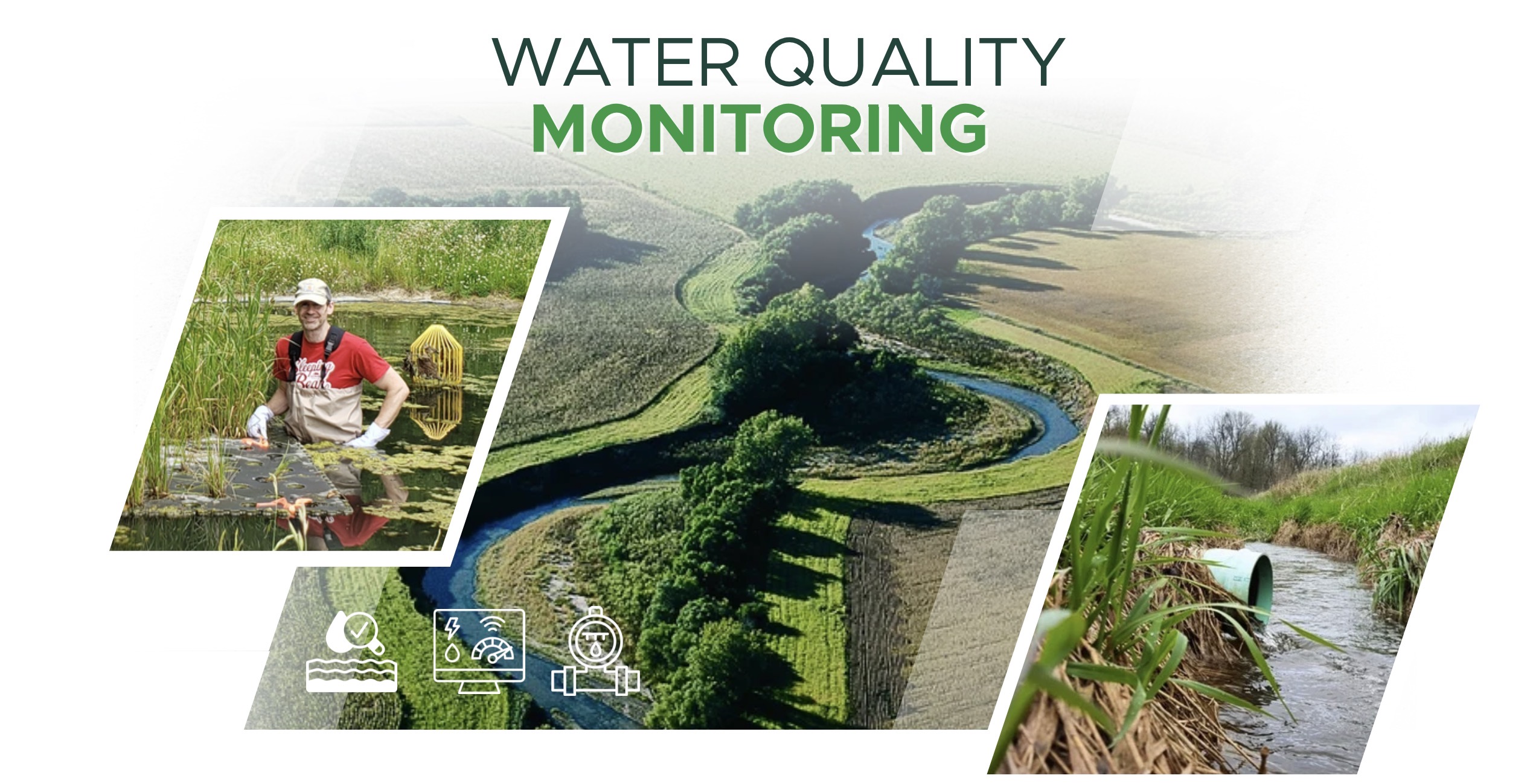
Water quality monitoring helps researchers understand how agricultural practices affect rivers, streams, and downstream ecosystems. By measuring nutrient and sediment movement from fields, drainage systems, and waterways, researchers can identify effective conservation strategies that improve both water quality and agricultural resilience.
Why It Matters
Agricultural runoff can carry nutrients and sediment into nearby waterways, impacting ecosystems and drinking water supplies. Monitoring provides the data needed to better understand these losses and improve conservation outcomes.
Key benefits include:
- Measuring nutrient and sediment movement from agricultural landscapes
- Evaluating conservation practices under real-world conditions
- Supporting science-based recommendations for farmers and land managers
- Improving long-term water quality and agricultural sustainability
Focus on the Western Lake Erie Basin
Water quality monitoring is especially important in the Western Lake Erie Basin (WLEB), where excess phosphorus has contributed to harmful algal blooms in Lake Erie.
Monitoring efforts help:
- Identify when and how nutrients leave agricultural fields
- Improve strategies to reduce phosphorus losses
- Support regional water quality goals
- Protect drinking water and aquatic ecosystems
IWR Expertise
The Institute of Water Research (IWR) at Michigan State University designs and implements monitoring systems that generate practical, science-based insights for producers, policymakers, and conservation partners.
IWR Expertise Includes:
- Edge-of-field and tile drainage monitoring
- Water quality data collection and analysis
- Conservation practice evaluation
- Watershed-scale monitoring and assessment
- Data-driven solutions for water quality improvement
Priority Areas
Edge-of-field monitoring – Measures nutrient losses directly from agricultural fields
Tile drainage monitoring – Tracks subsurface nutrient transport
Storm event sampling – Captures high-impact runoff events
In-stream monitoring – Assesses watershed-wide water quality impacts
Sediment monitoring – Evaluates erosion and sediment movement
Practice performance monitoring – Measures conservation effectiveness
Groundwater monitoring – Detects nutrient leaching and long-term impacts
Real-time sensor networks – Supports continuous monitoring and adaptive management
Current Work
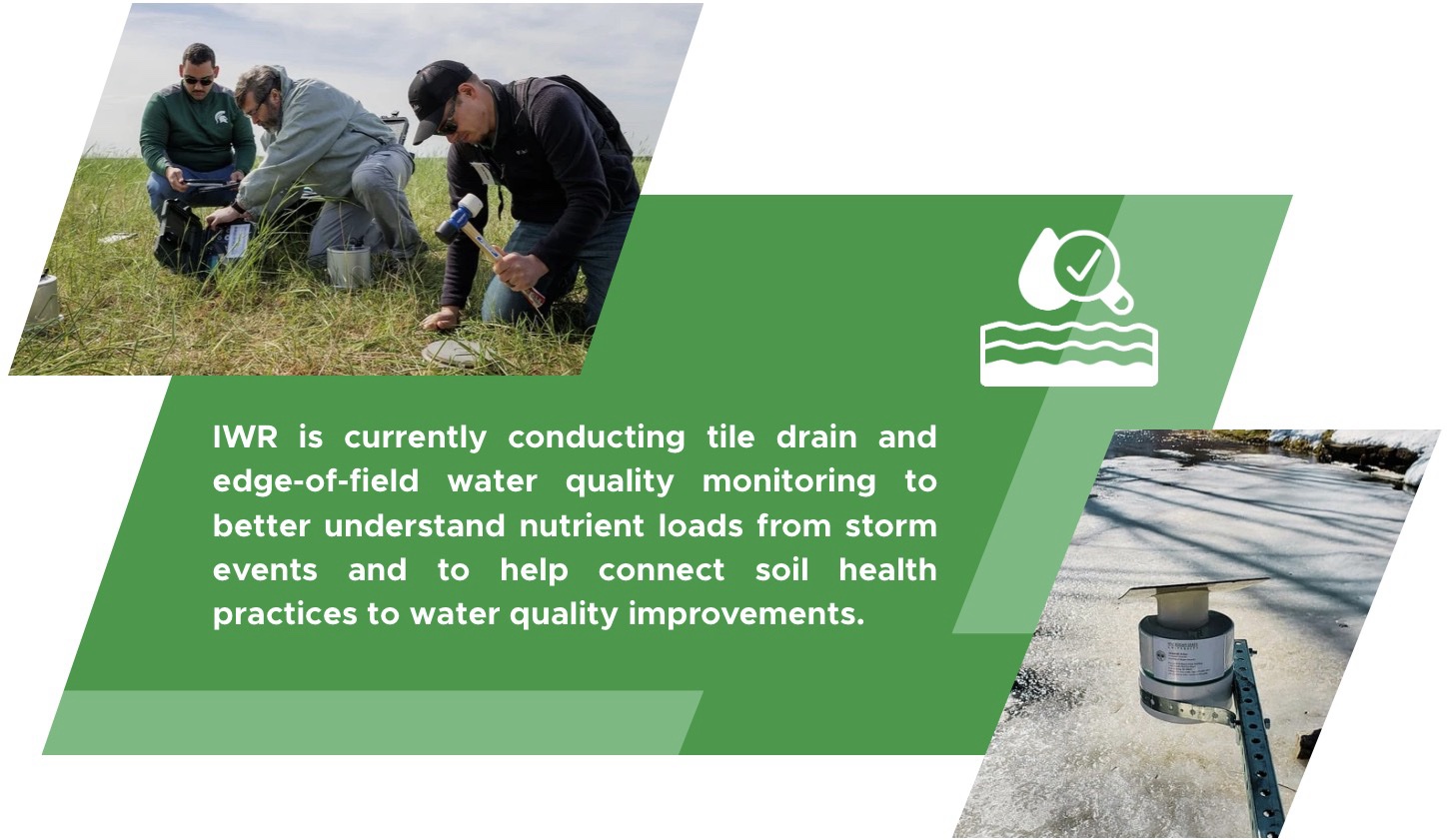
IWR and its partners are conducting tile drain and edge-of-field monitoring to better understand nutrient movement during storm events and connect soil health practices to measurable water quality improvements.
IWR is also leading a $12 million pay-for-performance conservation initiative in the WLEB that rewards measurable environmental outcomes rather than practice adoption alone.
Team Leadership
Team lead:
Jeremiah Asher - Assistant Director, Institute of Water Research

Jeremiah Asher is the Assistant Director at the Institute of Water Research, having an extensive background in geographic information systems (GIS), project management, decision support system development, and natural resource management. His research focus is on translating field research to decision support application systems. He is the chief application developer for two nationally awarded decision tools, the North Carolina Ecosystem Enhancement Program for Pasquotank Watershed and the Water Withdrawal Assessment Tool interface for the State of Michigan. His most recent activities and research focus on developing sensors for managing water, groundwater and managed aquifer recharge, edge-of-field monitoring, and floating wetland research.
Contact:
Phone: +1 517-432-5586
Email: asherjer@msu.edu
Collaborators:
Dr. Alex Kuhl

Research Associate
Email: kuhlalex@msu.edu
Cole Kelley
Research Assistant I
Email: kelle118@msu.edu
Quinton Merrill

Research Assistant I
Email: merrillq@msu.edu
Samantha Smith

Research Assistant
Email: smit3592@msu.edu
Dr. Andrey Guber
Professor - Soil physics, soil hydrology and modeling water flow, solute and microbial transport in soils
Email: akguber@msu.edu
 Print
Print Email
Email