Agrivoltaics as a rural economic engine in Michigan
 Print
Print Email
EmailAgrivoltaics offers a practical framework for producing food and electricity on the same land while supporting farmer choice, rural economic development and long-term agricultural viability.
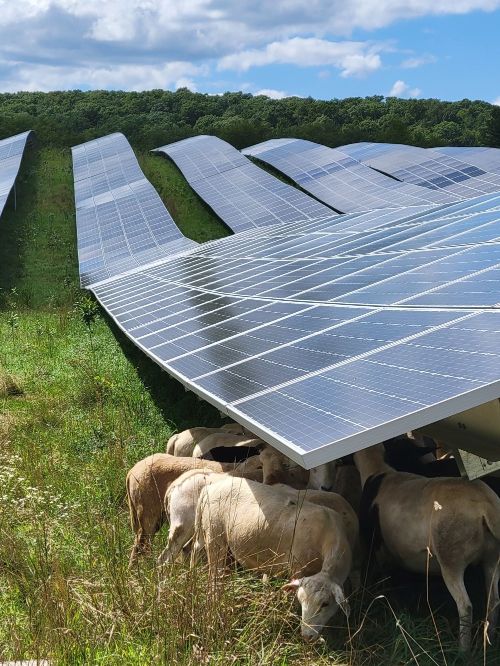
There is broad recognition that solar development can be sited in locations other than farmland, and that those alternatives should be evaluated first. However, solar projects already exist on farmland, additional projects are awaiting state or local review, and others are planned throughout Michigan's agricultural regions. When solar projects are built on farmland, it does not mean the land can’t be used to grow crops or graze livestock.
Producing food and power on the same land
Agriculture and solar is not a zero-sum proposition, meaning that if solar is put on agricultural land then agriculture must cease. That is simply not true, but it requires a paradigm shift in the way people think about how food is grown. Food for human consumption and electricity generation can occur on the same ground. In fact, not doing so may be one of the greatest missed opportunities in the future of sustainable land use. For example, if the vegetative groundcover of every currently operating and in-construction utility-scale solar facility (6.45 GW on approximately 32,000 acres in Michigan) was managed as an agricultural operation, the acreage could transform our state’s sheep industry from $13.9 million to $40 million in annual farm cash receipts and up to $115 million in annual regional economic contribution. This is where agrivoltaics offers a practical pathway to strengthen both energy and food security without requiring additional land. Agrivoltaic projects can be found throughout the United States and around the world (click here for a map of U.S. dual-use projects).
Farmer choice and land use decisions
Conversations with farmers over the years have repeatedly highlighted the importance of respecting private property rights and farmers' ability to make decisions regarding their land. Farmers don’t post a notice for public comment when they are going to grow soybeans in a field that grew corn the previous season. We accept the fact that they have made the best decision for their farming enterprise. No one questions their judgment. Why should that be any different for a farmer who recognizes the benefit of a solar project for their farming enterprise? Farm families who have owned and cared for their land for generations deserve a meaningful voice in determining its future.
For many farm families, these decisions are also shaped by economic realities. A significant number of farmers are approaching or beyond retirement age and wish to transition out of production agriculture. Years of thin profit margins have left some farmers without retirement savings. Their children have witnessed the financial challenges their parents faced and are reluctant to continue farming. Solar lease contracts and vegetation management contracts can provide two new sources of reliable and predictable farm income. Lease payments can support retirement, while long-term vegetation management opportunities can create incentives for younger generations to remain engaged in the farm business. Farmland doesn’t stay farmland because people love looking at it. It stays farmland because someone can make a living from it.
Washtenaw solar project case study
When developers estimate the economic impact of a solar project, they routinely include indirect (supply chain) and induced (household spending) effects in their analyses. While these ripple effects represent utility capital expenditures, developers rarely calculate the economic contributions of agricultural activities that can coexist within the array fenceline.
The Washtenaw Solar project provides an example of the agricultural employment and economic benefits that can be missed when solar and agriculture are treated as mutually exclusive land uses. The Michigan Public Service Commission found the proposed solar project’s current layout contains approximately 943 acres inside the array fencing. At an average stocking rate of three breeding ewes per acre, the land could support approximately 2,829 ewes. This stocking rate would provide low-impact seasonal grazing for the vegetation described in project filings.
Based on Michigan's average ratio of 1.2 marketed lambs per ewe, the flock would produce approximately 3,395 marketable lambs annually. This level of production generates more than 724,000 three-ounce servings of lamb each year, enough to serve over 181,000 families of four. If marketed wholesale two to three weeks before Easter, the lambs could generate approximately $814,800 in gross farm revenue. Alternatively, producers could retain the lambs for additional weight gain or use them in grazing operations, marketing them later at heavier weights and potentially achieving similar or greater revenues depending on market conditions. Ultimately, returns depend on how producers position themselves within the lamb marketplace and capture consumer demand.
An economic analysis was conducted using IMPLAN, an economic impact modeling software platform, to compare solar grazing activities with corn and soybean production over the 943 acres in the solar project. This comparison shows that the sheep + land maintenance scenario produces an estimated $1.86 million in total economic impact, compared with $1.49 million for corn and $775,000 for soybeans (Table 1). Relative to traditional crop production, sheep grazing and associated vegetation management generate approximately:
- 25% more total economic activity than corn production
- 4 times more total economic activity than soybean production
Table 1. Economic and employment impact comparison between solar grazing and corn and soybean production in the Washtenaw Solar Project.
|
|
Sheep + Land Maintenance |
Soybeans |
Corn |
|||
|
|
Economic Impact |
Employment |
Economic Impact |
Employment |
Economic Impact |
Employment |
|
Direct |
1,188,557 |
13.52 |
522,138 |
5.00 |
701,356 |
2.50 |
|
Indirect |
175,407 |
0.78 |
136,078 |
6.52 |
543,722 |
3.26 |
|
Induced |
491,956 |
2.55 |
116,547 |
2.48 |
240,616 |
1.24 |
|
TOTAL |
1,855,920 |
16.85 |
774,763 |
14.00 |
1,485,694 |
7.00 |
Other implications include the following:
- The sheep + land maintenance scenario generates approximately $492,000 in induced impact, which is more than double that of corn and over four times that of soybeans. This suggests that income earned from sheep grazing and vegetation management circulates more strongly through the local economy.
- The sheep + land maintenance scenario has the largest direct economic impact at approximately $1.19 million and 13.52 direct jobs. This indicates that most of the value is generated through on-the-ground agricultural and land-management activity rather than through secondary economic effects.
- Corn has the largest indirect economic impact ($544,000), indicating that corn production creates greater spending throughout supporting businesses and suppliers. However, even with these larger indirect effects, its overall economic impact remains lower than the sheep + land maintenance scenario.
It should be noted that the developer’s siting application states the solar project will create 13 total operations jobs. Under a solar grazing model, the mowing-related portion of these operational jobs would be replaced by shepherds responsible for vegetation management.
Practical agrisolar does not require specialty solar engineering
Sheep grazing demonstrates why specialty solar engineering is not required. A 2025 study evaluated sheep agrisolar business models across solar projects ranging from 200 kW to 465 MW and concluded that conventional solar designs can accommodate sheep without reducing electricity yield. Reliable grazing service payments improved farm profitability and resilience, with modeled returns on investment of 16%–31% for breeding-flock systems and 22%–43% for purchased-lamb systems. The most important enabling decisions were operational—vegetation selection, water, fencing, access, contracts and coordination—rather than changes to the panel system itself.
As Michigan navigates the expansion of utility-scale solar development, the question should not be whether land produces food or energy, but how it can produce both. Agrivoltaics demonstrates that with thoughtful planning and management, solar projects can support farm profitability, strengthen rural economies, enhance food and energy security and preserve agricultural opportunities for future generations. Rather than viewing agriculture and solar as competing land uses, policymakers, developers and communities should recognize the value of systems that allow both to thrive on the same acreage. Doing so may help address concerns regarding the "unreasonable diminishment of farmland" standard established under PA 233. The greatest public benefit will come from solar projects that simultaneously generate electricity, support agricultural production, create jobs and strengthen rural economies.
Acknowledgments: The author acknowledges the contributions of Samantha Craig, Craig Farms Katahdins dba Shepherd's Garden, for providing the sheep + land maintenance information and Bill Knudson, Professor, MSU Center for Economic Analysis, for assistance with IMPLAN modeling and economic impact analysis used in this article.