Connection Session Summary - Collective Impact: From Ideation to Action
July 2, 2026 - Lindsey Scalera, Colleen Matts, Anya Knecht, Megan Murphy
 Print
Print Email
EmailThe Statewide and Regional Food Systems Plans National Community of Practice hosted a Connection Session on May 28, 2026 to discuss Collective Impact: From Ideation to Action.
Session Details
Guest speakers:
- Anya Knecht, Knecht Research Consulting & Design, and Owner and Farmer at Anya Farm
- Megan Murphy, Food Systems Coordinator, University of Illinois Urbana-Champaign
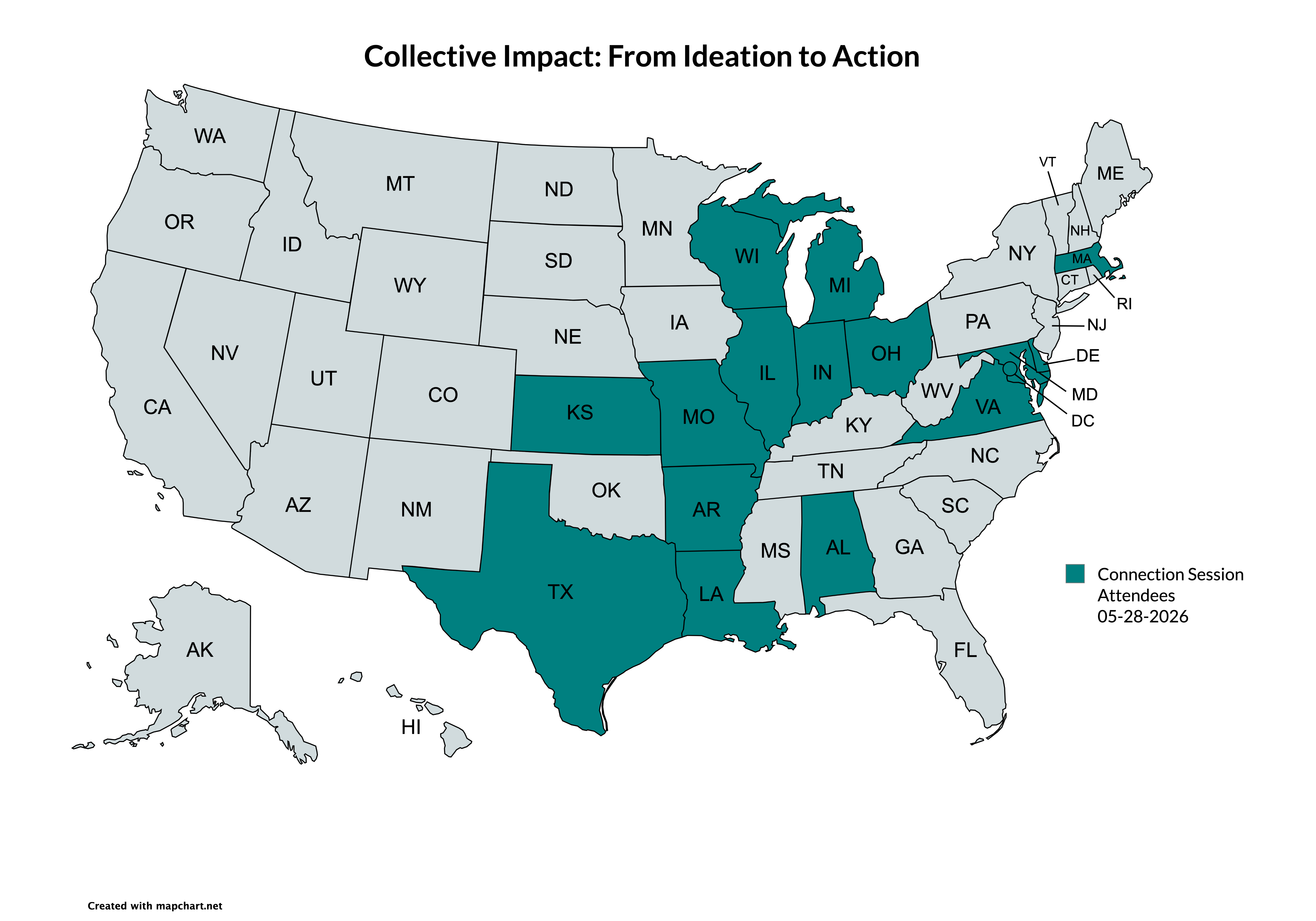
Attendees joined from Alabama, Arkansas, Delaware, Illinois, Indiana, Kansas, Louisiana, Maryland, Massachusetts, Michigan, Missouri, Ohio, Texas, Virginia, Washington DC, and Wisconsin.
Background
Collective Impact (and its subsequent updates over the years) is a framework for community-based change. Processes grounded in Collective Impact have successfully supported groups in addressing complex issues–issues that require more than one sector to work together. Collective Impact can bring us out of our silos and help us strategically contribute to the whole.
In this Connection Session, two guest speakers from Illinois joined us to discuss Collective Impact and how it differs from other forms of collaboration. Through an interactive discussion and a follow-up survey, we also gauged interest in continuing the conversation on this topic.
This session is not specifically related to the food system plan or planning process for Illinois, but please see the Illinois Food System Roadmap to learn more. It is also available in our plans gallery, where you can find food system plans for other states and regions.
Grounding Activity and Introduction
In a live poll, participants were first asked about their level of familiarity with Collective Impact.
- The majority of participants (59%) who responded indicated this was their first time learning about the framework, while 32% reported being part of a Collective Impact project or group, currently or previously.
- Fewer participants were familiar with foundational articles on the topic; 18% had read the initial 2011 article about Collective Impact by Kania and Kramer (Stanford Social Innovation Review), and 14% were familiar with the article Collective Impact 3.0: An Evolving Framework for Community Change by Cabaj and Weaver (Tamarack Institute, 2016).
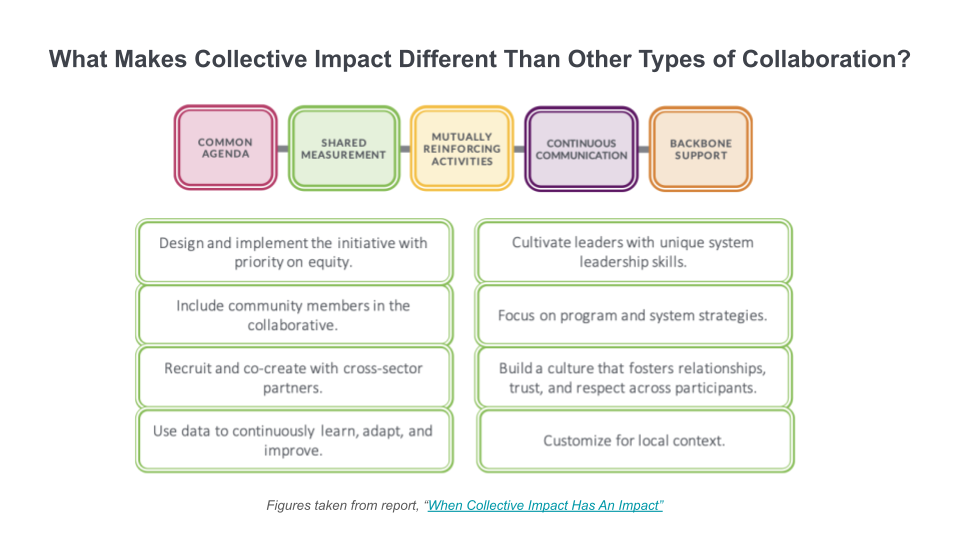
Guest speaker, Megan Murphy, introduced Collective Impact by reviewing what makes it different from other types of collaboration, starting with its cross-sector composition of people or groups involved, as well as five conditions and principles of practice that are important for achieving population change. These are shown below in figures from the report When Collective Impact Has an Impact: A Cross-Site Study of 25 Collective Impact Initiatives (Spark Policy Institute & ORS Impact, 2018).
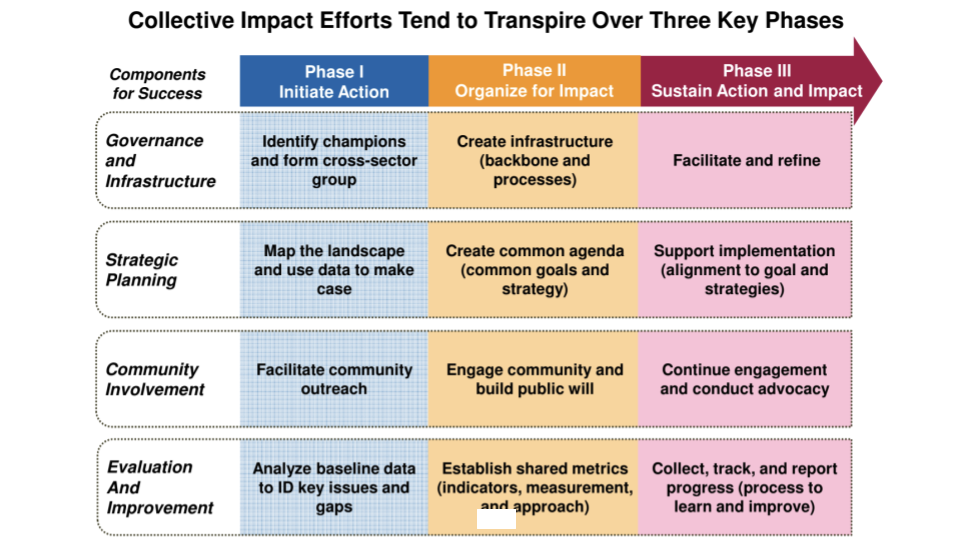
Collective Impact efforts tend to occur over three phases: initiating action, organizing for impact, and sustaining action and impact. Components for success include governance and infrastructure, strategic planning, community involvement, and evaluation and improvement. The following figure from FSG illustrates how these phases and components may interact through a group process.
The Michigan Good Food Charter, as an Example
Lindsey Scalera, MSU Center for Regional Food Systems, shared the Michigan Good Food Charter as an example of Collective Impact in action.
The first Michigan Good Food Charter was released in 2010, which provided a common agenda, one of the conditions of Collective Impact. The common agenda, along with key cross-sector partnerships, has helped build a strong collaboration infrastructure for food systems work across the state.
This “infrastructure” is composed of several interconnected components:
- building trust over time through working together;
- growing an interconnected ecosystem of cross-sector partners; and
- fostering a culture of collaboration and partnership.
These conditions served as a foundation for supporting a democratic process to develop the 2022 Michigan Good Food Charter.
See “Implementing Collective Impact for food systems change: Reflections and adaptations from Michigan” (Hoey, Pirog, Colasanti, and Fink Shapiro, Journal of Agriculture, Food Systems, and Community Development, 2017) to learn more.
Shifting Paradigms: From Management to Movement Building
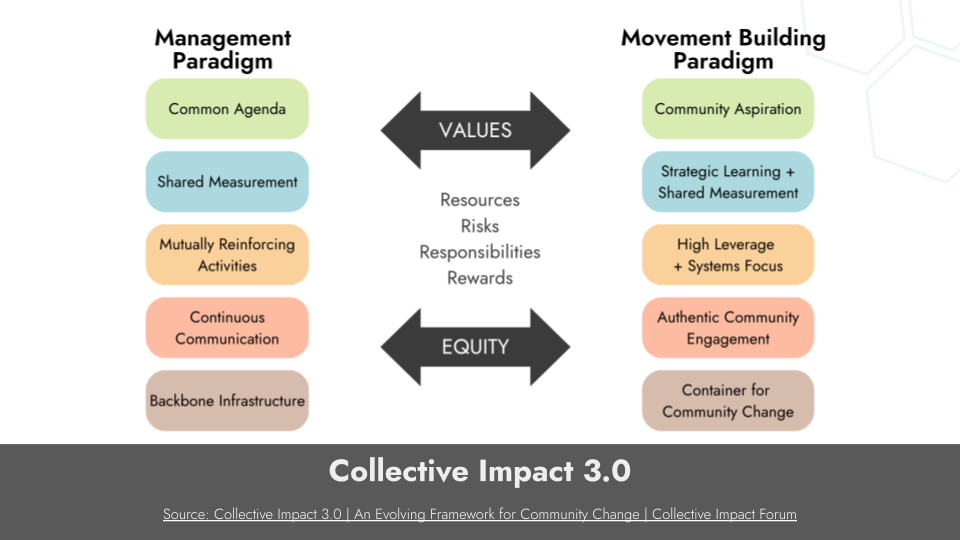
This “movement building” approach represents a shift from the “management paradigm” of the original Collective Impact framework. Lindsey shared that both can be helpful and necessary, including for day-to-day management of group efforts seeking big picture change, which can then feed into something bigger with shared risks, resources, responsibilities, and rewards.
Through movement-building efforts, though, power can be shifted to communities and those most impacted, participation and leadership expanded, and equity built into every condition as structural inequities are addressed. The Collective Impact 3.0 framework encourages us to “act like an organization, but think like a movement.”
Why Collective Impact?
Guest speaker Anya Knecht continued the conversation by explaining why Collective Impact is such an important framework and process for building relationships, maps, and decision pathways before emergency, disaster, or other crisis conditions arrive (e.g., storms, pandemics, supply chain disruptions, climate shock, funding loss).
Anya illustrated the importance of an integrated approach by sharing her personal experience of using the Collective Impact framework to fight her cystic fibrosis, which impacts the whole body and creates an “orchestra of cascading issues and management.” She described how every system in our bodies functions together, so addressing isolated, disconnected structures essentially results in more problems than solutions. If we take into account all the systems working in harmony, as within a Collective Impact approach, with each specializing in its own part of the whole, we can not only make the entire system better but also uplift each individual role. It can help to assess your resources when failures occur, but also to avoid redundancies and communication breakdowns. Applying the concept of Collective Impact has enabled her to survive and thrive, Anya reflected.
However, if systems are uncertain, disrupted, fragmented, have duplications, gaps, or low trust, it becomes very visible when emergencies hit. Lindsey added that systemic inequities such as racism makes it so that some people may face these “emergency-level” issues in their everyday lives. A silver lining can emerge in rebuilding the system after an emergency. As we saw during the coronavirus pandemic, the “storm” conditions led to supply chain disruptions and funding losses. But navigating that crisis together has led to, for example, local hubs, shared decisions, and more trusted partnerships that can support a food supply chain that is more locally rooted and directly informed by the people it serves.
Whiteboard Activity
Session attendees then participated as a group in a whiteboard activity through Zoom, responding to some of the key questions below:
- What stage(s) of coordinated collaboration are you in with your state/regional food system plan or food systems work, whether or not you have a plan in place?
- Do you see your state in multiple phases ?
- For those with experience with Collective Impact, how has it been different from “normal” collaboration?
Where are your strongest existing pathways - and where would coordination break down first during a shock? - What opportunities exist for highlighting the importance of backbone support to carry out effective collaborative work within our respective food systems?
To close the meeting, participants were asked to complete an interest form to gauge appetite for continuing the conversation on Collective Impact related to statewide and regional food systems plans and implementation.
Resource Hub
Key resources from this meeting are listed below, and see more resources in our online Resource Hub and you can find other food systems plans in our Plans Gallery. Submit your plan to share there!
- Collective Impact (Kania & Kramer, Stanford Social Innovation Review, 2011).
- Collective Impact 3.0: An Evolving Framework for Community Change (Cabaj & Weaver, Tamarack Institute, 2016)
- When Collective Impact Has an Impact: A Cross-Site Study of 25 Collective Impact Initiatives (Spark Policy Institute & ORS Impact, 2018).
- Implementing Collective Impact for food systems change: Reflections and adaptations from Michigan (Hoey, Pirog, Colasanti, and Fink Shapiro, Journal of Agriculture, Food Systems, and Community Development, 2017. Advance online publication. http://dx.doi.org/10.5304/jafscd.2017.072.014)
- Whiteboard Activity link - https://zoom.us/wb/doc/2K6ca-BIQtm2Tkgry7gjJQ/p/58275228090368