Learning Session Summary Food Systems Plans — Setting the Table for All Iowans: Evaluating for Funders, Policymakers, and Internal Partners
June 12, 2026 - Mallory DeVries, Arlene Enderton, Tommy Hexter, Colleen Matts and Lindsey Scalera
 Print
Print Email
EmailThe Statewide and Regional Food Systems Plans National Community of Practice hosted a Learning Session on April 23, 2026 to discuss the Iowa Food System Coalition's 10-year food systems plan, Setting the Table for All Iowans.
Session Details
Guest Speakers:
- Tommy Hexter, Executive Director, Iowa Food System Coalition
- Arlene Enderton, Evaluator, Iowa State University Extension & Outreach
- Mallory DeVries, Communications Director, Iowa Food System Coalition
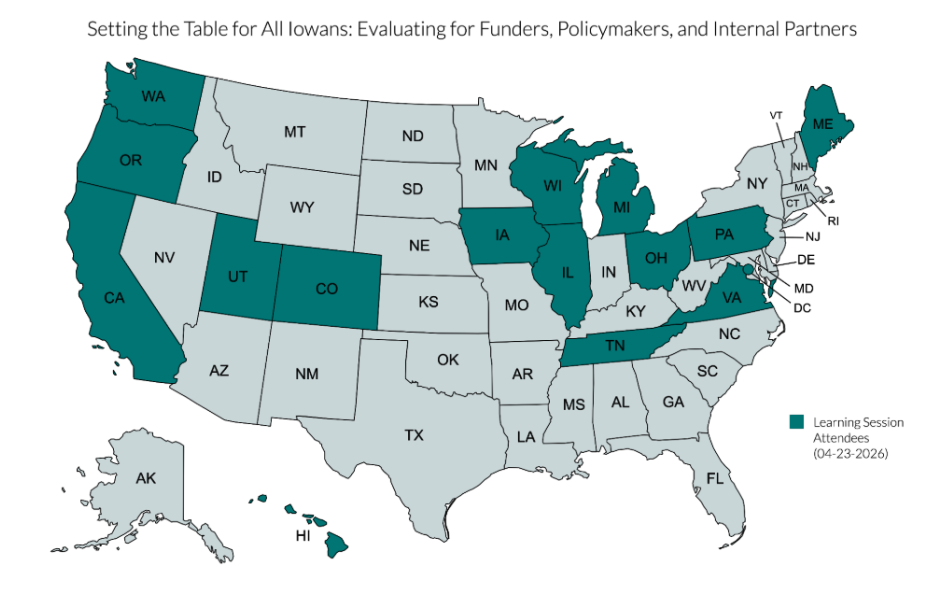
Attendees joined from California, Colorado, Hawaii, Illinois, Iowa, Maine, Michigan, Ohio, Oregon, Pennsylvania, Tennessee, Utah, Virginia, Washington, Washington DC, and Wisconsin.
Background
In 2024, the Iowa Food System Coalition (IFSC) launched Setting the Table for All Iowans, a ten-year statewide food systems plan organized around nine priority areas that bring partners together to set shared goals, strategies, and actions.
From the beginning, IFSC embedded evaluation into the process by working with an evaluator from Iowa State University Extension and Outreach to establish common metrics and data collection practices across the priority teams. This approach allows the coalition to track progress, demonstrate impact to funders and policymakers, and support partners in their work. It also gives IFSC’s communications team credible data to translate coalition activities into clear stories, policy insights, and public-facing communications that illustrate how collaborative food systems work is strengthening Iowa’s food system.
Grounding Activity
We asked attendees to participate in a set of live polls about the status of their food systems plans, active coalitions and current plans for evaluation.
- Plan Status: A strong majority (62%) are already engaged in planning, indicating readiness for implementation support.
- Active plan - 33%
- Plan in development - 29%
- No plan but interest in one - 19%
- Coalitions: For those with plans or plans in development, while a large portion of attendees (39%) do have an active coalition supporting their food system plan, over half of respondents are either (re)building or lack coalitions, signaling a need for further support for coalition development.
- Active coalition - 39%
- No official coalition - 28%
- Coalition in Development - 17%
- Reviving/re-energizing a previous coalition - 17%
- Evaluation: When asked about current plans for evaluation, interest in evaluation is high, but nearly as many are unsure how to proceed (44%), suggesting a gap in guidance or access to effective models. The breakdown of what participants said they are evaluating includes:
- Goals of the plan - 59%
- Output tracking - 44%
- Coalition strength - 19%
Guest Presentation
The presentation opened with sharing the book titled From What If to What Is (Rob Hopkins, 2019), as it lays out the uniting question bringing us all together and a call for collaboration after this session.
Founded in 2022, Iowa’s backbone organization - the Iowa Food System Coalition - offers the collaborative space for working toward a food system that cultivates health, justice, and sustainability for all people, communities and the environment. The organization seeks to create an open tent, regularly welcoming in new partners to work together on their plan, crafted with input from hundreds of Iowans.
The state’s food system plan, Setting the Table for All Iowans, is a guide with actionable strategies and nine priority areas, with teams supporting work on those strategies. Actions are also outlined and associated with expected outcomes for each priority area.
Recent wins from their collective efforts include leveraged funds and the Choose Iowa Purchasing Program (similar to the USDA’s Local Food Purchase Assistance Program (LFPA) and Local Food for Schools (LFS) program).
Evaluation Plan, Types, and Reflections
The Iowa Food System Coalition Evaluation Plan (2024) outlines outcomes, indicators, measures, and methods for assessing them. In this session, Outcomes, Formative, and Process evaluation efforts were further described, with highlights and examples of the planning process visualized in Miro boards.
Outcomes Evaluation
The strategies, actions, and outcomes set out within each of the 9 priorities were essentially turned into the evaluation plan to start. In 2024, breakout sessions for priority teams provided space to discuss who would do what and when, and to begin to get a sense of what they would like to measure. At this time, not all of the nine teams were actively meeting.
A key question that emerged was: do we have access to data to measure priority outcomes? The original intention was to have an online portal for sharing data, but that never came to be. When data were not readily accessible for a priority, they developed a system to collect them.
See Arlene Enderton's evaluation planning Miro board here. Please note, outputs are intentionally excluded in this board. Purple lines are overarching goals while pink lines link outcomes that are similar to each other. To explore the outcomes, see Arlene’s overlapping outcomes Miro Board here.
Formative Evaluation
This type of evaluation is a way of measuring if you are putting into place the foundations of your plan to work together to successfully meet your goals. Some measures can include the strength of your network, trust and belonging; mission, vision, and core values; roles, expectations, processes and satisfaction; and coalition leadership and decision-making.
A 2024 baseline coalition survey revealed positive results, including high levels of trust and satisfaction. Further, the team found that the more people were involved in the coalition, the higher they rated their agreement generally. This was true except when questions were asked related to the mission, vision, and values, however, where increased engagement could mean better understanding of what it takes to reach lofty goals.
Through a set of interviews, the need was identified for more support from the coalition for priority teams. Additionally, interviews conducted with partners who had originally committed to getting involved but never did illuminated some factors keeping them from further engagement.
Process Evaluation
This evaluation type is essentially focused on good record keeping, such as reach for communications, attendance, etc. These findings are especially but equally important as outcomes for funders.
Evaluation Gut Check: What would the evaluator have done differently?
- Use a LESS collaborative process in creating the outcomes evaluation plan but MORE collaborative process evaluation.
- If done again, first identify best potential measures for priority teams and ask for their help in narrowing down and/or deciding indicators rather than presenting teams with the full list of possibilities.
- Not assume that she could keep up with the breadth of coalition activities and recordkeeping for them, related to process evaluation.
Tips for Evaluators of Food Systems Plans
- It is important to be “friendly evaluators” and let people in your coalition know that. Do your best to not be received or perceived as intimidating or pushy.
- Some evaluators would choose not to evaluate the broader food systems changes shaped by many different actors and factors in the landscape, but these statewide indicators are important and matter. In these cases, consider “contribution versus attribution.” Your communication may be about contributing to this indicator, not attributing change to the work you did as the only factor that influenced it.
- Look for further intersections with communications.
Using Data for Storytelling
Measures to communicate about the coalition’s impact (What They Do) include:
- Coalition convenings and working groups
- Partner organizations and individuals engaged
- Advocacy engagement with policymakers
- Media reach and communications impact
- Resources produced for local food initiatives
Iowa’s Statewide Scorecard measures conditions across Iowa’s food system - the system that they are operating within - and indicators that are shaped by many actors across the state.
Tip: The Statewide Scorecard can be used as a communication and engagement tool, including with state legislators. The Iowa team created a scorecard game with legislators to guess answers for indicators they left blank, proving to be a powerful exercise to do together.
Mallory DeVries, the Communications Director, described how “humans are wired for stories,” and we also have “scope insensitivity.” As a result, communication lenses they use throughout the year to show their impact include:
- Scale - data shows size of an issue or opportunity
- Trend - data reveals whether the system is changing over time
- Connection - data helps show how policy, markets, and community outcomes relate
- Capacity & Action - data tracks how the coalition and partners are organizing to move the system
Additional communication tactics used by the Iowa team include the At the Iowa Farm Table Podcast with Beth Hoffman (with reliable data readily available to support this), press releases and story/press pitches. Impact data are also helpful for applying for grants, including for USDA grant applications (ex. the Regional Food System Partnership grant opportunity which has Performance Measures), and for grant reporting.
Q&A: Key Topics
- Also consider “Outcome harvesting” (which is best for in-person activities/events) and/or “Most Significant Change” as additional evaluation strategies.
- Groups with high levels of trust are ripe for trying out new evaluation strategies!
- The evaluator spent around 20% of her time on this evaluation when developing the evaluation plan and now likely spends 10-15% of her time on this evaluation effort.
- The Iowa Food System Coalition’s work and planning was funded initially by the W.K. Kellogg Foundation. Each priority team wrote their own chapter for the food plan, and each chapter had a team lead to convene and get consensus on changes and reviews. Team leads receive stipends.
- The Iowa plan does not “report” officially to the state; the current plan is more grassroots than state-driven. The state mandated writing the plan in 2011, but there was not momentum from the state to rewrite the plan.
Group Synthesis
While time was limited for discussion, the following prompt was posed by the Iowa team:
The data we would most want to get our hands on does not actually exist. How are people approaching the question: What percentage of the food we eat in Iowa is actually grown here? And who are the parties that should be involved in tracking this?
Examples and resources mentioned include:
- New England’s Local Food Counts from The New England Food System Planners Partnership (NEFSPP)
Led by a collaboration amongst seven state-level food system organizations and representatives from the six-state agricultural, economic and environmental departments in New England, The Local Food Count is part of the New England Feeding New England initiative, which aims to strengthen the region’s food system and increase local food sourcing. - Local Food Impact Calculator from USDA and Colorado State University
The Iowa team noted this created a fun “trick question” during the scorecard quiz with legislators. Different local food activities have different estimated economic multiplier effects. A dollar spent on local food for schools circulates differently than a dollar spent at a farmers market or through a food hub. It helped illustrate an important point: food dollars do not move through the economy equally. While the exact multipliers vary by program and market channel, they were all consistently high and reinforced the value of investing in local food systems.
Resource Hub
Key resources from this meeting are listed below, and see more resources in our online Resource Hub and you can find other food systems plans in our Plans Gallery. Submit your plan to share there!
- Setting the Table for All Iowans: A Plan for Creating a Thriving, Sustainable, and Equitable, Food System (2024)
- Iowa Food System Coalition Evaluation Plan (2024)
- 2025 Iowa Food System Coalition Statewide Scorecard
- IFSC Evaluation Webpage with links to evaluation plan, formative evaluation reports, and impact report.