Learning Session Summary Food Systems Plans — Methodology of a Rural Colorado Food System Plan
October 9, 2026 - Jae Sanders, Marissa Baron, Colleen Matts and Lindsey Scalera
 Print
Print Email
EmailThe Statewide and Regional Food Systems Plans National Community of Practice hosted a Learning Session on June 30, 2026 to discuss the Methodology of a Rural Colorado Food System Plan.
Session Details
Guest speakers:
- Jae Sanders, SLV (San Luis Valley) Local Foods Coalition
Co-Host:
- Marissa Baron, Food Policy Networks
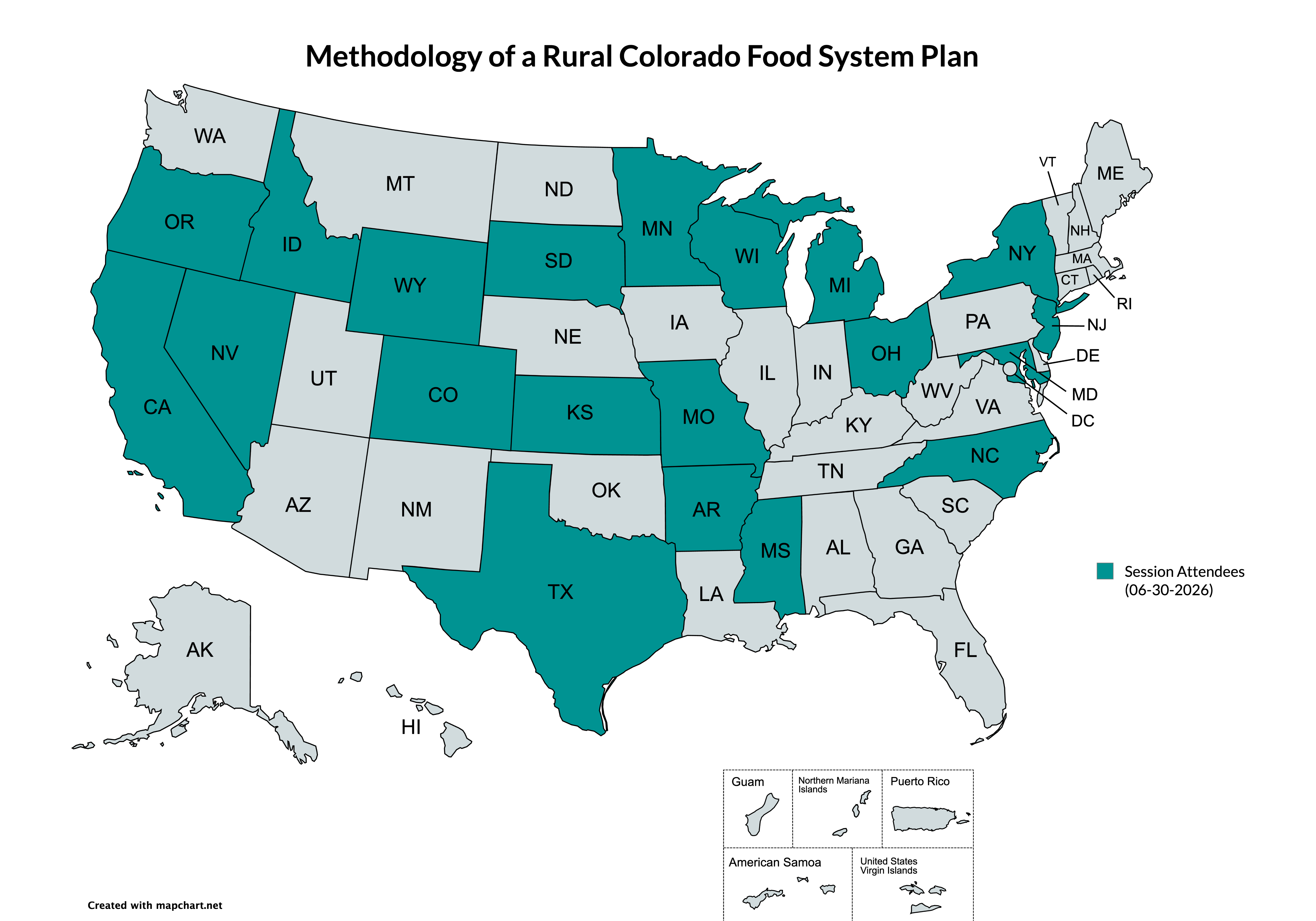
Attendees joined from 20 states across the country: Arkansas, California, Colorado, Idaho, Kansas, Maryland, Michigan, Minnesota, Mississippi, Missouri, Nevada, New Jersey, New York, North Carolina, Ohio, Oregon, South Dakota, Texas, Wisconsin, and Wyoming.
Background
In this session co-hosted with Food Policy Networks, we learned how a nonprofit in a frontier region moved from community input and assessment findings into a regional Food and Agriculture Action Plan. Jae Sanders, Local Foods, Local Places (LFLP) Director at the SLV (San Luis Valley) Local Foods Coalition (LFC), shared how ideas were gathered, organized into goals and objectives, and shaped into an actionable plan for a rural 6-county region. She also reflected on what worked well, and what was learned that may be useful for other rural and frontier communities.
Introductions
The Statewide & Regional Food Systems Plans National Community of Practice (NCoP) brings together leaders from across the U.S. around current and emerging food system plan efforts to share knowledge and strengthen local and regional food systems. Coordinated by the Michigan State University Center for Regional Food Systems (CRFS), monthly sessions like this one are designed to help leaders and stakeholders of food system plans learn from and support each other.
This virtual session was co-hosted with Food Policy Networks (FPN), originally founded and housed within the Johns Hopkins Center for Livable Future. It “exists to empower, connect and serve food policy councils (FPCs) that believe in building collective power, are committed to changing local and state policy, and center just and restorative food systems in their work.” FPN is currently prioritizing five core network functions: capacity building, policy incubation, convening, information management, and administrative and financial commons. Marissa Baron, Network Director with FPN, shared how there are over 300 active food councils across the country, many of which are working on food system plans. This session offered an opportunity to lift up the NCoP as a resource for those food councils.
FPN defines a food policy council as “a collaborative, civically-engaged group that brings people together across sectors to build the social, cultural, and civic infrastructure needed for more just food systems. FPCs work at the city, county, regional, state, or Tribal Nations level to surface shared intent, build trust, inform plans, engage policymakers, and bring infrastructure capacity, turning that intent into action through legislation, programs, values shifts, and other forms of food systems change. They may be sanctioned by a government body or operate independently of government.” Connect with FPN through their listserv, website, or by email at foodpolicynetworks.us@gmail.com.
Lindsey Scalera, CRFS co-lead of the NCoP, shared that food councils are crucial drivers of change, both individually in their local areas and together as part of efforts with wider scope. For shared understanding, the following set of terms and definitions were introduced for different types of geographies:
- Frontier: Extremely remote, isolated, sparse population
- Rural: Low-density, agricultural communities
- Suburban: Residential, near urban areas
- Periurban: Transitional urban–rural fringe
- Urban: Dense, centralized city area
Definitions adapted from: Frontier and Remote Area Codes - Documentation (Economic Research Service) and Locale Classifications (National Center for Education Statistics).
Grounding Questions
To get a sense of session attendees, three live poll questions were asked.
Which communities are you working with and/or representing?
- The most attendees (35%) were working with rural communities (low density and/or agricultural areas), followed by frontier areas (which are extremely remote, isolated, sparsely populated) and peri-urban (transitional, urban-rural fringe) areas (19% each). Two attendees indicated the “other” option because they represent or are working with more than one of these location types.
Are you part of a food (policy) council or policy coalition?
- The majority of attendees who responded (73%) reported that they are part of a food council or policy coalition.
What is the status of your statewide or regional food system plan?
Attendees reported a range for the status of their food system plans:
- Over 20% each reported having an active plan and no plan in place but interest in one, followed by 19% of attendees who indicated their food system plan was in development.
- The fewest reports were for no plan with no plans to start (12%), unsure (12%), and a plan update in progress (8%).
About the Frontier Valley Region
Before outlining the methodology of the SLV Community Food and Agriculture Assessment and Action Plan, Jae Sanders offered background information, including on the geography of the frontier valley for which the SLV plan was developed and context about why and how this plan came to be.
- The mountainous geographic region of the San Luis Valley is sparsely populated - with 46,000 people across all six counties - with an average 7,500 feet above sea level and a 90-120 day growing season.
- A 2017 county-level food plan for Alamosa County sparked interest in developing a plan for the broader region with a focus on PSE - policy, systems and environmental - changes for the food system. Jae described PSE as changes that are ongoing, long-term and sustaining, and focused on the community/population level with the ability to produce behavioral change over time.
Jae emphasized that we are all playing a role in our food system, and “all of us have a lot of power in what food system we’re supporting by how we’re spending our money.”

The Approach
Jae then shared more about the three-phase project of their Food & Agriculture Assessment project to support the ultimate development of the Action Plan:
Three Phases
- Assessment: Sept 2022 - March 2024
- Action Plan: Fall 2025 - April 2026 (when it was published)
- Implementation: began in January 2026
The Team:
- Local Foods, Local Places (LFLP) staff of the SLV Local Foods Coalition
- Project Stewards: a 12-30 person steering committee composed of community leaders, nonprofit liaisons, stakeholders invested in the regional food system, community members, etc.
Scope:
- 6 counties covering over 8100+ square miles
- Food and agriculture focus
- Sector experts and communities members for qualitative and quantitative data collection
- Supports PSE change
- 5-10 year action plan
Methodology
Jae identified three sources of input for the plan:
- Community Listening Sessions with three key questions:
- What’s working well in your sector?
- What’s not working well?
- What’s your vision for a thriving future?
- Survey Data
- Community survey
- Producer (farmer and rancher) survey
- Food business survey
- Secondary Data Sources
- USDA Census of Agriculture
- Regional demographics
- And more!
Community Norms
Each community session included the use of some basic community norms or guidelines to help conversation flow respectfully and smoothly.
- Take care of your needs.
- Make space for everyone to speak - step forward, step back idea; Move up, Move Back, or WAIT (Why Am I Talking).
- Expect unfinished business.
Findings
Assessment findings from data collection efforts (including 1,153 surveys taken plus185 session attendees for a total of 1,338 engagements) uplifted the following high level needs and opportunities in the region:
- Financial need across sectors
- Need for more housing
- Need for more labor
- Water costs and threats of water export are stressors
- Costs for producers is increasing
- Local food is desired but connections need to be made
- Education is desired on multiple levels
- Community values cultural heritage and mutual aide
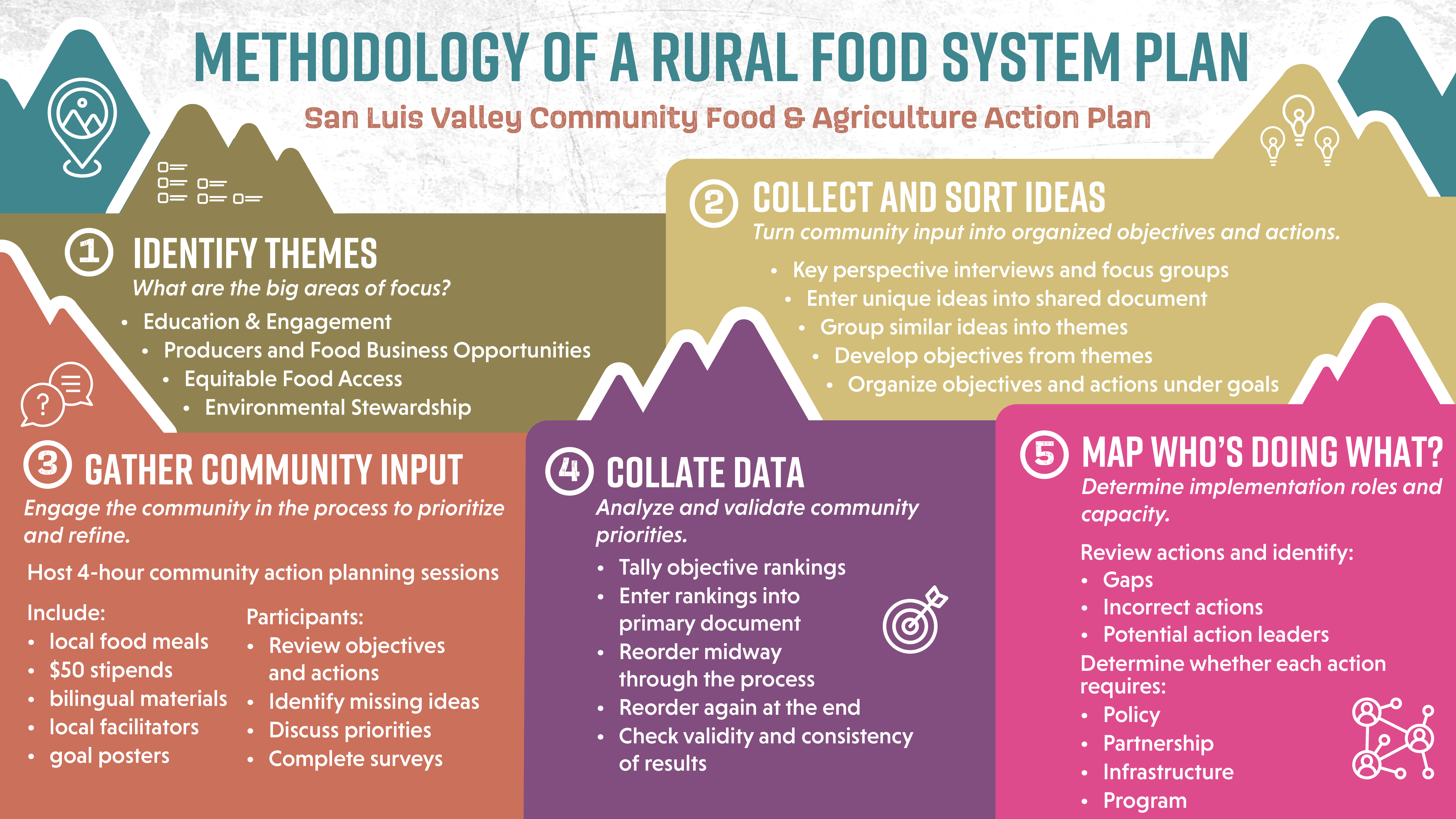
The Methodology for developing the SLV Community Food & Agriculture Action Plan is (outlined/illustrated TBD) below.
Moving Forward
The following actions were outlined for implementing the plan going forward:
- General
- Contact potential implementation partners
- Shepherd implementation and track progress of partners
- Advance policy, systems, and environmental change
- Share status progress of implementation, including through the website and annual “State of the SLV Food System” event
- Local Foods, Local Places Actions
- Increase community engagement with the food system
- Increase awareness of where to find healthy and local foods
- Improve and increase food access by providing technical assistance (TA) to food retailers
- Encourage policies that support the ability to grow and eat local food in the region
Key Takeaways
Lastly, Jae reflected on the successes, challenges, and lessons learned throughout the process.
Successes
- The Action Plan feels comprehensive.
- Goals were validated several times.
- Attendees were shown and learned about food and agriculture systems in a new way.
- Attendees had the opportunity to weigh in on this plan and now feel more invested in it and know about PSE change and the value of buying local foods.
Challenges
- People needed to be incentivized to take surveys.
- Bots also took surveys through SurveyMonkey whose results needed to be scrubbed out!
- While the LFC had been around for nearly a decade, Jae was not yet well known in the area, and people were skeptical to participate initially. Over the years, however, familiarity and trust grew, making community engagement during the second phase of the project easier. Some offered criticism of the process, including related to the level of community engagement.
- In response, LFLP staff paused, reflected, and recalibrated their community engagement efforts. As a result, as Jae reflected, they did an even better job of engaging community members with the action plan development, starting slowly and trying to visit every town.
- Some LFLP employees who were hired left for other positions, which challenged continuity and capacity for their process that covered a significant geographic area.
Lessons Learned and Reflections
- Monolingual events are more effective than bilingual ones.
- Survey design and software matter.
- Tip: Have fewer open-ended survey questions for “other”responses, since qualitative responses will be variable and harder to categorize.
- Interview stakeholders from more sectors and areas of expertise, and fewer community members, and conduct interviews on-site rather than on virtually when possible.
- Take and plan for more time, including to allow for engaging more community members.
- Since some of the actions in the plan were too general and others too specific, fewer actions or just objectives could have worked just as well for the final plan.
You can find the final plan and related reports at slvlocalfoods.org/ap.
Session Q&A: Key Topics
During the session participants asked a few questions. Here are those key topics:
- This work was funded through state tobacco tax dollars, given the connection between food and chronic diseases. SLV Local Foods Coalition needed about $250,000 per year for this project, with the majority of funds for putting on community meetings. These costs included local food for meals and stipends for attendees, infusing money from their grant back into the community.
- Jae found that few business owners engaged in the process - because they were busy running their businesses. Additionally, while the area is predominantly agricultural, most of the farms are 1000+ acre commodity-crop operations, which were not the focus for this effort as much as the producers growing food for the area residents, a much smaller number of farm business operations.
- Attendees were generally values-aligned, although that could differ from one town to the other given differing populations across the valley. Jae reflected that she was lucky to not have to manage much conflict throughout the process, and referred back to using community norms listed above as helpful in setting the stage for working together with community members.
- Going forward, Jae and her team plan to do less data collection and more sharing and connecting dots across the value based on what is now a “deep knowing” of the valley. She is planning to check in with individual farmers, ranchers, food businesses, including to check in about their local food directory, the Local Roots Guide, mental health, and how much has changed over time (e.g., are there any new food access points?). LFC intends to host annual state of the food system events in the near term and is interested in supporting a marketing campaign on where to find local foods in the region, as a different angle to community engagement.
- Other organizations doing similar work are free to use and “lean on” the data LFC collected. As noted earlier in the session, there were 1,153 usable engagements, after survey responses from bots were removed.
- Funders appreciated their work and provided a 2-year extension, with $250,000 per year to implement the plan, including working toward PSE while making it fun! Additionally, LFC is considering creating a food policy council for the region, potentially through a broader collective effort with the region located to the north. A food policy council could help with issues such as addressing local zoning related to land use for greenhouses. It is important to note, however, that LFC’s charge is focused on local policy change - county, municipal, and regional - but many of the most influential policy issues are state or federal in origin. FPN could also serve as a resource for working on policy scans for specific issues.
In closing, Jae celebrated that “people make everything happen” and "it's all about relationships,” especially in this frontier region.
Resource Hub
Key resources from this meeting are listed below, and see more resources in our online Resource Hub and you can find other food systems plans in our Plans Gallery. Submit your plan to share there!
- San Luis Valley (SLV) Food & Agriculture Action Plan and related documents, including the assessment report and survey results
- Food Policy Network’s listserv and website